

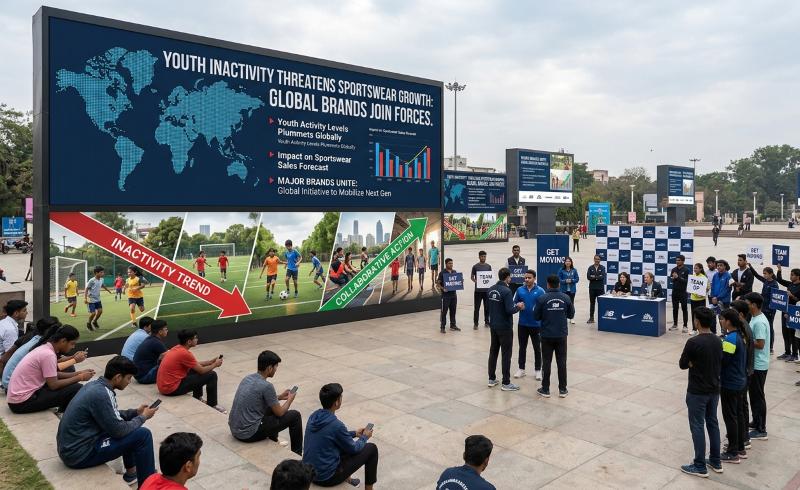
Global sportswear companies are joining forces to address a growing threat to their long-term consumer base: adolescent physical inactivity. With 86 per cent of teenagers worldwide failing to meet recommended activity levels, experts are viewing youth participation as both a public health priority and a commercial imperative. An analysis by the World Health Organization (WHO), published in The Lancet Global Health, finds that inactivity among adolescents has risen from 81 per cent in 2016 to 86 per cent currently. Around 240 million teenagers aged 11-17, or one in four globally, report zero active days in a typical week.
In response, 84 sporting goods manufacturers, retailers and sports federations, including Nike, adidas, ASICS, New Balance, PUMA and Decathlon, have formed a coalition coordinated by the World Federation of the Sporting Goods Industry (WFSGI). The industry’s concern extends beyond declining sports participation. Fewer young people developing active lifestyles today could mean weaker demand tomorrow for performance footwear, technical apparel, sports equipment and related accessories. For brands dependent on repeat purchases and long-term customer relationships, the issue threatens the future consumption pipeline.
The participation hap
The WHO findings reveal a widening inactivity problem, with adolescent girls particularly affected. Nearly 28 per cent girls report no active days in a typical week, compared to 22 per cent of boys. This gender gap is a significant missed opportunity for sportswear companies seeking to increase their female youth customer base.
Table: Global adolescent physical inactivity
|
Metric |
2016 Baseline |
Current WHO findings |
Commercial implication |
|
Adolescents Missing Activity Targets |
81% |
86% |
Weaking demand for youth sportswear |
|
Completely Inactive Adolescents |
Undisclosed |
240 mn (1 in 4) |
Total loss of entry-level sports participation pipeline |
|
Inactive Teenage Girls (0 Active Days) |
Regional variance |
28% |
Untapped female activewear market |
|
Inactive Teenage Boys (0 Active Days) |
Regional variance |
22% |
Lower potential demand for team-sport gear |
|
Surveys & Geographic Scope |
Fragmented |
389 surveys across 140 countries |
Globalized consumption barrier spanning 3.2 mn youth |
For brands, the female participation gap is especially relevant. Restrictive product designs, limited access to school sports and the cost of specialised equipment can discourage teenage girls from participating. Sportswear companies therefore have an opportunity to broaden their product strategies beyond elite-performance requirements. More inclusive fits, adaptable layering, versatile footwear and affordable entry-level collections could help attract younger consumers who are not yet committed to organised sport.
A $614 bn industry at risk
The coalition's economic rationale is substantial. According to The Industry That Moves the World, a WFSGI and Oliver Wyman assessment, the sporting goods industry generates $614 billion in annual revenue across 210 markets. Its wider economic contribution reaches $675 billion in global GDP and supports 28 million jobs. However, trade barriers and declining participation threaten the sector's growth prospects.
Table: Global sporting goods industry
|
Economic indicator |
Value |
Global benchmark |
|
Direct industry revenue |
$614 bn |
210 consumer markets; 62 manufacturing hubs |
|
GDP contribution |
$675 bn |
0.6% of global output |
|
Global employment supported |
28 mn |
10.5 mn direct jobs |
|
Tax contribution |
$230 bn |
$120 bn direct; $110 bn indirect |
|
Average import tariff |
14.10% |
Against 5.2% for traded goods and 2% for pharmaceuticals |
The average 14.1 per cent import tariff on sporting goods is nearly three times the rate across general merchandise. At the same time, Oliver Wyman estimates that rising inactivity and tariff-related friction could put as much as $169 billion in projected industry growth at risk. The combination creates a dual challenge: growing participation while managing costs across complex global supply chains. "Our biggest competitor is inactivity. Our greatest opportunity is participation," says Emma Zwiebler, CEO of WFSGI, calling for coordinated action by governments, industry and communities to encourage young people, particularly the least active, to participate in sport.
Retail moves beyond sponsorship
The industry's response is shifting from conventional advertising and athlete endorsements towards grassroots participation. Decathlon's community initiative is an example. Selected suburban stores across European and Latin American markets have introduced equipment-lending libraries and free after-school multisport programmes, working with local schools and physical education departments.
The initiatives also include subsidised footwear, team kits and protective equipment, lowering the financial barriers that prevent children from participating. Over a 24-month monitoring period, participating stores reportedly recorded a 19 per cent increase in family footfall and a 14 per cent rise in youth apparel sales. Customer retention was eight percentage points above brand averages.
The commercial logic is straightforward: community engagement can convert non-participants into recreational consumers while strengthening relationships with families. Unlike conventional sponsorships, such programmes create direct connections between retail stores, local communities and potential customers. Decathlon CEO Javier López has called youth wellbeing a collective responsibility, emphasising the need for cross-sector collaboration to make sport more accessible.
Protecting the next consumer generation
The WFSGI coalition is also pushing for greater government support, including tax relief on children's sporting equipment and investment in urban sports infrastructure. For sportswear companies, the challenge is no longer limited to winning market share from competitors. It is also about expanding the number of people who participate in sport and purchase related products.
With 86 per cent of adolescents falling short of recommended activity levels, the industry faces a long-term demand challenge that conventional marketing cannot solve. The coalition's success will ultimately depend on whether its commitments translate into more accessible facilities, affordable equipment and sustained participation. For global sportswear brands, investing in youth activity is becoming an investment in the next generation of consumers.