
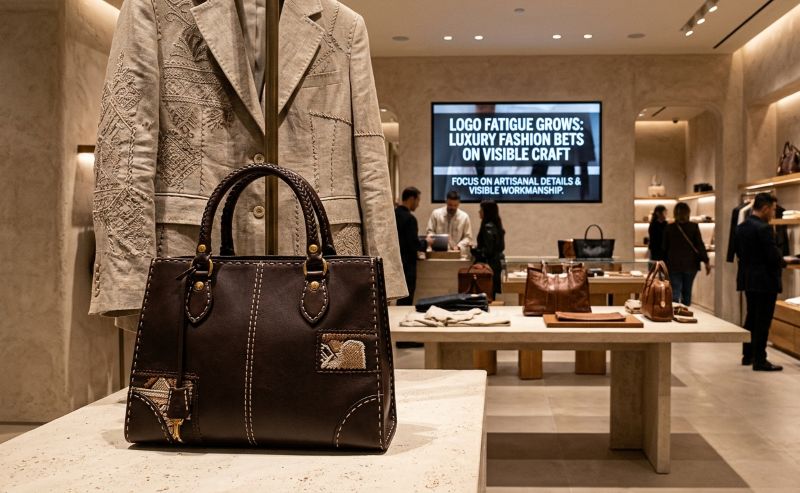
Global fashion houses are shifting their focus from logo-led exclusivity to visible craftsmanship, investing in artisanal skills, specialist workshops and traceable production to strengthen brand differentiation and protect margins. From hand-braided leather and hand-finished cashmere to intricate embroidery and traditional weaving, human skill is emerging as a commercial asset in a market increasingly saturated with digitally generated designs and machine-made uniformity.
The shift comes as luxury brands reassess growth strategies built on repeated price increases. Research by Bain & Company and Fondazione Altagamma has placed the global personal luxury goods market at approximately €358 billion to €369 billion, amid pressure on aspirational consumers and growing scrutiny of value for money. The industry’s challenge is no longer simply to command premium prices, but to demonstrate why individual products merit them.
For fashion businesses, the answer lies in the manufacturing process itself. As AI increases design development and automated knitting and garment technologies improve production efficiency, distinctive handwork, material depth and verifiable artisanal provenance offer brands a way to differentiate products beyond surface branding.
Craft becomes a competitive asset
Luxury houses are moving craftsmanship from brand storytelling into their operating models, investing in training, specialist manufacturing and long-term access to scarce skills.
Bottega Veneta has built its identity around Intrecciato, its signature woven leather technique. The Kering-owned label established the Accademia Labor et Ingenium across its Montebello Vicentino and Povolaro Dueville facilities to preserve artisanal expertise and train new generations of craftspeople. The initiative addresses a strategic vulnerability for luxury manufacturers: the risk that specialised skills will disappear as experienced artisans retire.
The model also helps protect production knowledge that cannot be easily replicated through conventional industrial automation. By developing internal capabilities, brands can exercise greater control over quality, consistency and the availability of specialist labour.
Spanish luxury house Loewe has similarly placed craft at the centre of its positioning. Through the Loewe Foundation Craft Prize and collaborations with artisans working across textiles, ceramics and wood, the LVMH-owned brand connects traditional techniques with contemporary luxury design. Hand-worked surfaces, woven structures and individually finished details create products whose appeal extends beyond logos and seasonal graphics.
Brunello Cucinelli follows a comparable approach in cashmere knitwear and tailoring. Its Solomeo-based production ecosystem emphasises hand-knitting, linking, mending and finishing, positioning skilled labour as part of the product's value proposition. In premium knitwear, where fibre quality and silhouette can be replicated across competing labels, the visibility of specialised workmanship offers an additional basis for differentiation.
Chanel institutionalises Savoir-Faire
Chanel is a prominent example of craftsmanship being treated as strategic manufacturing infrastructure rather than a decorative addition.
Through their Paraffection subsidiary, the French luxury house has brought specialist workshops into its wider production network, preserving capabilities across embroidery, featherwork, pleating, goldsmithing and footwear. Their Paris-based le19M complex, spanning approximately 25,500 sq. mt., houses 11 resident ateliers, including embroidery specialists Lesage and Montex, feather-maker Lemarié, goldsmith Goossens, pleater Lognon and shoemaker Massaro.
The facility brings complementary skills into closer proximity, supporting collaboration between designers and artisans while safeguarding expertise needed for complex collections. Chanel's Métiers d’Art presentations provide a commercial platform for this work, translating specialised techniques into luxury products.
The broader lesson for fashion businesses is that scarce craftsmanship becomes more valuable when brands can secure access to it, develop it systematically and incorporate it into repeatable product strategies. Atelier investment also reduces dependence on fragmented external suppliers for critical techniques.
However, the commercial benefits should not be confused with guaranteed returns. Handmade production carries higher labour costs, and claims of superior full-price sell-through or resale performance require product-level evidence. Craftsmanship can support pricing power, but its contribution depends on design relevance, execution, brand positioning and consumer demand.
Scaling craft has limits
The transition creates substantial operational challenges. Handloom weaving, natural dyeing, tambour embroidery, manual tucking and intricate leatherwork require time, experienced workers and specialised facilities. Their output cannot be expanded as quickly as machine-based production, making capacity planning and lead-time management central to sourcing decisions.
For brands operating across multiple categories and markets, this creates a tension between artisanal exclusivity and commercial scale. Traditional techniques must be integrated into seasonal calendars without compromising workmanship or forcing suppliers into unsustainable production schedules.
Labour availability is another constraint. Specialist skills are often concentrated in regional clusters, from leather workshops in Italy to embroidery units in Mumbai and handloom communities across Asia. An ageing artisan workforce and limited training pipelines threaten continuity, while fragmented subcontracting can obscure working conditions and compensation.
European sustainability and due-diligence requirements add another layer of scrutiny. Brands must strengthen visibility across supply chains, substantiate sourcing claims and address labour risks beyond their immediate suppliers. Digital Product Passport requirements under the EU’s Ecodesign for Sustainable Products Regulation are also shaping the wider push towards product information and traceability, although implementation depends on applicable product-specific rules.
For luxury companies, the priority is to ensure that claims of handmade provenance are supported by documented production processes, credible supplier records, fair compensation and safe working conditions. Long-term contracts, specialist training programmes and closer partnerships with artisan clusters can help secure capacity while improving accountability.
From heritage to business strategy
The renewed focus on craftsmanship signals a broader change in how luxury apparel creates and communicates value. Logo recognition and controlled distribution remain important, but they are increasingly being supplemented by tangible evidence of product quality, manufacturing expertise and provenance.
For sourcing and merchandising teams, this means identifying which techniques genuinely improve a product, which skills warrant dedicated investment and where specialist suppliers should be integrated more closely into the value chain. It also requires balancing labour-intensive production with commercial realities, including pricing, delivery schedules and inventory risk.
The opportunity extends beyond European luxury houses. Textile and apparel manufacturers in India and other established craft-producing economies can benefit if they move beyond low-cost subcontracting towards documented expertise, reliable delivery and partnerships that reward skill. Yet capturing more value will require investment in training, quality assurance, formal employment and transparent supply chains.
As consumers become more discerning about premium pricing, craftsmanship offers luxury brands a means to make product value visible. Its long-term advantage will depend not on presenting handmade work as an aesthetic novelty, but on building the skills, supplier relationships and production systems that make it authentic, scalable where possible and commercially sustainable.