
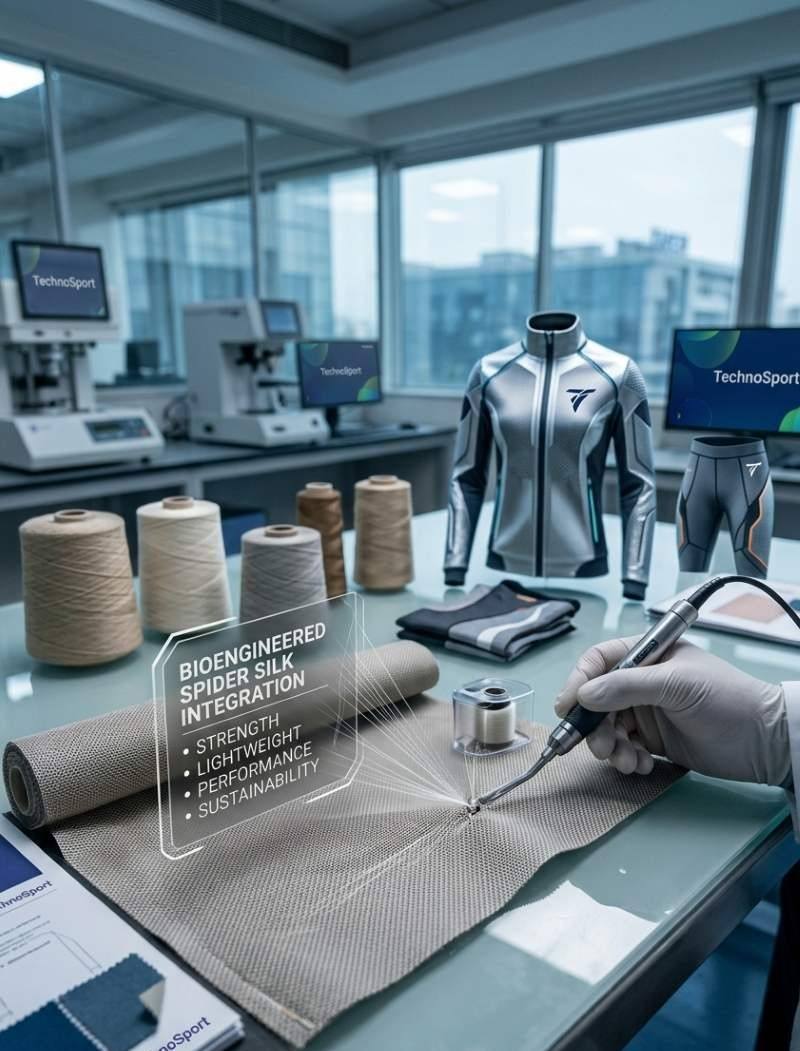
Recombinant spider silk is moving closer to commercial sportswear applications as performance brands explore alternatives to conventional synthetic fibres. Kraig Biocraft Laboratories has shipped its first commercial order of recombinant spider silk yarn to an undisclosed tier-one athletic brand, marking a step from material research towards mill-level product development.
The delivery targets high-performance applications where strength, flexibility, toughness and low weight are critical. For sportswear manufacturers, the opportunity lies in developing materials that deliver measurable functional advantages rather than relying solely on recycled-content claims.
Polyester, nylon and elastane remain central to technical apparel because of their cost, availability and established processing infrastructure. However, concerns over fossil-based feedstocks, microplastic pollution and tightening environmental requirements are encouraging brands to investigate alternatives. Recycled polyester has helped increase recycled content, but it does not automatically eliminate fibre shedding or provide new performance characteristics.
Bioengineered protein fibres offer a different proposition: materials designed around specific mechanical properties, with potential applications in running gear, cycling apparel, climbing equipment and technical footwear.
A decade of development
The commercial journey of protein fibres has progressed from footwear prototypes to limited-edition outerwear and broader product collections.
Table: Recombinant spider silk & protein fibre commercial milestones
|
Year |
Brand and technology |
Commercial milestone |
|
2016 |
adidas and AMSilk |
Futurecraft Biofabric footwear concept demonstrated the potential of bioengineered protein materials in athletic uppers. |
|
2019 |
The North Face Japan and Spiber |
Moon Parka introduced Spiber’s fermentation-derived Brewed Protein material through a limited commercial release. |
|
2023 |
Goldwin and Spiber |
Brewed Protein expanded into multi-category products, including knitwear, denim and technical apparel. |
|
2026 |
Kraig Biocraft Laboratories |
Recombinant spider silk yarn delivered to a global athletic brand for performance product development. |
Earlier initiatives established that engineered proteins could be incorporated into commercial products, although costs and production constraints limited wider adoption. Goldwin and Spiber subsequently expanded applications beyond one-off prototypes, demonstrating a route towards multi-product collections.
Kraig’s approach introduces a different production model. Rather than relying on microbial fermentation followed by protein recovery and fibre extrusion, the company uses genetically engineered silkworms to produce spider-silk proteins within cocoons. The resulting material is processed into yarn.
The approach could potentially use established silk-processing infrastructure, although commercial viability will depend on processing requirements, output consistency, yarn performance and production costs.
Two routes to market
The emerging category points to two distinct commercial strategies: premium lifestyle products and performance-led applications.
Goldwin’s work with Spiber has positioned protein-based materials in high-priced outdoor apparel. Limited releases and subsequent product expansion have enabled the partners to test consumer acceptance while developing manufacturing capabilities. The strategy places material innovation within a premium brand proposition rather than competing directly with commodity synthetics.
Kraig’s initial delivery, in contrast, is focused on technical performance. Founder and chief executive Kim Thompson said the yarn was intended for elite sports applications where materials face demanding mechanical stresses. He described the shipment as a milestone in moving the company’s technology into customer development programmes, while emphasising that the initial volume was designed for precision applications rather than mass-market supply.
For sportswear brands, the distinction matters. A premium capsule can absorb high material costs through limited volumes and elevated retail prices. Core performance lines require consistent quality, repeatable supply and economics that work at significantly larger production volumes.
The cost test
Price remains a major obstacle to scale. Global fibre production reached 139 million tonnes in 2025, according to Textile Exchange, with polyester accounting for approximately 59% of output. Virgin fossil-based polyester continues to dominate supply because of its cost competitiveness and mature manufacturing ecosystem.
Indicative prices for conventional polyester filament yarn range from $1.20 to $1.80 per kg, while technical nylon 6,6 can cost around $3.50 to $5.20 per kg. Early biofabricated protein fibres have been reported at prices exceeding $100 per kg, although costs vary by technology, specification and production scale.
That gap makes broad substitution commercially difficult. Recombinant silk will initially need to justify its premium through applications where its mechanical properties offer a meaningful advantage. Lower production costs, improved yields and reliable industrial supply will be essential before it can compete in mainstream sportswear volumes.
Kraig has reported increasing its silkworm production operations in Vietnam, including a monthly cycle yielding more than 1.3 tonnes of recombinant cocoons earlier in 2026. Its Atlas Gene Library is intended to support the development of fibres with different performance characteristics. These company-reported milestones indicate production development, but do not establish cost parity with conventional yarns.
The mill-floor challenge
Even when a novel fibre meets laboratory performance targets, it must run reliably on commercial textile machinery.
Knitting mills in Taiwan, South Korea and Vietnam will need to evaluate recombinant silk for yarn tension, friction, moisture behaviour, stretch recovery and compatibility with existing equipment. Differences in these properties can affect stitch formation, fabric uniformity, machine speeds and production efficiency.
Brands and mills must also establish consistent specifications across batches. A material that performs well in a prototype but produces inconsistent results during repeat manufacturing will struggle to move into seasonal collections.
End-use testing is equally important. Strength-to-weight performance, abrasion resistance, moisture management, durability and comfort must be assessed in finished fabrics and garments rather than inferred from the fibre’s molecular structure alone. Claims about biodegradability also require evidence under clearly defined disposal conditions.
From novelty to volume
Recombinant spider silk offers sportswear companies a potential route to differentiated performance materials, but commercial adoption will depend on more than its biological origin. Brands need repeatable quality, credible environmental credentials and a clear advantage over established fibres.
The immediate opportunity is likely to lie in targeted, high-value applications where material performance can justify a price premium. Wider adoption will require lower costs, greater production capacity and successful integration into industrial spinning, knitting and finishing operations.
Kraig’s yarn delivery marks progress towards that goal. Whether recombinant spider silk becomes a commercially meaningful activewear fibre will depend on what happens next: how it performs in finished products, how reliably mills can process it and whether manufacturers can scale supply without losing its technical advantages.