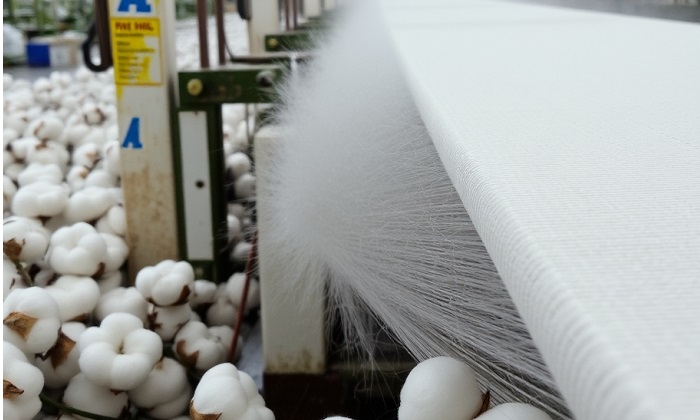
Uganda’s cotton has found favor with textile importers in Germany, Denmark and other European countries. Despite the unpredictable weather conditions that keep affecting yields, cotton prices have been on rise in Uganda. Increase in prices and the introduction of fast-yielding cotton variety, which takes four months as opposed to about seven earlier, is encouraging farmers to grow cotton.
Uganda's Vision 2040 highlights the importance of manufacturing and value addition in enabling the development of an export-led and an internationally competitive economy, which is able to spur growth. Almost 90 per cent of Uganda’s cotton is exported. Cotton production in Uganda is entirely rain-fed. The soil is highly fertile and therefore no fertilisers are used. Pest management is reliant on predatory black ants which are highly effective against most of the cotton pests. Pesticides, if applied, do not exceed two sprays on an average.
Uganda is the only country in the world that grows one variety of cotton, the long-stapled Bukalasa Pedigree Albar. The focus on one type ensures uniformity and easier quality control measures in producing lint and yarn. Currently, cotton is cultivated in about 1, 00,000 hectares.
In Uganda clothing and apparel manufacturing is still minimal and large quantities of fabrics and garments are imported.
- 1
- 2
- 3
- 4
- 5
- 6
- 7
- 8
- 9
- 10
The 2027 Mandate: Why denim’s future hinges on verifiable data
For decades, the global denim industry has relied on a narrative of durability, heritage, and authenticity. That narrative is now... Read more
Europe’s textile core unravels as costs, imports and policy pressure bite
Europe’s textile and apparel sector, long seen as a benchmark for craftsmanship and industrial depth, is slipping into a prolonged... Read more
Automation, innovation, regulation are the forces shaping textiles in 2026
The global textile sector has entered a new era. Early 2026 saw the industry breach a $1.06 trillion valuation, reflecting... Read more
The new Brussels rulebook, every EU apparel order is now a balance-sheet risk
The humble export order sheet is undergoing a transformation. What was once a straightforward commercial instrument: SKU, volume, FOB price,... Read more
Why 2026-27 could be a defining cotton year for India’s farm-to-fashion economy
The global cotton economy is entering a more constrained phase, and for India, the implications run far beyond the farm... Read more
Luxury resale’s next big battle is no longer digital, it is about who controls s…
For nearly a decade, the luxury resale story was written in the language of platforms. Market leadership was measured by... Read more
Digital Arms Race: Indian apparel giants deploy AI to neutralize tariff crisis
The Indian textile and apparel sector is in a digital survival phase in 2026, shifting from traditional labor-intensive models to... Read more
Europe’s Textile Endgame: Why Project FAE is becoming fashion’s most critical in…
Europe’s apparel majors are no longer treating circularity as a branding layer. With Project FAE or Feedstock Activation Europe, the... Read more
Engineering color at source, dye-free production is cutting cost, water, and tim…
For over a century, coloring has been anchored in wet processing, an energy-intensive, chemically saturated stage that happen post spinning.... Read more
The €11 bn deadlock, can Europe’s textile recycling catch up?
Europe is at a tipping point. Fast fashion consumption, led by rising incomes and a growing global middle class, has... Read more