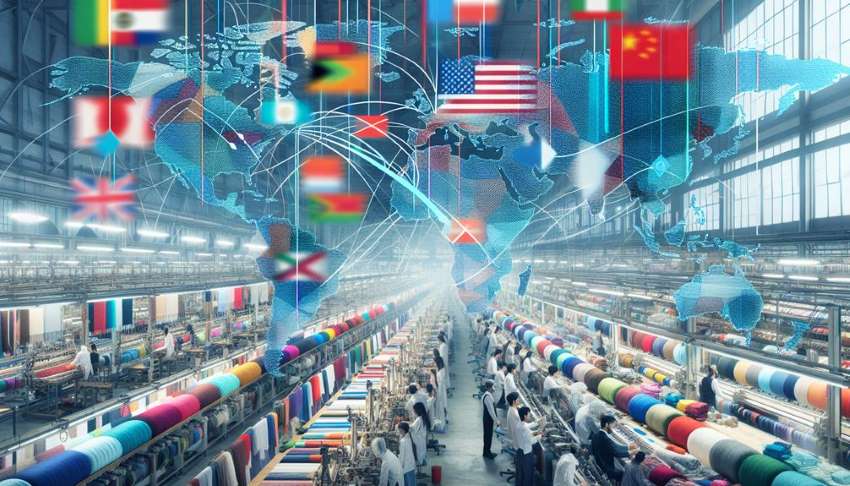
Taiwan Textile Federation and Gujnon have signed an agreement to expand economic and trading relations between Taiwan and Indian nonwoven industries. This concerns direct investments, joint ventures and marketing partnerships as well as all other forms of bilateral cooperation.
Gujnon is an association of manufacturers of nonwoven products in Gujarat. Gujarat has become a hub for nonwovens. There are some 40 nonwoven fabric units in the state and many more are in the pipe line. Gujnon’s objective is to promote the consumption of nonwovens, to widen the applications of nonwovens, and to spread the word that nonwoven is 100 per cent recyclable and reusable and, if burnt, does not lead to much air pollution. Products made with nonwovens are considered safe because they are non-toxic.
Taiwan Textile Federation and Gujnon will collaborate on a private-sector basis in protecting intellectual property rights (IPR), by cooperating to promote the exchange of information on policies and activities relating to IPRs in their regions and by striving to prevent infringement on IPRs in domestic and international trade practices.
Both will place at each other’s disposal information concerning investment conditions, relevant valid legal regulations, current trading and market access conditions, and will exchange regular statistics and newsletters.

- 1
- 2
- 3
- 4
- 5
- 6
- 7
- 8
- 9
- 10
Crude correction gives polyester a fresh cost advantage
A sustained correction in crude oil and petrochemical benchmarks is reshaping the economics of synthetic yarns, widening the cost gap... Read more
Chinese apparel majors trade volume for margin in premiumisation push
China’s apparel and consumer goods market is moving beyond the traditional volume-at-any-cost model, with leading domestic brands betting on premium... Read more
India’s MMF push faces rising risk from China’s petrochemical dominance
India’s ambition to build a globally competitive synthetic textile industry is facing constraints as downstream capacity alone cannot solve: concentration... Read more
Shein’s Vietnam retreat exposes the limits of nearshoring
The global apparel industry has spent the past few years pursuing a straightforward strategy: reduce dependence on China by moving... Read more
Regional pavilions compete on fiber strengths and supply chain niches at Yarn Ex…
The trade floor at Yarn Expo Autumn 2026 in Shanghai, held between Aug 25-27, capitalizing on a sharp rebound in... Read more
Inside activewear's shift from stitched mesh to precision engineered textiles
The global functional apparel market, on track to touch $640 billion, is looking at a production shift as activewear manufacturers... Read more
Brazil’s cotton dominance puts Asian spinners on a new sourcing map
Brazil’s emergence as the world’s largest cotton exporter is no longer simply an agricultural success story. It has given a... Read more
Textile industry sees long-term growth but $100-bn export goal stays a stretch: …
India’s textile and apparel industry is entering a phase of optimism, but that confidence is tempered by a hard export... Read more
Apparel trade slumps as global textile mills move upstream
Global manufacturing is growing, but finished apparel is failing to capture that growth. United Nations Industrial Development Organization (UNIDO) data... Read more
Global apparel value chain converges in Shanghai as Intertextile Autumn 2026 ope…
The global apparel and textile community gathered in full force yesterday, August 25, 2026, as the Autumn Edition of Intertextile... Read more