The trade floor at Yarn Expo Autumn 2026 in Shanghai reflected a clear segmentation of the global upstream textile market, with regional pavilions deploying contrasting value propositions. As international spinning mills, synthetic extruders, and fabric developers converge at the National Exhibition and Convention Center, the primary country and regional pavilions; India, Pakistan, Uzbekistan, and Taiwan, targeted distinct tiers of the downstream textile matrix. Their collective presence illustrates how global textile hubs are responding to demands for cost efficiency, specialized functionality, traceable raw materials, and circular production standards.
India targets premium spinning and branded traceability
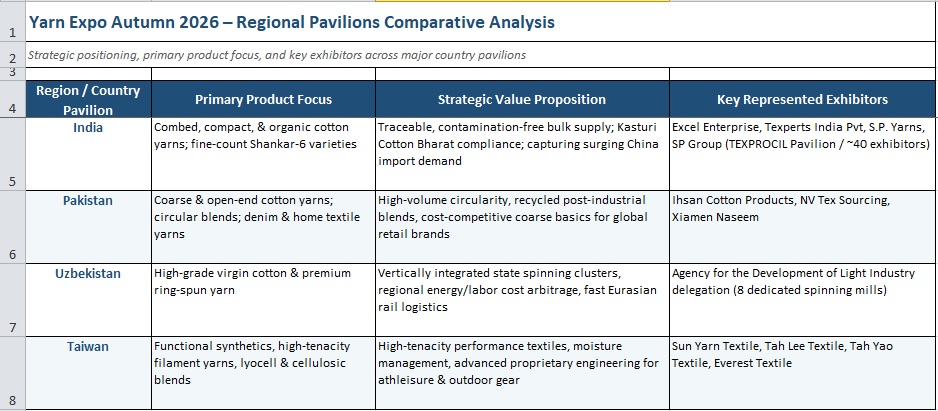
The India Pavilion, coordinated by The Cotton Textiles Export Promotion Council (TEXPROCIL) and featuring approximately 40 exhibitors, is positioned around high-grade natural fibers. Indian spinners, including Excel Enterprise, Texperts and S.P. Yarns concentrated on premium Shankar-6 long-staple combed cottons, compact ring-spun yarns, and certified organic fibers tailored for circular knitting and fine weaving. India's strategic push capitalizes on raw material availability and the national Kasturi Cotton Bharat program to deliver certified traceability and low contamination. This strategy aligns with Indian mills' commercial rebound in China, where exports surged 112 percent to cross $460 million in FY2025-26 as fabric converters sought reliable, high-specification yarn inputs.
Pakistan capitalizes on ‘Recovered’ fibers and coarse counts
In contrast to fine-count apparel focus, the Pakistan Zone is targeted at the industrial denim, workwear, and home textile segments. Suppliers such as Ihsan Cotton Products and NV Tex Sourcing are spotlighting open-end yarns, blended substrates, and circular solutions manufactured from post-industrial textile waste. By prioritizing regenerated cotton and cost-competitive coarse-to-medium counts, Pakistani exporters are catering to international home furnishings and casualwear brands under strict mandates to incorporate post-manufacturing recycled content into basic fabric constructions.
Uzbekistan accelerates vertical value addition and regional logistics
Represented by eight dedicated suppliers coordinated by the Agency for the Development of Light Industry, the Uzbekistan Pavilion highlighted the rapid industrial transformation of Central Asia’s cotton sector. Moving decisively away from raw fiber exports, Uzbek mills are promoting high-grade, 100 percent virgin cotton ring-spun yarns. Backed by state-driven modern spinning clusters, lower regional energy inputs, and direct overland Eurasian rail links, Uzbekistan is positioning itself as a competitive alternative supplier for standard knitting and weaving yarns required by large Asian fabric converters.
Taiwan leads in Functional Cellulosics and Technical Polymers
Occupying the high-performance end of the regional pavilion spectrum, the Taiwan Zone bypassed conventional cotton commodity competition altogether. Exhibitors including Sun Yarn Textile, Tah Lee Textile, and Tah Yao Textile are presenting high-tenacity filament yarns, functional blends, and low-impact cellulosic developments like lyocell. Taiwanese manufacturers are targeting downstream athleisure, outdoor apparel, and specialized protective textiles, leveraging proprietary spinning technologies to deliver moisture management, tensile strength, and eco-certified next-generation man-made fibers.
Regional strategies mirror fragmented sourcing mandates
The interplay among these four manufacturing hubs demonstrates that global apparel and fabric mills are no longer deploying single-source procurement models. While Taiwan captures technical margins through engineered functional blends, India and Uzbekistan are competing for dominance in traceable, premium natural ring-spun yarn. Concurrently, Pakistan’s focus on mechanical recycling and open-end counts provides the high-volume circular feedstock demanded by retail mass markets. Yarn Expo Autumn 2026 serves as the primary stage where these differentiated industrial strategies directly interface with global demand.
Specialized export councils advance national competitiveness
National trade bodies like TEXPROCIL and Uzbekistan’s Agency for the Development of Light Industry serve as institutional catalysts for their domestic spinning sectors. By funding national pavilions, standardizing quality certifications, and managing cross-border commercial outreach, these organizations enable regional mills to scale export revenues and capture specialized market segments across global manufacturing hubs.