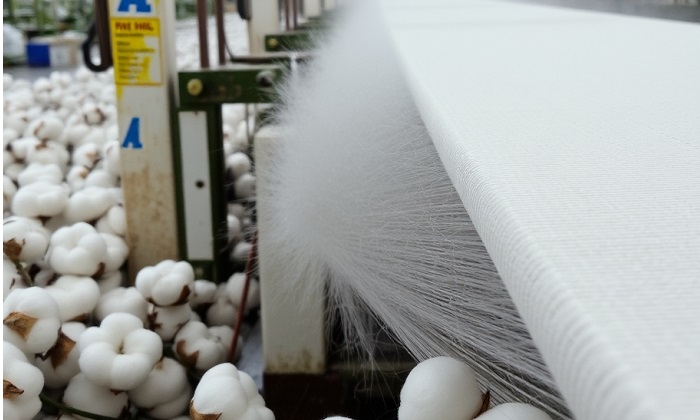
South Indian textile mills have reduced their cotton procurement by around 40 per cent from Gujarat during the October-September season of 2016-17. Reason: growing adulteration in cotton. Faced with a growing demand, ginners in Gujarat reportedly started mixing comber waste in cotton. This propelled many mill owners to tap other parts of the country for cotton procurement to meet the compliance norms set by buyers.
High contamination affects the quality of yarns as well as the final product, that is, the garment. It is difficult for mills to identify the contamination as comber waste looks cleaner than cotton. Generally the quality of cotton is determined by its color, fiber length, strength, fitness and the degree to which the cotton is free from contamination. One of the important factors which make quality of raw cotton low is contamination. A contamination may be an impurity, which can affect the subsequent processes, product appearance or product quality in general. Contamination causes to produce low quality lint cotton, yarn and manufactured goods.
Contamination of raw cotton may take place at any level, at farm while picking, at storage and marketing or at ginning. Cotton at the farm level is mainly contaminated before or at the time of picking in a number of ways. At the time of ball opening brackish and decayed seed cotton appears. Mixed picking of these balls also causes contamination.
- 1
- 2
- 3
- 4
- 5
- 6
- 7
- 8
- 9
- 10
India’s textile trade gets a Pacific push as New Zealand FTA removes tariff barr…
India and New Zealand have inked a ‘once-in-a-generation’ Free Trade Agreement (FTA), one that will have a profound impact on... Read more
Lululemon’s world-first nylon circularity push signals a new apparel arms race
The global apparel industry’s circularity narrative is entering a more technically demanding phase. Polyester recycling once the flagship of sustainable... Read more
Beyond the DTC Rush: Levi’s hybrid channel strategy sets a new retail benchmark
The global apparel sector is entering a phase where channel strategy is no longer a tactical lever but a core... Read more
The New Rules of Resale: EPR turning secondhand into fashion’s strategic growth …
The global fashion industry is facing a decisive regulatory and commercial reset. What began as a sustainability narrative around reuse... Read more
The 2027 Mandate: Why denim’s future hinges on verifiable data
For decades, the global denim industry has relied on a narrative of durability, heritage, and authenticity. That narrative is now... Read more
Europe’s textile core unravels as costs, imports and policy pressure bite
Europe’s textile and apparel sector, long seen as a benchmark for craftsmanship and industrial depth, is slipping into a prolonged... Read more
Automation, innovation, regulation are the forces shaping textiles in 2026
The global textile sector has entered a new era. Early 2026 saw the industry breach a $1.06 trillion valuation, reflecting... Read more
The new Brussels rulebook, every EU apparel order is now a balance-sheet risk
The humble export order sheet is undergoing a transformation. What was once a straightforward commercial instrument: SKU, volume, FOB price,... Read more
Why 2026-27 could be a defining cotton year for India’s farm-to-fashion economy
The global cotton economy is entering a more constrained phase, and for India, the implications run far beyond the farm... Read more
Luxury resale’s next big battle is no longer digital, it is about who controls s…
For nearly a decade, the luxury resale story was written in the language of platforms. Market leadership was measured by... Read more