The first quarter of FY27 marks a decisive turning point for India's textile industry, revealing a move that extends well beyond cyclical recovery. While stable cotton prices and easing freight costs have provided some relief after a turbulent FY26, the latest financial results indicate that profits is being determined by business models rather than commodity cycles.
The contrast is clear. Integrated textile companies with diversified operations across fabrics, garments, home textiles, technical textiles and branded businesses are giving healthy earnings growth despite modest revenue increase. Meanwhile, companies largely dependent on commodity yarn production continue to grapple with lower spreads, higher finance costs and limited pricing power. The sector's evolution suggests that India's textile leaders are no longer competing primarily on spinning capacity but on their ability to capture more value across the supply chain.
Value addition drives earnings
Across key corporate players in home textiles, integrated spinning/weaving, and technical fabrics, top-line trajectory varied widely. Operational performance was largely dictated by value-addition capabilities and export exposure.
Table: Q1 FY27 financial outlook of leading Indian textile corporates
|
Company |
Revenue YoY |
PAT YoY |
Growth Driver |
|
Welspun Living |
+2.66% |
+27.84% |
US manufacturing expansion and domestic brands |
|
KPR Mill |
+9.73% |
+4.62% |
Vertical integration and captive renewable energy |
|
Arvind Ltd |
+4.11% |
+24.31% |
Advanced Materials and diversified fabric portfolio |
|
Sangam India |
+8.07% |
+1852.38% |
High-capacity synthetic fabric and denim operations |
|
Vardhman Textiles |
+3.11% |
+4.96% |
Processed fabrics offset yarn pressure |
|
Indo Count Industries |
+5.48% |
+36.84% |
Wamsutta relaunch and geographic diversification |
|
Trident |
+4.42% |
+13.02% |
Operational leverage and debt reduction |
|
Nahar Spinning |
+3.05% |
+20.45% |
Cost optimization and integrated operations |
|
Sutlej Textiles |
+4.26% |
Loss |
Margin compression and high finance costs |
The financial picture reinforces a consistent theme: modest revenue growth is translating into disproportionately stronger profits for companies that have expanded into higher-value segments.
Home textile manufacturers, integrated apparel producers and diversified fabric companies generated stronger earnings even without major top-line increase. Their focus on branded products, processing, technical textiles and downstream manufacturing has enabled them to protect margins in an environment where commodity pricing remains subdued. In contrast, businesses concentrated in spinning continue to face intense pressure from volatile yarn-cotton spreads and rising financing costs, limiting earnings despite relatively stable sales.
Integration becomes the competitive edge
Perhaps the clearest lesson from Q1 FY27 is that vertical integration has become the industry's primary competitive advantage. Sangam India exemplifies this change. After finance and depreciation costs sharply reduce profits a year earlier, the company benefited from its expanded synthetic weaving and denim capacities reaching optimal utilization. Instead of selling lower-margin polyester-viscose yarn, the company increasingly converts its own yarn into fabrics and garments, significantly improving profitability. Its announcement of a Rs1,500 crore investment plan further underscores confidence in this integrated model.
KPR Mill continues to showcase similar resilience. Internal consumption of yarn for garment manufacturing, combined with extensive captive wind and solar power generation, has insulated margins from both raw material and energy cost fluctuations. The emerging pattern suggests that companies capable of controlling multiple stages of production—from fiber to finished products—are increasingly less exposed to the volatility that traditionally characterizes textile markets.
Looking beyond India
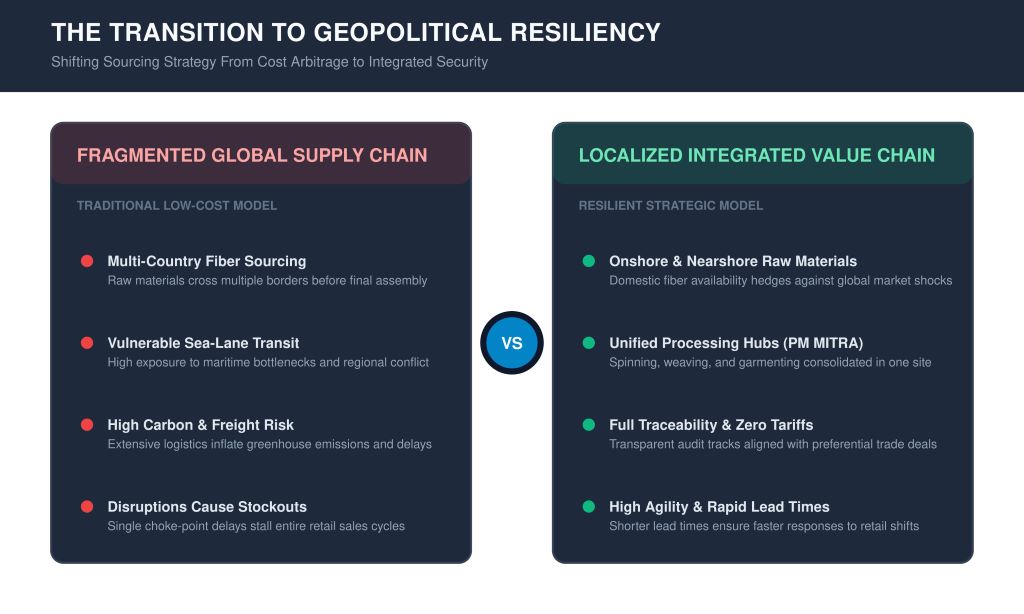
Another defining feature of Q1 FY27 is the growing importance of geographic diversification. Global retailers remain cautious following recent disruptions caused by geopolitical tensions, shipping bottlenecks and changing tariff regimes. Rather than relying solely on exports from India, leading manufacturers are creating production footprints closer to key consumer markets.
Welspun Living's investment in a pillow and bedding facility in Nevada reflects this strategic recalibration. Local manufacturing not only reduces delivery timelines but also mitigates tariff uncertainty and supply chain disruptions for its largest export market.
Indo Count Industries is pursuing diversification through market expansion. By increasing the contribution of non-US markets while simultaneously reviving the Wamsutta brand in the United States, the company is reducing dependence on a single geography and building a more balanced revenue portfolio.
These initiatives indicate that global competitiveness is increasingly being shaped by supply chain flexibility rather than manufacturing costs alone.
Beyond apparel
Another notable shift is the movement into technical and industrial textiles. Arvind Limited continues allocating greater resources toward advanced materials used in healthcare, industrial filtration, defense and protective applications. These businesses typically offer higher margins, stronger entry barriers and lower exposure to seasonal apparel demand than traditional denim manufacturing.
This diversification reflects a broader industry realization that long-term earnings stability will increasingly depend on participation in specialized textile segments rather than commodity apparel alone.
Balance sheets matter again
The sector is also showing greater financial discipline than during FY26. Last year, higher freight costs, inventory corrections across Western retailers and longer cash conversion cycles placed significant strain on corporate balance sheets. Q1 FY27 indicates that companies have responded by emphasizing debt reduction, tighter working capital management and operational efficiency.
Welspun Living reduced net debt while improving its cash conversion cycle, illustrating how stronger balance sheet management is complementing operational improvements. Trident also benefited from debt reduction alongside operational leverage, while Vardhman Textiles defended profitability through consistently high capacity utilization and an increasing contribution from processed fabrics and acrylic fiber.
These improvements suggest that financial discipline is becoming as important as production efficiency in sustaining earnings growth.
The next phase
Q1 FY27 confirms that India's textile industry is entering a new competitive era. The defining divide is no longer between exporters and domestic players or between cotton and synthetic producers. Instead, it is between companies that remain exposed to commodity cycles and those that have successfully moved downstream into brands, technical textiles, value-added processing and geographically diversified manufacturing.
As global supply chains continue to evolve, India's strongest textile companies appear increasingly positioned not as commodity suppliers but as integrated manufacturing and consumer businesses. Their ability to combine scale with value addition, operational efficiency and strategic diversification may ultimately determine which players emerge as long-term winners in the next phase of the industry's transformation.