The traditional divide between manufacturing and retail is rapidly disappearing in China. For decades, global apparel production operated through a familiar hierarchy: factories manufactured garments, wholesalers aggregated inventory, brands created market appeal, and retailers sold products to consumers. Every intermediary extracted a margin, making the retail price several times higher than the manufacturing cost.
China is dismantling that structure through its Manufacturer-to-Consumer (M2C) model. Textile factories that once supplied global brands are increasingly selling directly to individual consumers through digital platforms, transforming themselves from anonymous suppliers into retail businesses. The result is a shift in the country's apparel ecosystem, where industrial manufacturers now compete alongside established fashion brands.
Driven by integrated e-commerce platforms, live-stream shopping and data-driven production planning, the M2C model is becoming a defining feature of China's fashion economy. More importantly, it is reshaping how apparel is designed, manufactured and sold, forcing global retailers to reconsider long-established sourcing and distribution strategies.
Eliminating the cost pyramid
Traditional apparel supply chains are built around multiple layers of intermediaries. After garments leave the factory, they typically move through sourcing agents, distributors, logistics providers, wholesalers and retailers before reaching consumers. Each participant adds operating costs and profit margins, often increasing the final selling price by 300% to 500% above manufacturing costs. China's M2C ecosystem removes most of these intermediaries.
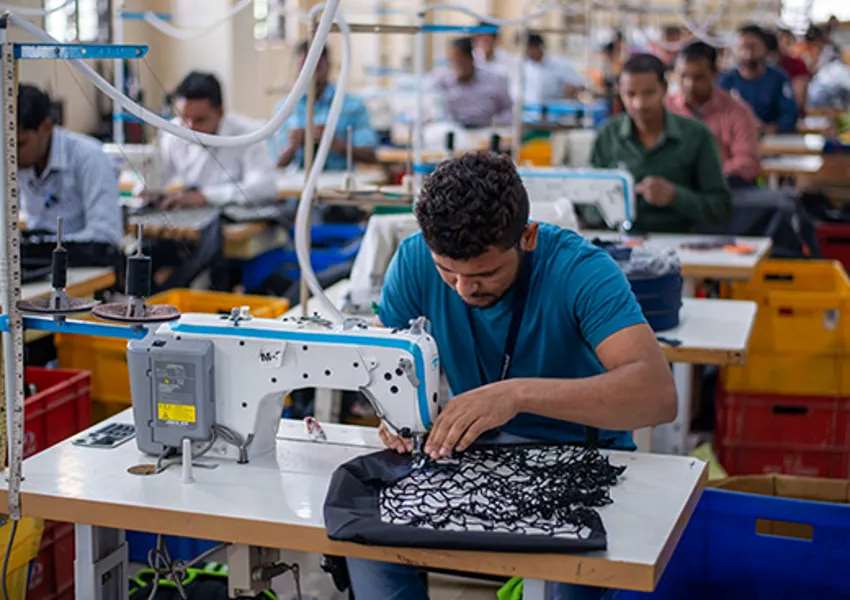
Factories located in major textile manufacturing clusters such as Zhejiang and Guangdong can now list products directly on digital marketplaces including Taobao, Douyin, Pinduoduo and WeChat-based stores. Consumers effectively purchase garments from the same facilities that weave fabrics, cut patterns and stitch finished products. The pricing advantage is substantial. Without multiple distribution mark-ups, many products reach consumers at only 15 per cent to 30 per cent above production costs, fundamentally altering the economics of apparel retail.
|
Retail system element |
Traditional global supply chain |
Chinese M2C digital model |
|
Intermediary Layers |
Multi-tiered (Agents, Wholesalers, Distributors) |
Zero (Direct industrial factory-to-consumer link) |
|
Retail Price Markup |
300% to 500% over manufacturing cost |
15% to 30% over production cost |
|
Feedback Loop |
3 to 6 months (Seasonal retail buying cycles) |
Real-time via live-stream interactions |
|
Primary Channels |
Trade shows, wholesale orders, retail outlets |
Taobao, Douyin, WeChat, Pinduoduo ecosystem |
The transformation extends beyond pricing. Chinese manufacturers increasingly communicate directly with buyers through live-stream broadcasts, private chat groups and instant messaging, answering questions about fabric quality, sizing and delivery in real time. This direct engagement shortens decision cycles and builds stronger customer relationships than conventional wholesale models.
Producing only what sells
Perhaps the greatest advantage of China's M2C model lies in how it changes manufacturing itself. Traditional fashion production depends heavily on demand forecasting. Brands typically place seasonal orders months before products reach stores, exposing manufacturers and retailers to inventory risks if consumer preferences shift unexpectedly.
Chinese factories are replacing this approach with demand-led production. Instead of producing thousands of garments upfront, manufacturers launch new designs through micro-production batches of just 50 to 100 units. These products are showcased on live-commerce platforms or online storefronts, where customer engagement, click-through rates and sales performance are monitored almost instantly.
Successful products move rapidly into full-scale manufacturing, often within 48 hours. Designs that fail to attract sufficient demand are discontinued with minimal financial losses.
The production cycle follows a simple but highly responsive framework:
Consumer engagement → Real-time analytics → Small production run → Demand evaluation → Production halted or scaled up
This approach dramatically reduces unsold inventory—one of the apparel industry's largest financial burdens. Lower inventory risk also frees up capital that manufacturers increasingly invest in automation, smart production systems, digital analytics and flexible manufacturing technologies. Rather than relying on seasonal forecasts, factories are responding directly to actual consumer demand.
Reinvention in Shengzhou
The transition from export manufacturing to direct retail is already reshaping several industrial clusters across China. One of the clearest examples is Shengzhou, globally recognised as one of the world's largest neckwear manufacturing centres. For years, its factories depended heavily on bulk export contracts from overseas retailers and corporate clients.
As global demand for traditional neckwear weakened, many medium-sized weaving factories faced falling export orders and declining factory utilisation. Instead of waiting for international buyers, several manufacturers established their own digital storefronts on domestic e-commerce platforms. They shifted from producing standard export products to developing scarves, fashion accessories and casual neckwear targeted directly at Chinese consumers.
The transition also changed product development. By analysing platform search behaviour and purchasing data, manufacturers adjusted colours, materials and designs on a weekly basis rather than waiting for seasonal buying cycles. This flexibility enabled factories to align production closely with changing consumer preferences while reducing dependence on long-term contracts.
According to industry estimates, several participating manufacturers recorded gross profit improvements of approximately 22 per cent compared with traditional export-oriented business models. The Shengzhou experience illustrates how manufacturing clusters are evolving from contract suppliers into consumer-focused retail businesses.
Digital retail has new demands
The M2C model offers significant commercial advantages, but it also introduces operational challenges unfamiliar to many industrial manufacturers. Running a production facility requires a different set of capabilities than managing a consumer-facing retail brand.
Factories entering digital commerce must now oversee customer service, product returns, after-sales support, online marketing and brand reputation—functions traditionally handled by retailers. Rising competition has also pushed customer acquisition costs higher across China's major e-commerce platforms, making profitability more difficult for smaller manufacturers.
Maintaining consistent quality has become equally important. Marketplace algorithms reward sellers with strong customer ratings while reducing visibility for businesses that accumulate complaints or inconsistent reviews. Manufacturers therefore face growing pressure to maintain rigorous quality standards alongside efficient production. For factories accustomed to focusing solely on manufacturing efficiency, retail success increasingly depends on digital marketing, customer engagement and operational responsiveness.
Platforms driving the shift
China's M2C transformation has got a boost from powerful digital ecosystems that seamlessly connect industrial production with consumer demand. Among them, Taobao remains one of the country's most influential online marketplaces. Since its launch in 2003 under Alibaba, the platform has evolved into a massive commercial ecosystem connecting millions of manufacturers, merchants and consumers.
For apparel producers, Taobao provides far more than a sales channel. Its integrated payment systems, logistics networks, consumer analytics and recommendation algorithms enable factories to launch products, analyse demand and scale production with remarkable speed. The platform's continued investment in industrial digitisation and rural manufacturing clusters is expected to deepen factory participation in direct consumer retail over the coming years.
A new competitive reality
China's Manufacturer-to-Consumer model represents more than an e-commerce innovation it reflects a fundamental restructuring of the apparel value chain. By integrating manufacturing, marketing and retail into a single digital system, Chinese factories are capturing value that traditionally flowed to wholesalers, distributors and fashion brands. The model reduces inventory risk, shortens product development cycles and creates closer connections between producers and consumers.
For international apparel companies, the implications are profound. Brands that continue to rely on lengthy sourcing cycles and multi-layered distribution networks may find themselves competing against manufacturers that are faster, leaner and increasingly capable of building their own consumer brands.
As digital commerce continues to blur the boundaries between factory and retailer, China's M2C is emerging as a blueprint for the next phase of global apparel competition. The companies that can combine manufacturing efficiency with real-time consumer engagement are likely to define the industry's future.