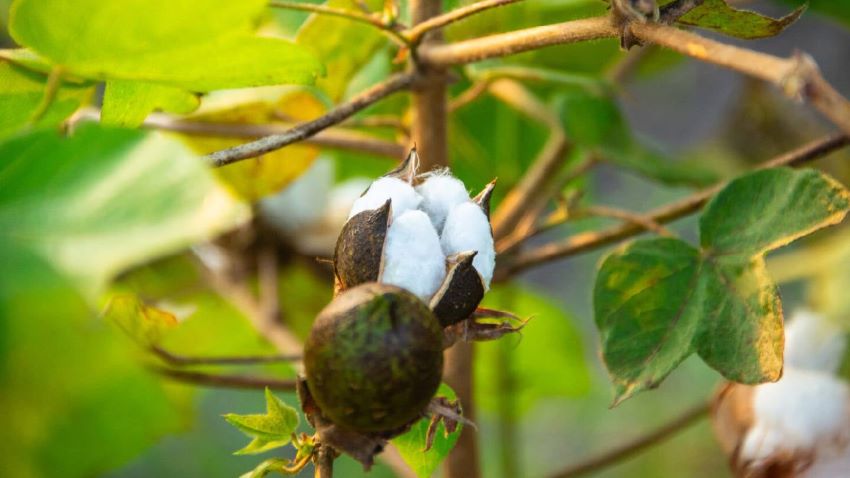
Due to tight supplies during the drought, cotton exports from India, the world’s biggest producer, have nearly halted as local prices have rallied, forcing key importers like Bangladesh, Pakistan and Vietnam to turn to other suppliers.
The freeze in Indian export will prompt Brazil, Australia and United States to raise shipments and has pushed global prices to near their highest since August. The price rise could subsequently push up fabric and clothing prices and put pressure on the margins of garment makers. In last three-four weeks Indian exporters could not sign a deal.
Meanwhile, the landed cost of Indian cotton for buyers in Pakistan and Bangladesh is at 75 cents to 76 cents per lb compared to around 73 cents for Brazilian cotton. Pakistan and Bangladesh prefer Indian cotton due to lower freight charges. Local cotton spot market prices have surged 10 per cent from a month ago to Rs 38,400 per candy of 356 kg (73.5 cents per lb) due to limited supplies after consecutive droughts cut production. A candy is equivalent to about two Indian bales of 170 kg each.
According to Cotton Association of India, India may produce about 34.1 million bales of cotton in the 2015/16 season that started on October 1, down from last year’s output of 38.3 million. India has exported around 6.5 million bales of cotton so far during the 2015/16 season, with Bangladesh and Pakistan accounting for more than half of the total exports. In 2014/15 India exported 6 million bales.
- 1
- 2
- 3
- 4
- 5
- 6
- 7
- 8
- 9
- 10
The New Rules of Resale: EPR turning secondhand into fashion’s strategic growth …
The global fashion industry is facing a decisive regulatory and commercial reset. What began as a sustainability narrative around reuse... Read more
The 2027 Mandate: Why denim’s future hinges on verifiable data
For decades, the global denim industry has relied on a narrative of durability, heritage, and authenticity. That narrative is now... Read more
Europe’s textile core unravels as costs, imports and policy pressure bite
Europe’s textile and apparel sector, long seen as a benchmark for craftsmanship and industrial depth, is slipping into a prolonged... Read more
Automation, innovation, regulation are the forces shaping textiles in 2026
The global textile sector has entered a new era. Early 2026 saw the industry breach a $1.06 trillion valuation, reflecting... Read more
The new Brussels rulebook, every EU apparel order is now a balance-sheet risk
The humble export order sheet is undergoing a transformation. What was once a straightforward commercial instrument: SKU, volume, FOB price,... Read more
Why 2026-27 could be a defining cotton year for India’s farm-to-fashion economy
The global cotton economy is entering a more constrained phase, and for India, the implications run far beyond the farm... Read more
Luxury resale’s next big battle is no longer digital, it is about who controls s…
For nearly a decade, the luxury resale story was written in the language of platforms. Market leadership was measured by... Read more
Digital Arms Race: Indian apparel giants deploy AI to neutralize tariff crisis
The Indian textile and apparel sector is in a digital survival phase in 2026, shifting from traditional labor-intensive models to... Read more
Europe’s Textile Endgame: Why Project FAE is becoming fashion’s most critical in…
Europe’s apparel majors are no longer treating circularity as a branding layer. With Project FAE or Feedstock Activation Europe, the... Read more
Engineering color at source, dye-free production is cutting cost, water, and tim…
For over a century, coloring has been anchored in wet processing, an energy-intensive, chemically saturated stage that happen post spinning.... Read more