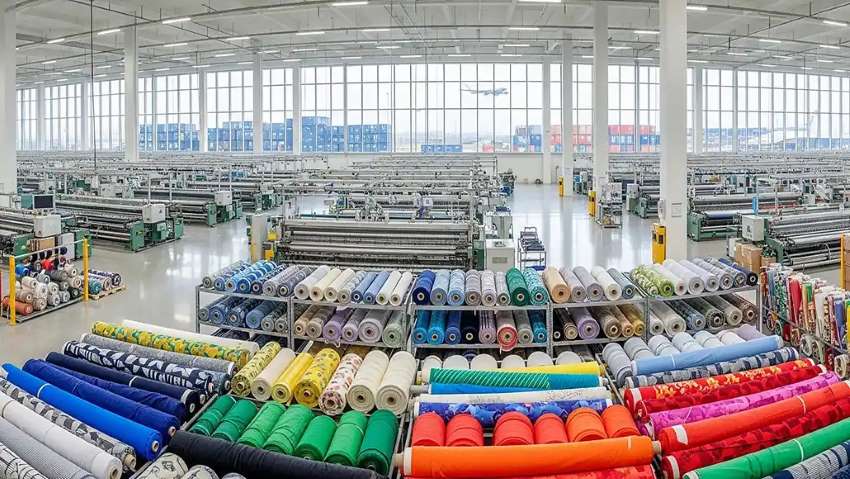
Pakistan wants to increase its textile exports in the next five years. Special incentives would be given to small and medium enterprises. New schemes and initiatives will be launched to increase the use of information technology. The plan envisages making textile sector compliant with labor and environment rules and conventions domestically and internationally. Textile units will be encouraged to use modern management practices for improving efficiency and reducing waste. The government will also provide vocational training to 12,000 workers.
Pakistan is the eighth largest exporter of textile products in Asia and the fourth largest producer of cotton with the third largest spinning capacity in Asia after China and India. Organisational rules will be amended to extend incentives to employees on the basis of performance and output. The proposed measures include formulation of a new policy as well as restructuring of institutions dealing with cotton to promote availability of better cotton for the value-added sector in the textile value chain.
Cotton standardisation and clean cotton with reduced contamination levels will be facilitated through upgradation of ginning machinery. A comprehensive training and capacity building program would be developed to establish a system in the private sector for grading and classifying cotton, ensuring that proper premiums are paid on cotton.
- 1
- 2
- 3
- 4
- 5
- 6
- 7
- 8
- 9
- 10
Bharat Tex 2026: Redefining the global textile value chain
Union Minister of Textiles, Giriraj Singh, has officially unveiled Bharat Tex 2026, signaling a significant leap in India’s influence over... Read more
Intertextile Shanghai Spring 2026: A hub for global textile innovation
The textile industry’s pulse is quickening as Intertextile Shanghai Apparel Fabrics – Spring Edition prepares to open its doors from... Read more
Moscow Fashion Week 2026: Blending sustainable innovation with timeless glamour
Scheduled to run from March 14-19, 2026 in Moscow, Russia, the Moscow Fashion Week (MFW) is cementing its status as... Read more
The Store as Stage: How fashion is crafting immersive consumer worlds
The North American fashion retail sector in 2026 is shedding its product-first identity and shifting towards a model that values... Read more
Turning the supply chain upside down, on-demand production reshapes apparel
The global fashion industry, long celebrated for its creativity and scale, is facing a structural reckoning. For decades, retailers and... Read more
Intertex Milano 2026 - A global nexus for textile innovation
Intertex Milano is set to return this summer, confirming its status as a premier international destination for the textile and... Read more
Primark at crossroads as AB Foods weighs spin-off amid digital and Lefties press…
The long-standing supremacy of Europe’s budget fashion champion, Primark, is facing a test. As of February 2026, Associated British Foods... Read more
Vietnam, Bangladesh, Cambodia drive US apparel imports in 2025
The 2025 year-end data for the US apparel sector reveals an industry in structural flux. Despite aggressive tariff measures and... Read more
The New Dress Code: Sportswear’s takeover of modern wardrobes
For much of the last decade, fashion retail has been defined by volatility. Trends have shortened, discount cycles have intensified... Read more
Hemp finds its moment in India’s $500 billion American trade calculus
In the grand arithmetic of India’s expanding trade engagement with the US, the headlines usually gravitate toward oil cargoes, aircraft... Read more