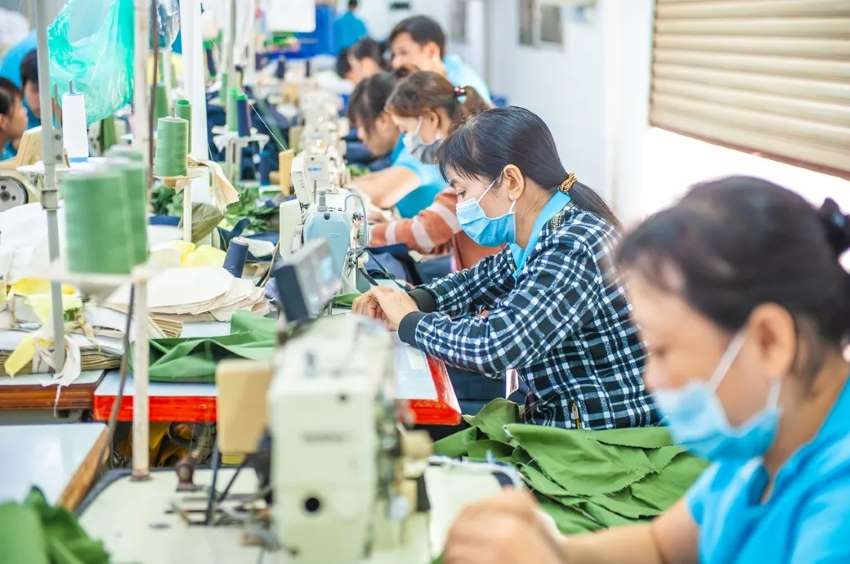
Celebrating its 110th anniversary this year Japanese sports brand Mizuno, continues to refuse to help 346 Indonesian workers who were unfairly dismissed after a strike in 2012. Some of the women, who have been working for years on Mizuno sportswear, lost their homes and families after the company producing for Mizuno sacked them. Adidas, another buyer at the factory at the time, also refuses to support the workers.
The labour issue started in July 2012 when a group of 1300 mostly female workers was fired from the PT Panarub Dwikarya Benoa factory (PDK) after a strike demanding the right to freedom of association and a back payment of the legal minimum wage. The women also suffered from verbal and physical violence. Early 2012 workers founded the union SBGTS-GSBI. In July 2012 factory management unilaterally decided to postpone negotiations regarding wage violations, while the workers started a spontaneous protest, followed by a strike which was joined by 2000 workers. After five days of strike, the factory management dismissed the workers.
Out of the 1300 dismissed workers, 346 are still fighting for fair severance payment. The other workers agreed to be paid off with a meager ransom, due to the pressure of the factory management and the hardship of lack of income. The remaining workers recently considerably lowered their financial demands in order to be able to reach a settlement and close the case.
- 1
- 2
- 3
- 4
- 5
- 6
- 7
- 8
- 9
- 10
Global cotton enters a deficit year in 2026 as supply drop meets logistics risk
The global cotton economy has entered a fragile and sensitive phase. Early projections for the 2026-27 season suggest that world... Read more
India’s textile trade gets a Pacific push as New Zealand FTA removes tariff barr…
India and New Zealand have inked a ‘once-in-a-generation’ Free Trade Agreement (FTA), one that will have a profound impact on... Read more
Lululemon’s world-first nylon circularity push signals a new apparel arms race
The global apparel industry’s circularity narrative is entering a more technically demanding phase. Polyester recycling once the flagship of sustainable... Read more
Beyond the DTC Rush: Levi’s hybrid channel strategy sets a new retail benchmark
The global apparel sector is entering a phase where channel strategy is no longer a tactical lever but a core... Read more
The New Rules of Resale: EPR turning secondhand into fashion’s strategic growth …
The global fashion industry is facing a decisive regulatory and commercial reset. What began as a sustainability narrative around reuse... Read more
The 2027 Mandate: Why denim’s future hinges on verifiable data
For decades, the global denim industry has relied on a narrative of durability, heritage, and authenticity. That narrative is now... Read more
Europe’s textile core unravels as costs, imports and policy pressure bite
Europe’s textile and apparel sector, long seen as a benchmark for craftsmanship and industrial depth, is slipping into a prolonged... Read more
Automation, innovation, regulation are the forces shaping textiles in 2026
The global textile sector has entered a new era. Early 2026 saw the industry breach a $1.06 trillion valuation, reflecting... Read more
The new Brussels rulebook, every EU apparel order is now a balance-sheet risk
The humble export order sheet is undergoing a transformation. What was once a straightforward commercial instrument: SKU, volume, FOB price,... Read more
Why 2026-27 could be a defining cotton year for India’s farm-to-fashion economy
The global cotton economy is entering a more constrained phase, and for India, the implications run far beyond the farm... Read more