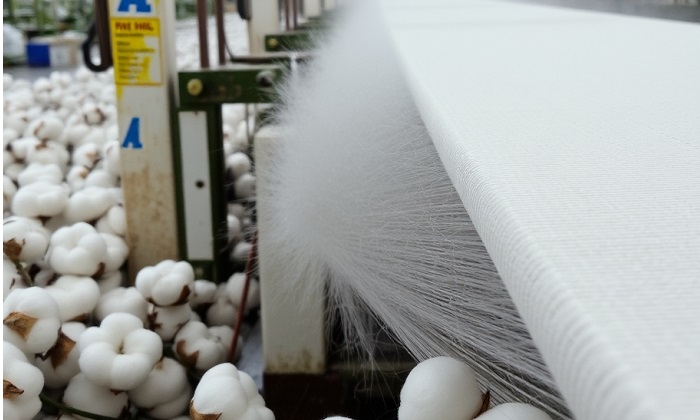
A team of scientists and students at Imperial College London have engineered bacteria found in green tea to produce cellulose that can find applications in the filtration and textile industry. The team has developed DNA tools to engineer a specific strain of bacteria found in fermented green tea to produce modified bacterial cellulose. This technique also enables to incorporate proteins and other bio molecules to the bacteria.
Among many different potential applications, protein incorporated bacterial cellulose filter can be used to target contaminants in water supplies. An interesting application is developing sensors using cellulose material that can detect bio toxins, based on color change.
The study shows bacterial cellulose production can be genetically engineered and proteins can be woven into cellulose, which has not been possible before. The next step is to collaborate with NASA scientists to manufacture new materials on Mars using these engineered microbes. Other applications are envisioned in the fashion and textile industry.
Undergraduate students specialising in synthetic biology led this research effort. This study is one of the first to use synthetic biology to engineer ways in which materials are produced. The research work has been published in the recent issue of Proceedings of the National Academy of Sciences, USA.
- 1
- 2
- 3
- 4
- 5
- 6
- 7
- 8
- 9
- 10
Intertextile Shanghai Spring 2026: A hub for global textile innovation
The textile industry’s pulse is quickening as Intertextile Shanghai Apparel Fabrics – Spring Edition prepares to open its doors from... Read more
Moscow Fashion Week 2026: Blending sustainable innovation with timeless glamour
Scheduled to run from March 14-19, 2026 in Moscow, Russia, the Moscow Fashion Week (MFW) is cementing its status as... Read more
The Store as Stage: How fashion is crafting immersive consumer worlds
The North American fashion retail sector in 2026 is shedding its product-first identity and shifting towards a model that values... Read more
Turning the supply chain upside down, on-demand production reshapes apparel
The global fashion industry, long celebrated for its creativity and scale, is facing a structural reckoning. For decades, retailers and... Read more
Intertex Milano 2026 - A global nexus for textile innovation
Intertex Milano is set to return this summer, confirming its status as a premier international destination for the textile and... Read more
Primark at crossroads as AB Foods weighs spin-off amid digital and Lefties press…
The long-standing supremacy of Europe’s budget fashion champion, Primark, is facing a test. As of February 2026, Associated British Foods... Read more
Vietnam, Bangladesh, Cambodia drive US apparel imports in 2025
The 2025 year-end data for the US apparel sector reveals an industry in structural flux. Despite aggressive tariff measures and... Read more
The New Dress Code: Sportswear’s takeover of modern wardrobes
For much of the last decade, fashion retail has been defined by volatility. Trends have shortened, discount cycles have intensified... Read more
Hemp finds its moment in India’s $500 billion American trade calculus
In the grand arithmetic of India’s expanding trade engagement with the US, the headlines usually gravitate toward oil cargoes, aircraft... Read more
EU PET spunbond imports under scrutiny, misclassification sparks regulatory and …
The European nonwovens and technical textiles sector is facing an unprecedented compliance crisis as a rise of customs misclassification threatens... Read more