Challenges confront the global apparel industry in 2020. Polarisation of manufacturers is continuing, with top class of large, well equipped manufacturers growing their market share at the expense of smaller suppliers. Domestic production in the US and in Europe is growing, but its market share is still very small. All of these trends are expected to continue in 2020.
The supply chain needs to accelerate the transformation to a more demand driven model. That’s a prerequisite for improving the bottom line. The challenge is for buyers and manufacturers and their suppliers to build responsive, flexible and sustainable value chains that are able to deliver the right product in the right amount at the right time. This requires collaboration which in turn requires from buyers to look beyond cost, to be prepared to share part of the investment burden by forfeiting short term lower buyer prices for long term gains and to engage suppliers as strategic partners. It also requires an acceleration of implementation of the ample technology available to move the industry into the digital age.
Another challenge is to reduce the environmental impact of clothing. Once improvements are made they must be communicated in the right way to consumers.
- 1
- 2
- 3
- 4
- 5
- 6
- 7
- 8
- 9
- 10
India’s textile trade gets a Pacific push as New Zealand FTA removes tariff barr…
India and New Zealand have inked a ‘once-in-a-generation’ Free Trade Agreement (FTA), one that will have a profound impact on... Read more
Lululemon’s world-first nylon circularity push signals a new apparel arms race
The global apparel industry’s circularity narrative is entering a more technically demanding phase. Polyester recycling once the flagship of sustainable... Read more
Beyond the DTC Rush: Levi’s hybrid channel strategy sets a new retail benchmark
The global apparel sector is entering a phase where channel strategy is no longer a tactical lever but a core... Read more
The New Rules of Resale: EPR turning secondhand into fashion’s strategic growth …
The global fashion industry is facing a decisive regulatory and commercial reset. What began as a sustainability narrative around reuse... Read more
The 2027 Mandate: Why denim’s future hinges on verifiable data
For decades, the global denim industry has relied on a narrative of durability, heritage, and authenticity. That narrative is now... Read more
Europe’s textile core unravels as costs, imports and policy pressure bite
Europe’s textile and apparel sector, long seen as a benchmark for craftsmanship and industrial depth, is slipping into a prolonged... Read more
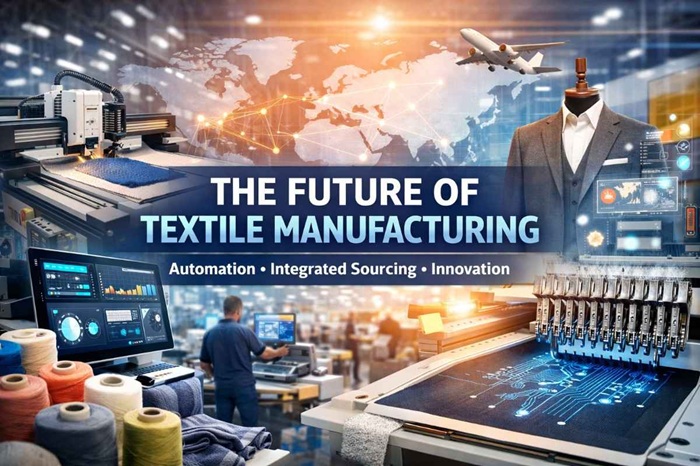
Automation, innovation, regulation are the forces shaping textiles in 2026
The global textile sector has entered a new era. Early 2026 saw the industry breach a $1.06 trillion valuation, reflecting... Read more
The new Brussels rulebook, every EU apparel order is now a balance-sheet risk
The humble export order sheet is undergoing a transformation. What was once a straightforward commercial instrument: SKU, volume, FOB price,... Read more
Why 2026-27 could be a defining cotton year for India’s farm-to-fashion economy
The global cotton economy is entering a more constrained phase, and for India, the implications run far beyond the farm... Read more
Luxury resale’s next big battle is no longer digital, it is about who controls s…
For nearly a decade, the luxury resale story was written in the language of platforms. Market leadership was measured by... Read more