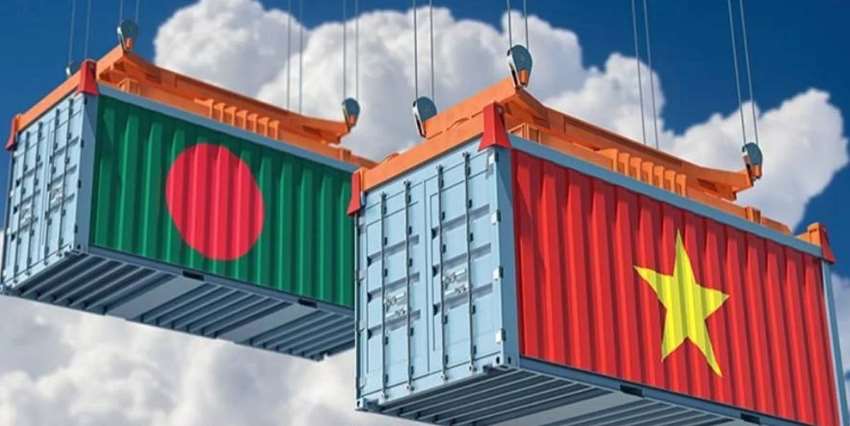
The EU has signed trade agreements with Mercosur and Vietnam. Mercosur is a bloc comprising Argentina, Brazil, Paraguay and Uruguay. The agreement is expected to give European companies an important head start in a market with an enormous economic potential. It will remove the majority of tariffs on EU exports to the countries—which will spell an opportunity for textiles, too. For clothing and footwear, the agreement will see 35 per cent tariffs eliminated, and the 26 per cent tariff on knitted fabrics will also be removed. This will help boost exports of EU products that have so far been facing high and sometimes prohibitive tariffs. Through this trade pact, Mercosur countries have decided to open up their markets to the EU. This is the largest trade agreement the EU has ever concluded.
The free trade agreement with Vietnam is the most ambitious free trade deal between the EU and an emerging economy to date. The deal is set to strengthen trade relations between the EU, and not just Vietnam, but the entire Asean region, which also comprises Indonesia, Malaysia, Philippines, Singapore, Thailand, Brunei Darussalam, Vietnam, Laos, Myanmar, and Cambodia. The EU is aiming at closer trade and investment relations between the two regions.

- 1
- 2
- 3
- 4
- 5
- 6
- 7
- 8
- 9
- 10
Why European consumers are spending more but buying less fashion
For much of the last two decades, the European fashion industry operated under the assumption that rising consumer wealth would... Read more
Why US apparel prices defied inflation while product quality improved
As inflation reshapes nearly every aspect of American household spending, one consumer category continues to stand apart. Housing costs have... Read more
The Resale Revolution: Vinted’s marketplace model reshapes European retail
The French fashion market has reached a turning point. In a development that highlights the growing influence of circular commerce,... Read more
France declares war on ultra-fast fashion with new green law, will reshape globa…
France has become the first major economy to legislate specifically against the ultra-fast fashion business model, a watershed moment for... Read more
France declares war on ultra-fast fashion with new green law, will reshape globa…
France has become the first major economy to legislate specifically against the ultra-fast fashion business model, a watershed moment for... Read more
Click-and-Collect: Why retailers are turning pickup counters into sales machines
Modern retail has changed the role of the physical store. Once viewed primarily as a point of sale or inventory... Read more
Why fashion e-commerce returns persist despite smarter sizing technology
For over a decade, the fashion sector has invested heavily in virtual fitting rooms, AI-powered size recommendations, and 3D body... Read more
A Quest for Essence: Unveiling the 2027 A/W Trends at Intertextile Shanghai Appa…
As the global textile industry looks toward the upcoming season, the Intertextile Shanghai Apparel Fabrics – Autumn Edition stands ready... Read more
Beyond globalization, local consumer behavior rewriting fashion retail strategy
The traditional blueprint for global fashion expansion is being rewritten. For decades, apparel companies assumed globalization would gradually create a... Read more
Virtual wardrobes redraw retail boundaries as gaming platforms become fashion ec…
The boundary between physical clothing and digital apparel is rapidly eroding as gaming environments evolve into fully functioning consumer markets.... Read more