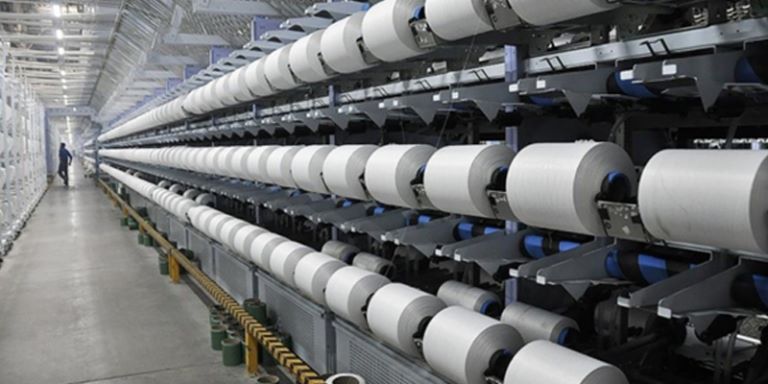
From April to May, many polyester plants in China scaled down or suspended production. Polyester feedstock price also weakened. The inventory burden has been obviously eased. Cash flow of PFY and PET bottle chips slightly improved, and PFY plants turned to be profitable but PSF plants still suffered losses with falling prices. The polymerization rate has increased to around 90.5 per cent from 87.8 per cent. In addition, some PFY and PSF plants have presold some orders. The polymerization rate is expected to be supportive to the upstream feedstock market in the short term.
Players lowered their run rate to slow down the accumulation speed. Orders improved sporadically after PFY price firmed up, but the overall weakness has not changed, supporting the run rate of twisting units and fabric manufacturing plants. The intensified Sino-US trade conflict has made downstream plants cautious in purchases and the situation is not expected to change in the short run.
Replenishing of downstream plants in June has improved compared with April or May. Polyester plants witnessed decreasing stocks. Actually, the inventory was transferred to the downstream market and partially to traders. Downstream demand has been continuously weak. Stocks of feedstock and finished goods are expected to be high in the short run.

- 1
- 2
- 3
- 4
- 5
- 6
- 7
- 8
- 9
- 10
Why US apparel prices defied inflation while product quality improved
As inflation reshapes nearly every aspect of American household spending, one consumer category continues to stand apart. Housing costs have... Read more
The Resale Revolution: Vinted’s marketplace model reshapes European retail
The French fashion market has reached a turning point. In a development that highlights the growing influence of circular commerce,... Read more
France declares war on ultra-fast fashion with new green law, will reshape globa…
France has become the first major economy to legislate specifically against the ultra-fast fashion business model, a watershed moment for... Read more
France declares war on ultra-fast fashion with new green law, will reshape globa…
France has become the first major economy to legislate specifically against the ultra-fast fashion business model, a watershed moment for... Read more
Click-and-Collect: Why retailers are turning pickup counters into sales machines
Modern retail has changed the role of the physical store. Once viewed primarily as a point of sale or inventory... Read more
Why fashion e-commerce returns persist despite smarter sizing technology
For over a decade, the fashion sector has invested heavily in virtual fitting rooms, AI-powered size recommendations, and 3D body... Read more
A Quest for Essence: Unveiling the 2027 A/W Trends at Intertextile Shanghai Appa…
As the global textile industry looks toward the upcoming season, the Intertextile Shanghai Apparel Fabrics – Autumn Edition stands ready... Read more
Beyond globalization, local consumer behavior rewriting fashion retail strategy
The traditional blueprint for global fashion expansion is being rewritten. For decades, apparel companies assumed globalization would gradually create a... Read more
Virtual wardrobes redraw retail boundaries as gaming platforms become fashion ec…
The boundary between physical clothing and digital apparel is rapidly eroding as gaming environments evolve into fully functioning consumer markets.... Read more
From Estimates to Audits: Virgin PET data disrupts global synthetic fiber econom…
The global textile industry is recalibrating how environmental impact is measured, priced, and regulated. While polyester continues to dominate global... Read more