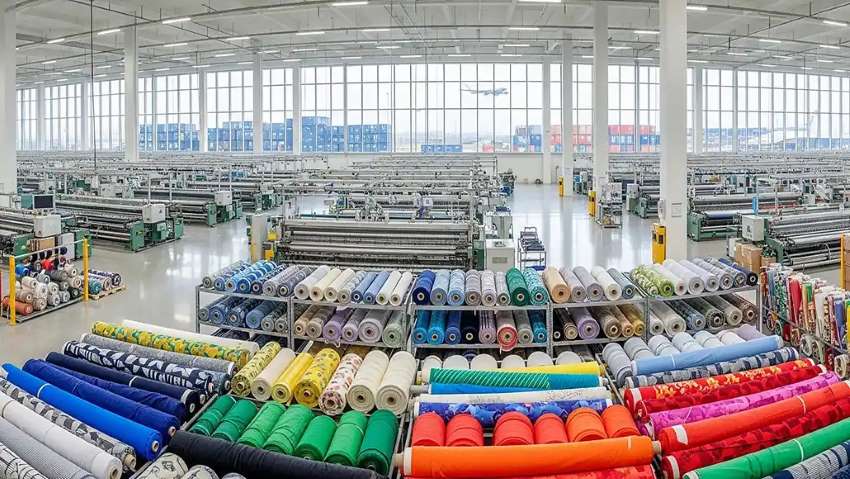
China now produces half of the world’s clothing and 65 per cent to 70 per cent of fiber. China and its neighbors have formed a mutually beneficial and healthy regional supply chain cooperation relationship. China supplies textiles to neighboring countries. These process and sell to the global market, and some of them return to the Chinese market. In the next few years, the production capacity of textile and clothing industries in China can be improved by a move to neighboring countries.
Large-scale textile factories in Vietnam are basically run by the Chinese. China’s textile and clothing companies or factories operating in Cambodia and Myanmar account for at least 30 per cent of the total number of local textile and garment companies. China’s investment has promoted textile and clothing in these countries.
In the global value chain of the textile and garment industry, raw materials, cotton and accessories are at the low end of the smile curve and the lowest added value of production is at the middle of the value chain. Distribution, design, marketing etc. are high value-added fields. China hopes to move to the upper end of the smile curve to enhance the level of industrial development, carry out industrial upgrading, and better integrate into the global value chain. Every link in the smile curve has development potential.
- 1
- 2
- 3
- 4
- 5
- 6
- 7
- 8
- 9
- 10
India’s textile trade gets a Pacific push as New Zealand FTA removes tariff barr…
India and New Zealand have inked a ‘once-in-a-generation’ Free Trade Agreement (FTA), one that will have a profound impact on... Read more
Lululemon’s world-first nylon circularity push signals a new apparel arms race
The global apparel industry’s circularity narrative is entering a more technically demanding phase. Polyester recycling once the flagship of sustainable... Read more
Beyond the DTC Rush: Levi’s hybrid channel strategy sets a new retail benchmark
The global apparel sector is entering a phase where channel strategy is no longer a tactical lever but a core... Read more
The New Rules of Resale: EPR turning secondhand into fashion’s strategic growth …
The global fashion industry is facing a decisive regulatory and commercial reset. What began as a sustainability narrative around reuse... Read more
The 2027 Mandate: Why denim’s future hinges on verifiable data
For decades, the global denim industry has relied on a narrative of durability, heritage, and authenticity. That narrative is now... Read more
Europe’s textile core unravels as costs, imports and policy pressure bite
Europe’s textile and apparel sector, long seen as a benchmark for craftsmanship and industrial depth, is slipping into a prolonged... Read more
Automation, innovation, regulation are the forces shaping textiles in 2026
The global textile sector has entered a new era. Early 2026 saw the industry breach a $1.06 trillion valuation, reflecting... Read more
The new Brussels rulebook, every EU apparel order is now a balance-sheet risk
The humble export order sheet is undergoing a transformation. What was once a straightforward commercial instrument: SKU, volume, FOB price,... Read more
Why 2026-27 could be a defining cotton year for India’s farm-to-fashion economy
The global cotton economy is entering a more constrained phase, and for India, the implications run far beyond the farm... Read more
Luxury resale’s next big battle is no longer digital, it is about who controls s…
For nearly a decade, the luxury resale story was written in the language of platforms. Market leadership was measured by... Read more