A global recession can hit Bangladesh’s export income and remittances, two life lines of the country’s economy. Recession can hurt Bangladesh’s export diversification as nearly 16 per cent of the country’s exports consist of non-readymade garment products. If there is a recession many companies in the Middle East would be out of business in which a good number of Bangladesh workers are employed. These workers can lose their jobs, having an adverse impact on the country’s remittances.
The recent slowdown in the US economy, dismal German economic performances, lowest ever industrial production growth in China in recent times, and a contraction in the economies of Argentina, South Africa and Iran are warning signs of a possible global economic meltdown.
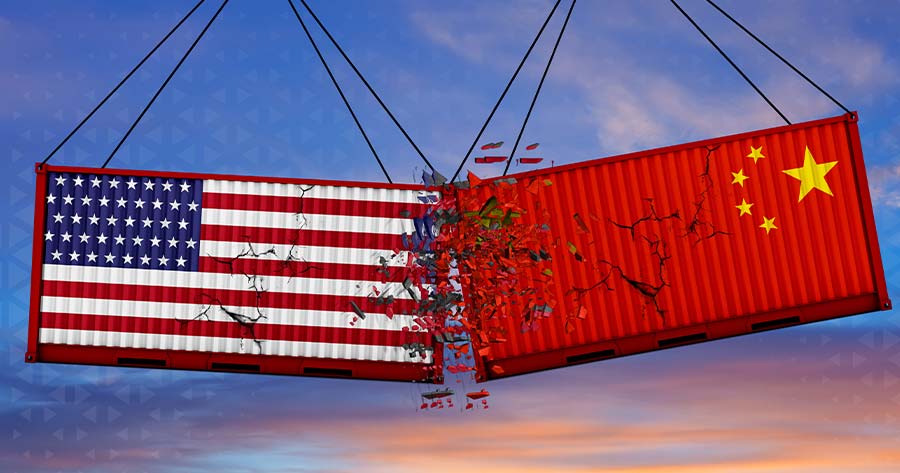
Though Bangladesh is getting some benefits from the US-China trade war, economic diversification can help Bangladesh avoid the impact of a possible economic recession. However such diversification needs investments. Value addition is one way out and being sustainable is another. The country has to take initiatives to capture more low-end apparel manufacturing relocation from China. Bangladesh exports low-end garment products. Apparel exports contribute 84 per cent to the country’s total export earnings. Bangladesh has already witnessed double-digit growth during the July-May period of the current fiscal year.
- 1
- 2
- 3
- 4
- 5
- 6
- 7
- 8
- 9
- 10
Global cotton enters a deficit year in 2026 as supply drop meets logistics risk
The global cotton economy has entered a fragile and sensitive phase. Early projections for the 2026-27 season suggest that world... Read more
India’s textile trade gets a Pacific push as New Zealand FTA removes tariff barr…
India and New Zealand have inked a ‘once-in-a-generation’ Free Trade Agreement (FTA), one that will have a profound impact on... Read more
Lululemon’s world-first nylon circularity push signals a new apparel arms race
The global apparel industry’s circularity narrative is entering a more technically demanding phase. Polyester recycling once the flagship of sustainable... Read more
Beyond the DTC Rush: Levi’s hybrid channel strategy sets a new retail benchmark
The global apparel sector is entering a phase where channel strategy is no longer a tactical lever but a core... Read more
The New Rules of Resale: EPR turning secondhand into fashion’s strategic growth …
The global fashion industry is facing a decisive regulatory and commercial reset. What began as a sustainability narrative around reuse... Read more
The 2027 Mandate: Why denim’s future hinges on verifiable data
For decades, the global denim industry has relied on a narrative of durability, heritage, and authenticity. That narrative is now... Read more
Europe’s textile core unravels as costs, imports and policy pressure bite
Europe’s textile and apparel sector, long seen as a benchmark for craftsmanship and industrial depth, is slipping into a prolonged... Read more
Automation, innovation, regulation are the forces shaping textiles in 2026
The global textile sector has entered a new era. Early 2026 saw the industry breach a $1.06 trillion valuation, reflecting... Read more
The new Brussels rulebook, every EU apparel order is now a balance-sheet risk
The humble export order sheet is undergoing a transformation. What was once a straightforward commercial instrument: SKU, volume, FOB price,... Read more
Why 2026-27 could be a defining cotton year for India’s farm-to-fashion economy
The global cotton economy is entering a more constrained phase, and for India, the implications run far beyond the farm... Read more