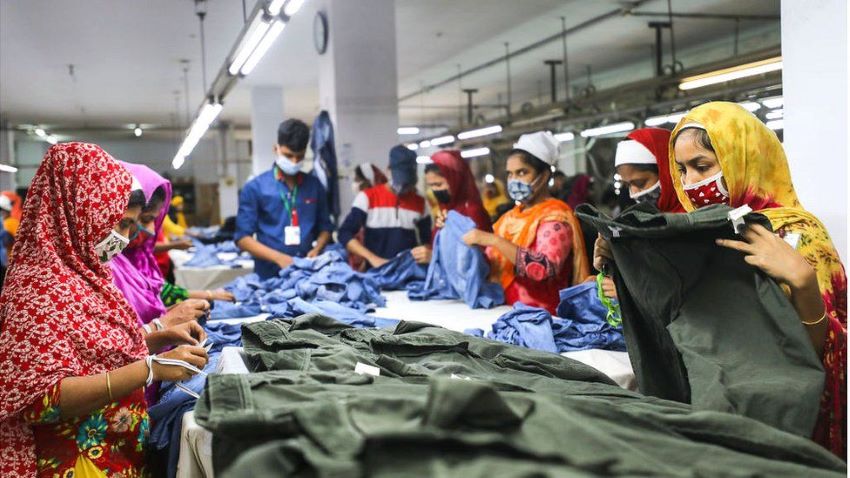
Bangladesh is expected to grow at eight per cent this year, the highest in Asia. The country continues to be among the fastest growing economies in Asia and the Pacific. Buoyant exports, robust private consumption, higher remittance, accommodative monetary policy and ongoing reforms to improve the business climate and high infrastructure spending are helping Bangladesh.
Favorable trade prospects are expected to continue. Exports and remittances are likely to be further strengthened. Strong public investment and expedited implementation of large infrastructure projects are also envisaged.
Public investment expanded from eight per cent to 8.2 per cent and total investment contributed 2.8 percentage points to growth. But private investment edged up to 23.4 per cent in fiscal 2018-19 from 23.3 per cent a year earlier. Apart from that, private sector credit growth slowed to 11.3 per cent from 16.9 per cent, partly due to a decline in deposit growth. Inflation is expected to edge up to 5.8 per cent from 5.5 per cent on upward adjustments to domestic gas prices, higher price of goods and services due to expansion in value-added tax coverage, and the depreciation of the currency against the dollar. The revenue shortfall is expected to be offset by lower public spending, holding the budget deficit under the ceiling of five per cent of GDP.
- 1
- 2
- 3
- 4
- 5
- 6
- 7
- 8
- 9
- 10
Global cotton enters a deficit year in 2026 as supply drop meets logistics risk
The global cotton economy has entered a fragile and sensitive phase. Early projections for the 2026-27 season suggest that world... Read more
India’s textile trade gets a Pacific push as New Zealand FTA removes tariff barr…
India and New Zealand have inked a ‘once-in-a-generation’ Free Trade Agreement (FTA), one that will have a profound impact on... Read more
Lululemon’s world-first nylon circularity push signals a new apparel arms race
The global apparel industry’s circularity narrative is entering a more technically demanding phase. Polyester recycling once the flagship of sustainable... Read more
Beyond the DTC Rush: Levi’s hybrid channel strategy sets a new retail benchmark
The global apparel sector is entering a phase where channel strategy is no longer a tactical lever but a core... Read more
The New Rules of Resale: EPR turning secondhand into fashion’s strategic growth …
The global fashion industry is facing a decisive regulatory and commercial reset. What began as a sustainability narrative around reuse... Read more
The 2027 Mandate: Why denim’s future hinges on verifiable data
For decades, the global denim industry has relied on a narrative of durability, heritage, and authenticity. That narrative is now... Read more
Europe’s textile core unravels as costs, imports and policy pressure bite
Europe’s textile and apparel sector, long seen as a benchmark for craftsmanship and industrial depth, is slipping into a prolonged... Read more
Automation, innovation, regulation are the forces shaping textiles in 2026
The global textile sector has entered a new era. Early 2026 saw the industry breach a $1.06 trillion valuation, reflecting... Read more
The new Brussels rulebook, every EU apparel order is now a balance-sheet risk
The humble export order sheet is undergoing a transformation. What was once a straightforward commercial instrument: SKU, volume, FOB price,... Read more
Why 2026-27 could be a defining cotton year for India’s farm-to-fashion economy
The global cotton economy is entering a more constrained phase, and for India, the implications run far beyond the farm... Read more