


FW
Extension of duty-free facilities to help Bangladesh boost exports to China
The extension of duty-free treatment to 98 per cent of tariff lines will help Bangladesh to further increase its exports to China, says, Wang Yi, State Councilor and Foreign Minister, Chinese Embassy in Dhaka.
During his recent visit to Bangladesh, Yi announced that the duty-free treatment of 98 per cent of goods in the different tariff lines originating from Bangladesh will take into effect on September 1.
This will further help to boost Bangladesh’s export to China.
China had been providing duty-free facility to 97 percent of Bangladeshi products, including all garment products, since July 1, 2021. Around 383 new products, including leather items, have been added to the list now, thereby expanding the benefit to 98 percent of the products.
Businessmen in the leather industry have already been focusing on the opportunity provided by the duty-free treatment, according to the Chinese Embassy.
Programs are even underway to facilitate Chinese manufacturing enterprises related to leather products to form business relations with Bangladesh’s leather exporters, it said
API organized TPT Indo Intertex-Inatex 2022 exhibition
The Indonesian Textile Association (API) is organizing the TPT Indo Intertex-Inatex 2022 exhibition from August 10-13, 2022, According to JemmyKartiwaSastraatmaja, General Chair, API, this year's exhibition triggers optimism and investment interest among national textile business players in the post-COVID-19 pandemic. It echoes the spirit that the textile industry still has a long and bright future, he adds.
The Indo Intertex-Inatex 2022 exhibition is being held at the Jakarta International Expo after being delayed by two years due to the COVID-19 pandemic. The 18th edition of the exhibition presents over 130 participants from 16 Asian and European countries displaying products and technological innovations from textile and garment machinery, raw materials, digital printing machines, textile chemicals, accessories and other textile products.
Paul Kingsen, Project Director, PeragaExpo, says, the Indonesian textile and apparel industry recorded the highest growth and played an important role in the national economy.
Based on the Making Indonesia 4.0 roadmap, the textile and clothing industry is one of five manufacturing sectors that are being prioritized.
According to him, the Indo Intertex exhibition plays an important role as a credible platform to pioneer and lead the transformation of the local textile and garment sector by introducing new technologies from the world.
The industrial machinery and accessories on display allow companies to make a faster transition to Industry 4.0 without much hassle. Despite being one of the world's leading apparel manufacturers, until 2021 Indonesia still has not been able to enter the ranking of the top 10 world textile producers.
Previously, in 2017-2020 Indonesia was one of the largest apparel exporters in the world. Based on TexfilesBD, currently, the leading countries in textile exports include Asian countries like China, Germany, Bangladesh, Vietnam, India. Indonesia is considered to still have to struggle to encourage increased competitiveness to be able to compete better with these competing countries. The increase in competitiveness is carried out through the encouragement of regulatory improvements and industrial reforms.
Organic cotton market to grow at 40% CAGR from 2021-2028
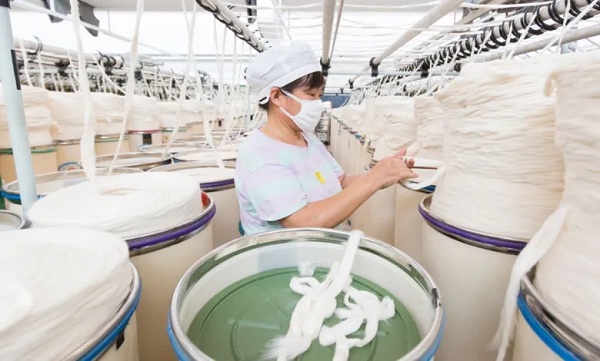
The use of organic cotton is increasing amongst brands across the world. As per the Quint report the organic cotton market is expected grow at 40 per cent CAGR to reach $6,730 million by 2028. India, a major global cotton market, produces over half of the world’s organic cotton, according to the Textile Exchange, a global non-profit for the fibre industry. The government has launched the National Program for Organic Cotton Production that aims to provide an accreditation framework to consumers, producers, processors and traders across the country.
India also has over 5,000 GOTS-certified facilities. It currently produces organic cotton worth 1.23 million tons. Madhya Pradesh and Odisha are among the states with significant rise in production. As cotton requires plenty of water and harmful pesticides for cultivation, it has often been called the world’s dirtiest crop.
Natural fertilizers, less emission make organic cotton good choice
However, organic cotton replaces harmful pesticides with organically approved ones. Farmers use natural fertilizers to grow organic cotton. They also abstain from using genetically modified seeds. The entire cultivation chain in organic cotton is closely monitored. Farmers do not use artificial substances such as formaldehyde and chlorine to process and manufacture organic cotton. This makes clothes made from organic cotton more comfortable and durable. Also, carbon dioxide emitted from production of organic cotton is almost half of those emitted through conventional cotton production.
Challenges in cultivation
Despite these benefits, organic cotton production and manufacturing faces certain challenges. First, farmers often lack access to good-quality seeds suitable for organic farming. Similarly, organic fertilizers and bio-pesticides are not always available for the cultivation of organic cotton. To cultivate organic cotton, farmers to be trained to use natural fertilizers and create a healthy soil balance. They also need to keep pests under control instead of destroying them with the use of chemicals.
These challenges can be surmounted through an effective collaboration between farmers’ association with environmental bodies. These associations can arrange the terms of microcredit for farmers. They intervene to make organic cotton yields more attractive. In short, inputs and facilities can be made more readily available and the benefits of soil health can be properly communicated.
Setting global standards for organic fibers
Selling organic cotton with credibility requires proper labeling and certification. Global Organic Textiles Standard (GOTS) aims to achieve this by setting the global standard for organic fibers. To be GOTS certified, all processes and activities in the chain need to be periodically inspected on-site. GOTS certification also enables processors and manufacturers to export fabrics and garments in major markets.
In India, organic cotton production is monitored by state governments. The country currently has over 5,000 GOTS-certified facilities, the highest number in the world. GOTS recently cancelled all wrongly issued transaction certification after a thorough audit amid reports of faulty certification leading to fake organic cotton products, a thorough audit was conducted by GOTS. It is developing a revised system for raw material checks and reviews of certification bodies.
Transforming farming communities
The outlook for organic cotton in India is marked by rising production and increasing growth. Many organizations and industry experts are streamlining the supply chain to create favorable conditions for buyers and suppliers to promote the industry. A responsible supply chain is being created through the formation of a body called the Organic Cotton Accelerator (OCA).
India currently produces 1.23 million tons of organic cotton with Madhya Pradesh and Odisha leading production in the country. Besides, production in Maharashtra, Gujarat and Rajasthan has grown to 99 per cent of the total cotton production in the last five years. The Indian Council of Agricultural Research with associated bodies has released 64 non-GM cotton varieties and hybrids from 2017 to 2021. These varieties can be adopted by organic cotton growers to directly the crop.
Minimizing pollution and making the world a better place, organic cotton is thus transforming farming communities in India besides improving livelihoods and reducing climate change.
RSWM Q1 FY’23 sales surge by 38%
The Q1 FY’23 sales of one of India’s largest manufacturers and exporters of value added synthetic, mélange, blended spun yarns and denim fabric, RSWM surged by 38 per cent to Rs1,024 crore, up 38 per cent from Rs742 crore in Q1 FY22.
The company’s EBITDA increased from Rs. 90 crore in Q1 FY22 to Rs141 crore in Q1 FY23.Domestic demand of the company witnessed a strong growth, increasing 62 per cent Y-o-Y. Export sales were in-line with Q1 FY22 at Rs286 crore and exports-maintained momentum despite of recession concern. RSWM’s cost optimization program helped in maintaining the profit margin.
Strong realisation led to 81 per cent PAT growth to Rs67 crorefrom Rs37 crore in Q1 FY22. Higher raw material prices are getting absorbed by end users; but it still continues to remain a concern for the industry.
Additionally, a 30,000 spindles yarn capacity unit at Gulabpura and denim fabric and knitting units at Banswara undertaken last year, started commercial production from July 1, 2022.
Smart Clothing adds new jeans factory
Bengaluru-based leading bottomwear manufacturer Smart Clothing is adding a new jeans factory.
The company manufactures 60,000 pieces of garments per month. It plans to launch a jeans factory with an initial capacity of 5,000 pieces per day.
Vishal Devatha, Director, says, the company will start with the sewing setup and will later go for washing operations also. It is exploring various opportunities, technologies and other aspects of the trade
Smart Clothing has over 4 acre for the new plant, with the overall investment being around Rs. 8 to 10 crore. Sewing operations will start in next three months, while washing operations will take some more time.
Dedhia believes, g new product category will help the company add new clients.
As of now, Smart Clothing works with Indian brands and in future it will also explore export opportunities. The company’s new denim plant will be fully compliant as per the need of export.
Global cashmere clothing market value to reach $4,105.41 million by 2029
As per the latest report by Data Bridge Market Research, valued at $3,015.28 million in 2021, the global cashmere clothing Market is projected to grow at 3.93 per cent CAGR from 2022-2029 to reach $4,105.41 million by 2029.
Over the last few years, the popularity and demand for cashmere apparel products have risen dramatically. Many industrialized countries are importing these products. Globally, factors such as rising demand for high-quality clothes and the adoption of fashionable and luxury garments are expected to fuel market expansion.
The rapid surge in demand for cashmere clothing products is also been attributed to rising disposable income among the working population and a trending predisposition of millennials to spend on luxury and premium products.
Furthermore, with the continuous digitalization of major countries and the resulting internet penetration, social media websites have become a perfect outlet for raising awareness about cashmere garments in some locations where the market was not large enough.
Market players are further investing in innovations in the design and comfort of fashion products, which further extend profitable opportunities over the forecast period of 2022 to 2029. Additionally, the increasing awareness about cashmere clothing in several regions where the market was not sufficiently large will further expand the future growth of the cashmere clothing market.
Copenhagen Fashion Week teams up with Ukrainian Fashion Week
Copenhagen Fashion Week has teamed up with the Ukrainian Fashion Week to uplift the fashion organization in times of war.
Copenhagen Fashion Week will support Ukrainian Fashion Week in its determinism to provide brands with an opportunity to be nurtured and showcased by their global allies and supporters.
The Ukrainian Fashion Week (UFW) celebrates its 25th anniversary in 2022. The fashion week had announced numerous projects during its 50th season that were halted due to the severe war that erupted through Russia’s invasion. The initiatives launched by UFW included “Support Ukrainian Fashion" Initiative to reinforce Ukrainian designers and ensure presenting of their new collections on the international catwalks.
Bypartnering with Ukrainian Fashion Week, Copenhagen Fashion Week will be able to showcase the COAT and TG Botanical as part of the official Event & Presentation Schedule. The COAT will release a digital fashion film and TG Botanicals as a physical presentation. Spalt PR will be the official PR supporters for both brands.
PVH Corp publishes 2021 Corporate Responsibility report
PVH Corp, the growth platform for Calvin Klein and Tommy Hilfiger published its 2021 Corporate Responsibility (CR) report. The company continues to collaborate with peers and partners to make progress on its Forward Fashion strategy, while continuing to navigate an increasingly challenging global environment.
PVH is committed to continue driving meaningful and impactful change within the organization and across the apparel industry as part of the company’s purpose to drive fashion forward for good.
This year’s report chronicles notable progress against PVH’s Forward Fashion commitments and also displays improvements on how and what the company reported.
According to the report, PVH increased the number of Calvin Klein products made using sustainable materials by 50 per cent. It incorporated sustainable materials including recycled and organic materials in two-thirds of Tommy Hilfiger collections. One-third of the consumer packaging for products was manufactured using recycled materials, up from 0% in 2019.
For the first time, the majority of PVH’s energy consumption came from the use and support of renewable sources. The company became a founding member of the International Accord for Health and Safety in the Textile and Garment Industry. It collaborated with fashion industry peers to launch The Resilience Fund for Women in Global Value Chains and the Power of Nutrition; expanded existing career advancement programs to support the women who make up the majority of PVH’s supply chain workforce. It exceeded target to support 135,000 individuals worldwide through education services, resources and trainings.
Huntsman Corporation to sell Textile Effects division
Huntsman Corporation has entered into a definitive agreement to sell its Textile Effects division to Archroma, a portfolio company of SK Capital Partners. The total enterprise value of the transaction is approximately $718 million, which includes the assumption of approximately $125 million in net underfunded pension liabilities as of December 31, 2021. The acquisition is being partially funded with preferred equity, of which Huntsman is taking up to $80 million, an amount SK Capital Partners will seek to syndicate prior to the transaction closing.
Over the last twelve months ending June 30, 2022, the Textile Effects division reported sales of $772 million and adjusted EBITDA of $94 million. Huntsman anticipates cash taxes on the transaction of approximately $50 million. Huntsman intends to report Textile Effects as discontinued operations beginning in the third quarter of 2022. The transaction is subject to regulatory approvals and other customary closing conditions and is expected to close in the first half of 2023.
Karl Mayer Group acquires yarn tensioner technology
Karl Mayer Group has acquired the yarn tensioner technology from Appalachian Electronic Instruments
As per the agreement, the Karl Mayer Group will take over the complete range of products YTC (YTC-2000 AND YTC-2000 MAX) and the complete technology of yarn tensioners for weaving and warp knitting preparation from AEI. The after sales service for the installed base machines will be taken over by Karl Mayer effective from September 01, 2022. AEI will continue to support Karl Mayer and the customers during the transition. As market leader and full range supplier in indigo dyeing, the Karl Mayer Group will complete their yarn tensioner product range with this integration of the YTC technology.
Since patenting the first electronic disk tensioner in 1979 AEI has been a pioneer and leading supplier of yarn tensioners for denim and warp knitting applications. After 43 years, AEI has made the decision to exit the tension control market and focus on its patented broken and tight yarn monitoring technology.











