


FW
Spring garment export orders pick up for Bangladesh
Apparel orders have started to pick up for Bangladesh.
Fresh enquiries are coming in from top buyers for the spring season, with manufacturers considering it a positive sign for the country amid the global economic downturn. Besides, the trend of buyers shifting orders from China – as the country is still in Covid-induced lockdown – has proved to be beneficial for Bangladesh.After the economy started to gain pace, Bangladesh’s exports of garments in the last fiscal year grew by over 35 per cent.
But apparel makers are concerned about the current gas and electricity crisis in the country.This did not matter so far as the volume of orders was low but if orders start to increase now exporters have to send the products by air at 14 times higher the cost since shipments can’t be done on time due to the gas-electricity crisis.
The order flow usually picks up during four seasons of the major clothing markets.Export for the winter season, one of the biggest of the year, is almost nearing the end while orders for the spring season are coming in with the products expected to be shipped between January and March. After the Russia-Ukraine war began, Bangladesh's exports were hit. On the one hand, orders kept decreasing while the overall production cost increased.
India: CITI hosts Global Cotton Conference
2nd Global Cotton Conference was held in New Delhi, November 23, 2022.
The theme of the conference was game-changing technologies and traits for achieving high yields and fine quality of cotton. This hybrid event was attended by senior government officials and industry stakeholders and experts across the entire textile value chain.
The conference also held detailed discussions on the various crucial aspects of the cotton value chain at the technical sessions.The conference witnessed overwhelming support from industry stakeholders and also received good support from the textile industry as sponsors.
The event was organized by the Confederation of Indian Textile Industry, a leading industry chamber for the textile and clothing sector, which represents the entire textile value chain through its leading regional and industry associations and 18 major corporate members. Northern India Textile Mills’ Association, Denim Manufacturers Association, Ahmedabad Textile Industry Research Association, Northern India Textile Research Association, Bombay Textile Research Association and South India Textile Research Association were the supporting partners.
Cotton is a global commodity that is grown in over 75 countries and also holds a predominant position in the Indian textile sector which has a presence in the entire textile value chain, from farm to fashion.
Hebei fair is online
The Hebei textile and apparel export fair is online.
More than 50 high quality textile and apparel enterprises in the Chinese province of Hebei are exhibiting sports, overall, casual, home textiles, bedding, fabrics, and other categories.
The online fair has prepared a series of innovative products such as eco-friendly apparel and recycled fabrics for global buyers. The online fair will exhibit and display all the enterprises and products for six months, allowing professional buyers from overseas to conduct in-depth online discussions with these Hebei enterprises and helping the enterprises expand the market and seek business opportunities online.
From January 2022 to September 2022, Hebei’s export turnover increased by 14 per cent compared to the same period of 2021. Hebei’s brands such as Xinji leather and Qinghe cashmere go all over the world and are being integrated into the international industrial chain and supply chain at a faster pace than ever before and have become an important part of the global textile and apparel market.
During January2021 to September 2021, online retail sales of goods in China were up 18.5 per cent year on year. Sales of physical goods were up 15.2 per cent year on year. Among physical goods, retail sales of clothing inched up by 15.6 per cent year on year. That of food increased by 20.2 per cent and that of goods 14.5 per cent.
India’s cotton exports fall short of targets
India’s cotton exports this year may fall short of estimates. Export enquiries are poor as Indian cotton is more expensive compared with world cotton prices. The season started with very poor opening stock.Arrivals are not picking up as expected and domestic mills are gradually increasing capacity utilization.
Cotton arrivals in November usually surpass 1.5 lakh bales a day. At present, it is 1.3 lakh bales a day. In several areas, sowing and harvesting have been delayed. Farmers were waiting for prices to improve. Since prices are down by 35 per cent farmers are not selling cotton. But there are no signs that prices will improve.
Since October 1, 2022, only 50,000 lakh bales were exported compared to seven lakh bales last year. Another major reason for the tepid demand for cotton is the slowdown across the textile supply chain globally. Almost 50 per cent of Indian cotton exports are to Bangladesh. And China, Vietnam, Thailand, and Indonesia are the other major importers of Indian cotton. Bangladesh is said to be facing a crisis and there is no demand from that country. Further, a spinner in Bangladesh is able to get west African or US cotton at a relatively lower price.
Bangladesh remembers factory horror
It’s been ten years since the disaster at a garment factory in Bangladesh.
The fire at Tazreen Fashions killed at least 112 garment workers, many of them because they were unable to escape – trapped between locked exits and barred windows. The struggle for workplace safety and justice for injured and killed workers in Bangladesh and beyond continues.This was not the first major garment factory incident in Bangladesh: for years brands and factory owners had been aware of the hazards for garment workers in the industry, but failed to act.
Only after the Rana Plaza building came crashing down exactly six months later did brands rush to action and sign the legally binding Accord on Fire and Building Safety in Bangladesh.
A decade later, there are however still brands which have failed to draw the lessons from the preventable deaths at Tazreen and Rana Plaza. While 186 brands have signed this agreement, several brands which have first hand experience with workers dying in their death trap factories have failed to commit to protecting the safety of the workers in their supply chain. But ten years since the Tazreen fire, and more than nine years since the start of the Accord program, the legally binding and enforceable system that holds brands to account for its suppliers and gives workers avenues to raise their safety issues effectively has proven its worth. It has prevented mass casualties in the industry and made factories noticeably safer.
Denim fabric market grows at 6 per cent
The global denim market is growing at six per cent a year.
Major factors that are expected to boost the growth of the denim market are the rise in the urbanization and the increasing trend of denim shirts. The growing popularity of stretchable denim jeans by blending cotton with synthetic material is further anticipated to propel the growth of the denim market. The rise in consumer income levels is escalating the growth of the denim market.
In addition, the easy accessibility of raw materials and the growing advances in denim wear will further provide potential opportunities for the growth of the denim market in the coming years. Increasing demand for better user experience and the rising popularity of offerings such as video conferencing and high-quality video streaming are also further contributing to the growth of the target market.
EU August imports up 13 per cent
The European Union’s imports of textile and apparel increased 13 per cent in August 2022.
From January 2022 to August 2022 the year on year increase was ten per cent. In terms of import value, textile and apparel imports in August 2022 were up 50 per cent and the cumulative year on year growth rose 35 per cent from January 2022 to August 2022.
From the perspective of imported varieties, knitted clothing, textile products and woven clothing accounted for more than half, followed by chemical fiber yarn, accounting for about 20 per cent. The proportion of cotton products, yarn, and yarn fabrics was relatively small.
The EU’s imports of knitted clothing mainly came from Bangladesh and China, followed by Turkey. Woven clothing came mainly from China and Bangladesh while the share of Turkey and Pakistan was relatively small. Other manufactured goods were mainly sourced from China, followed by India and Pakistan, and Turkey only accounted for a relatively small proportion. Chemical staple fiber and yarn mainly came from China and Turkey, followed by India. China was also the largest source of the EU’s chemical filaments and fabric imports. For cotton products and yarn, the sources were mainly Turkey, followed by India and Pakistan.
Chinese consumers get more discerning
China’s clothing industry has developed rapidly. The country accounts for 25 per cent of the world’s footwear and clothing market. The United States is the second largest, accounting for 21 percent, and Western Europe is around 20 percent.
China’s fashion consumption has experienced four stages in the past 20 years: basic, developed, enjoyable and emotional consumption. The shifts have been driven by the drastic rise in per capita GDP that China has seen since its reform and opening-up,powering the development of a high-quality domestic clothing industry catering to ever-more refined tastes.
As Chinese consumers are becoming more mature, key purchasing factors are becoming more diversified and decentralized, which has shifted patterns of material consumption from tangible to intangible, including spiritual, cultural and emotional consumption. At the same time, the cultural confidence of millennials and Generation Z, who grew up in the period when China’s economy was booming, has greatly improved, further promoting the vigorous development of brands. Over 31 percent of Gen Z buyers display more individualistic consumption patterns, preferring niche and unique brands over famous commercial brands.
The pandemic has contributed to growing economic uncertainty, making them care more about quality-to-cost ratios.At the same time, sustainable fashion and environmental protection are becoming the consensus of the younger generation of designers.
Remake’s Fashion Accountability Report 2022 shows fashion companies not meeting green commitments
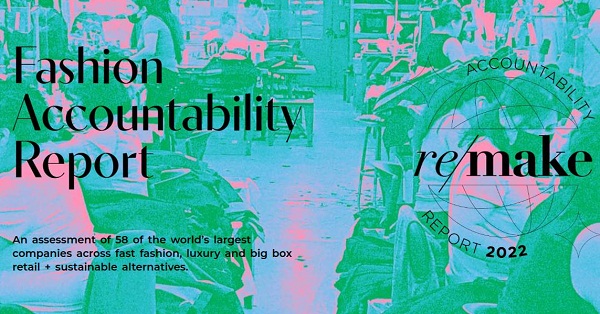
After the two years of the pandemic that turned the world upside down, Remake World – a global advocacy organization that fights for fair pay and climate justice in the $3 trillion clothing industry- is all out to revamp sustainability issues and repair and remake the future of fashion.
Remake World released its second annual 2022 Remake Fashion Accountability Report in early November, which assesses around 58 major fashion retailers, including new entries such as Chanel, J.Crew, and Allbirds among others. It has updated its evaluation framework and expanded the list of brands to go beyond transparency and to measure accountability levels instead of just looking at profits and progress figures among the big players in the fashion industry.
New sustainability fashion policies
One of the key positive 2022 trends in the apparel industry is that fashion policy has taken centre stage and moved into the mainstream while shaping global legislative agendas around the world. The hard-won recent passing of the Garment Worker Protection Act (SB62) in California in 2021 has tried to inspire a wave of proposed policies in the US and Europe that will protect labour and human rights in the poorer parts of the globe. To follow up further, in May 2022, The US Congress introduced a successor law to SB62 called the Fashioning Accountability and Building Real Institutional Change or FABRIC Act, which has strong provisions that both hold companies accountable for supply chain wages and incentivize investments in domestic manufacturing.
Climate criteria issues met only by few brands
In the wake of this, Remake’s 2022 Fashion Accountability Report's key finding is that global fashion companies are making bold promises on climate change policies but they are all half-hearted. Just about three companies comprising 5 per cent of the listed ones, Burberry, Everlane and H&M Group have managed to meet all four climate criteria levels of Remake. These four criteria include: disclosure of full emissions, short-term 1.5℃ pathway-aligned Science Based Targets, ambitious long-term net-zero targets and lastly, a bigger reduction in their total greenhouse gas.
Further breakdown of the report shows four companies or 7 per cent which include Hanesbrands, Patagonia, Ralph Lauren and Reformation have shown some progress towards a living wage in their supply chains in addition to disclosing the methodology they use to quantify a living wage.
Another five companies or 9 per cent which include Burberry, Kering (Gucci, Balenciaga), Marks & Spencer, PUMA and Reformation have shown partial information which points out that a few of their direct employees, such as corporate employees or retail workers were earning a living wage. “As companies reveal their full supply chain emissions, the scale of the problem is clear: Inditex (Zara’s) annual emissions are equivalent, for example, to consuming 39 million barrels of oil,” says the report.
The report states, a third of the assessed companies are reducing their packaging waste and 20 per cent now offer upcycling or repair services. Despite a rise in resale platforms and some repair initiatives, there has not been a transition away from linear production. We continue to see companies co-opting customer interest in circularity – like Shein’s new resale platforms – to greenwash.
This year has been a tug-of-war with two opposing forces making a mark in the fashion segment. There’s been a pull-back in status quo with Shein’s rise and Boohoo’s greenwashing move among others, at the same time, some better policy reform like the Fabric Act, regulatory backlash to greenwashing as well as a lot of global organizing between unions, civil society and citizens such as the Levi’s Accord campaign are happening. The industry remains in hope that 2023 will continue to see more industry support from big companies for worker-driven policies and binding agreements which will make the world a better place for everyone.
Indian cotton gains market share in Turkey’s textile sector
October 2022 saw a decline of cotton prices globally and Turkish cotton growers are feeling the pinch as they are struggling to control their production cost to meet worldwide prices. However, between January and October 2022, Turkiye has seen an overall growth in its textile exports, primarily led by Africa. Morocco has become the country with the highest increase in imports from Turkiye.
Overall as a group of countries, in terms of export Africa’s share was 11.6 per cent. The calculated increase stood at 14.9 per cent and was valued at $1.2 billion. Textile and clothing are key export products for Turkiye and its clothing industry has successfully created popular brands for the African and European markets with quality material and on trend designs. Today, many Turkish brands enjoy a good reputation in high street fashion across Europe.
The Istanbul Textile and Raw Materials Exporters’ Association (ITHIB) published an export sector report titled ‘Textile and Raw Materials Sector October 2022 Export Performance’ and stated the sector’s exports were up 4.8 per cent from January to October this year with a value of $10.9 billion. The data was comparative to the same period in 2021.
Exports to EU remain steady
The export growth figures for Turkish textile exports show despite price rises, the EU market bank on the Turkish brand equity of quality. It’s most important market Italy increased import by 8 per cent, valued at $996 million. Whilst valued at $832 million, the Germans imported 1.1 per cent less of Turkish textiles this year, attributed to the tightening of the fuel crisis in the country. Exports to the US in this period increased by 8.1 per cent and reached a value of $745 million contributing to a 6.8 per cent share of total textiles exported. Spain came in the fourth place with exports valued at $501 million, a 27.7 per cent increase. The only European country where Turkiye experienced a sharp 16.5 per cent decrease was the UK, valued at $418 million.
Turkish yarn exports decline 0.9 per cent
Overall, a key export component, Turkish yarn did not perform as well as textiles. Within the export product group yarn, cotton yarn came in as the second largest contributor with a share of 32.2 per cent, a decrease of 5.4 per cent and valued at $701 million. This may be attributed to the inability of local producers to drive cost-efficiency well enough to match the current low prices offered globally. In fact, Turkiye increased its import of cotton, cotton yarn and cotton textile by a whopping 51 per cent valued at $4.3 million. Top cotton trading partners of Turkey in 2021 were the US with a share of 15.2 per cent valued at $567 million, Brazil with a share of 13.6 per cent valued at $508 million and Uzbekistan with a share of 13.4 per cent valued at $497 million. China continues to be the single largest supplier of cotton yarn and garments to Turkiye, followed by India. Synthetic and artificial filament fibers were Turkiye’s largest exported items in this group with 35.7 per cent share, valued at $778 million.
Interestingly for India, the tag of Indian cotton has gained traction in Turkiye and the country nudged China out to become the second largest importer of Indian cotton, after Bangladesh.











