


FW
More and more China’s Dyeing & Printing companies face Red
Taken together, there are 768 companies running in red, accounting for 48.72 percent of all the dyeing and printing companies, considered in a statistical study, a large increase by 16.15 percentage points over the corresponding months last year. The total loss of money in these red bottom-line companies added up to 1086 million Yuan, up by 46.41 percent.
From January to February, the beginning of the year 2020, production of dyed and printed fabrics was reported to have touched 4913 million meters, a two-digit reduction by 22.42 percent, and further drop by 29.88 percent for sales income that totaled 24.706 billion Yuan from 1560 dyeing and printing companies, in the size of the companies considered above a designated size. Much more jaw-dropping is the fact that profits had a freefall by 101.8 percent while the export were down by 23.9 percent as opposed to the same period in 2019.
Normally, the swim or sink of a corporate profit rests with many factors, but financial cost, management cost, and the sales cost are the big three cost factors critical for any company’s bottom line that appears in red or in black. These big three cost factors take up a lion-share of an average of 85.64 percent of the business income in dyeing and printing industry. In the dyeing and printing sector, these big three costs, increased by 9.39 percent in the first two months of 2020, whereas, sector wise the increase for cotton fabrics was by 8.87 percent, and for fabrics made from man-made fiber, it was 14.08 percent.
Taken together, there are 768 companies running in red, accounting for 48.72 percent of all the dyeing and printing companies, considered in a statistical study, a large increase by 16.15 percentage points over the corresponding months last year. The total loss of money in these red bottom-line companies added up to 1086 million Yuan, up by 46.41 percent.
 |
| Dye & Print Fashion amid Pandemic |
China Dyeing and Printing Association (CDPA) issued its annual report in late March 2020 for the economic performance in dyeing and printing sector (Annual Report 2019), stating that the twelve months 2019 witnessed 0.83 percent increase in business sales income totaling 283.153 billion Yuan, a drop by 2.15 percentage points, and the profit increased by 6.49 percent, but growth rate had a considerable downslide by 11.44 percentage as compared with 2018 due to the increase in the big three costs to amounting to 15.835 billion Yuan.
The number of companies running at a loss amounted to 309, representing 18.92 percent of the total companies included in the statistical study, up by 9.76 percent to increase by 21.24 percentage points higher over 2018. The year of 2019 saw an increase in international trade for $29.144 billion by 7.34 percent, resulting in trade surplus for $25.689 billion, up by 10.4 percent.
Speaking of the import, the eight big categories of dyeing and printing textiles, including the dyed and printed cotton or manmade fiber or their blended fabrics in different textures of weaves and knits, as per CDPA’s own standards for identifying the product lines in the sector, were registered for 878 million meters for $1727 million, 12.62 percent down in volume and 10.94 percent drop in value, about 1.97 dollar/meter on average, up by 1.92 percent.
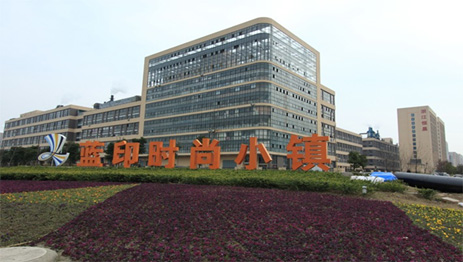 |
| Blue-print Fashion Town in Keqiao, Shaoxing city of Zhejiang Province |
The export of the eight big categories from January to December in 2019 amounted to 26.823 billion meters, and to 27.417 billion dollars, enjoyed an increase in volume by 12.83 percent and in value by 8.75 percent, but the average unit prices of sales decreased by 3.62 percent and decreased 1.02 dollar/meter in terms of weighted average.
In the report, CDPA predicts that the global pandemic impacts will slow down the world economic growth as it is the severest challenge since the financial crisis in 2008, and will weaken the support force to the market recovery. The dyeing and printing industry will bear even greater pressure in sustaining a continually smooth run and a more arduous task for reshaping the industry for better development.
And sure enough, if the opening two months of 2020 and pandemic thereafter is to be looked at, China’s Dyeing & Printing Industry is far away from being termed as a “good beginning” is “half done”.
Contributed by Mr. ZHAO Hong
He is working for CHINA TEXTILE magazine as Editor-in-Chief in addition to being involved in a plethora of activities for the textile industry. He has worked for the Engineering Institute of Ministry of Textile Industry, and for China National Textile Council and continues to serve the industry in the capacity of Deputy Director of China Textile International Exchange Centre, V. President of China Knitting Industry Association, V. President of China Textile Magazine and its Editor-in-Chief for the English Version, Deputy Director of News Centre of China National Textile and Apparel Council (CNTAC), Deputy Director of International Trade Office, CNTAC, Deputy Director of China Textile Economic Research Centre. He was also elected once ACT Chair of Private Sector Consulting Committee of International Textile and Clothing Bureau (ITCB)
Zegna Group shifts to manufacturing of medical suits
Ermenegildo Zegna Group, the Italian menswear label has reopened its facilities in both Italy and Switzerland to produce protective medical suits for hospital staff in the Piedmont region and Canton Ticino, with a production goal of 280,000 units. Zegna’s relief efforts are made possible by a partnership between the Zegna Group, Fondazione Zegna, the Piedmont region in Italy and Canton Ticino, Switzerland.
The medical suits produced are made from a non-woven fabric produced by Pratrivero Spa in Biella, Italy. The Zegna Group is proactively collaborating with the Piedmont Crisis Unit and Canton Ticino relevant authority to speed up the production process in an effort to meet the pressing need for vital medical supplies.
ZDHC launches dummies manual to detox the fashion
ZDHC Foundation has launched a dummies manual aimed at detoxing the fashion industry.
The manual focuses on educating the textile and apparel industry and consumers on chemicals used in the making of apparels and creating awareness about the harmful chemicals and keeping them away from the environment.
The manual offers various levels of understanding on the chemistry involved in the apparel manufacturing, while also educating industry on the use of these chemicals for creating a sustainable environment.
The manual aims to enlighten the apparel industry professionals on the adverse effects of manufacturing practices on the environment and people, while also sharing alternative and best practices to motivate them on the revolution.
Under Armour appoints Lisa Collier as CPO
Under Armour recently appointed Lisa Collier as its chief product officer. Until recently, Collier served as president and chief executive officer of NYDJ Apparel LLC. Her more-than-30-year career has also included time at Levi Strauss & Co., Sunrise Brands and Limited Brands.
Collier will begin her new role on April 27 and report to Patrik Frisk, Under Armour’s president and CEO. Collier will direct the Baltimore-headquartered company’s product and merchandising in addition to other responsibilities.
Under Armour, Inc. manufactures footwear, sports, and casual apparel.[Under Armour's global headquarters are located in Baltimore, Maryland with additional offices located in Amsterdam, Austin, Guangzhou, Hong Kong, Houston, Jakarta, London, Mexico City, Munich, New York City, Panama City, Paris, Pittsburgh, Portland, San Francisco, São Paulo, Santiago, Seoul, Shanghai and Toronto.
Euratex to develop recovery strategy for the textile and apparel industry
The European textiles and clothing sector needs urgent support, if it wants to remain a strategic pillar of the European economy. Euratex President Alberto Paccanelli held a constructive dialogue with Commissioner Breton to develop quick and effective solutions.
According to a recent survey among European textile and clothing companies, short term prospects for the industry are dramatic: 60 per cent of companies expect sales to drop by half 70 per cent of companies has serious financial constraints and 80% of the sample has reduced workforce, using temporary unemployment schemes where available. Production companies report problems in their supply chains, whereas retailers face the problem of a “lost Summer season”. 1 out of 4 companies is considering to close down.
These dramatic figures were presented recently by Euratex President Alberto Paccanelli in a videoconference with Commissioner Breton and other key actors of the industry.
Despite this unprecedented situation, the European textile and clothing industry responded immediately to the situation provoked by COVID-19. Over 500 companies reconverted part of their sites or invested in new machineries, to produce protective masks and garments. They are showing great sense of solidarity and want to overcome the crisis.
To safeguard the industry, short term measures are needed, such as accessing liquidity, re-opening shops as quickly as feasible (to create demand), guaranteeing a smooth functioning of the internal market and avoiding any disruption in export markets. The Commission should also refrain from adding any regulatory burden in these difficult times.
In the longer run, a strategic plan needs to support the relaunch of our industry and enhance the global competitiveness. Critical supply chains should be brought back to Europe, and we need to ensure a level playing field on the global market and, especially, on imported goods. Innovation, digitalisation and green economy remain a target for the industry, but they need to be reviewed in light of a relaunch programme for the sector.
COVID-19: Pakistan to export textile masks and sanitizers
Pakistan’s federal government has decided to lift the ban on the export of textile masks and sanitizers. This is a reflection of Pakistan’s successful policy to contain COVID-19 in a situation when the developed countries have succumbed to it. But will the government be able to satisfy the Supreme Court of Pakistan about its successful policy?
This was decided in a meeting of the National Command and Opera¬tion Centre (NCOC), working under the Nati¬onal Coordination Committee. He stated the decision will help boost the country’s exports by meeting the demand for these products within the international market.
The export of all types of surgical masks and sanitizers was banned at the start of the coronavirus outbreak in the country. Though there was no export ban on washable cloth masks, mainly used as anti-dusk pollution masks, but customs authorities were not allowing such exports.
The adviser said that the commerce ministry will issue further clarification with reference to the export of the products. He reiterated that surgical masks and N-95 masks which are in short supply within the local market, will not be exported.
It is worth noting that Pakistan Young Pharmacist Association (PYPA) has recently submitted an application to Federal Investigation Agency (FIA) in which they alleged that 20 million face masks were smuggled out of Pakistan in connivance with government officials.
Nasa Garment exports its products to Canada
Nasa Garment Plc has become the first Ethiopian company from the Hawassa Industrial Park (HIP) to export its products to Canada.
Founded in 2019, the firm on April 8 exported to Canada a container with 21,000 units of apparel, including shirts, trousers, active wear and sweaters. Canada offers duty-free privileges to the East African country’s products.
The company is owned by Saron and Goitom Afework and can make 30,000 pieces of clothing a day with its 30 production lines. It employs 340 workers and it is expected to hire 2,100 more when it becomes fully operational. Nasa started production in January 2020 and will ship products to Canada every week, according to Ethiopian media reports.
The company plans to earn $1.5 million from exports this year and expects to earn $7 million dollars next year.
During the past eight months of this fiscal, the country’s textile and garment industry generated $129 million from exports, a 32 per cent increase over the same period last year. The volume also registered a 4,100 tonne increase from the preceding year.
Lululemon CFO Patrick Guido resigns
Canadian athleisurewear maker Lululemon Athletica is the latest to announce the exit of its CFO, after a string of company’s announcement of the resignation of top-level executives.
Patrick Guido, who joined the company in 2018, after seven successful years at VF Corp, will be taking his leave on 8 May to pursue interests outside the apparel industry.
The role will now be fulfilled by senior Vice President Meghan Frank and Controller Alex Grieve who will jointly oversee the workings of the finance team till a suitable successor is found.
Lululemon had earlier announced that the executive-level management will be taking a pay cut of 20 per cent during this crisis as the company’s stores in Australia, New Zealand, Malaysia and all of Europe remain shut due to lockdowns.
Kingpins cancels New York edition
Originally scheduled to take place June 02–03 in Manhattan, the New York edition of Kingpins, the trade event for denim enthusiasts, has been canceled. This follows the cancellations of its April 22–23 edition in Amsterdam and May 13–14 show in Hong Kong, the Andrew Olah–founded brand announced recently.
To sate the appetite for professionals in the denim space to reconnect, Kingpins announced on March 24 that a new show format would take place as a virtual edition. Named Kingpins24, the event will allow the denim industry to share new ideas, plans for the future and solutions for the industry in anticipation of life after COVID-19. Kingpins24 takes place April 22–23.
In addition to this fresh trade-show concept, Kingpins announced in an April 10 email that it had launched a new Kingpins Shop, an online retail store that offers books, art, apparel and accessories, home goods, vintage pieces, lifestyle goods, and kits to embark on do-it-yourself projects at home.
COVID-19 to drive demand for activewear
In a recent webinar, Fashion Snoops stated that climate change, coupled with the uncertainty of the coronavirus, is leading the active wear category down a design path based on utility and preparedness. Over the next 18 months, consumers in crisis mode will likely drive up the demand for active wear that provides adaptability, utilitarian practicality and protection, the trend forecasting firm reports.
There’s been an uptick in designs that aim to protect the wearer for some time, said Taylor San Nicolas, Fashion Snoops active wear editor.
From material innovation to construction design, Fashion Snoops says designers will reconsider activewear garments for extreme adventure and resiliency.
Here, fabrics will help bridge science and fashion. Materials and hardware are based on preparedness and protection. Reinforced mesh that doubles as a pollution filter, canvas with high tensile strength and thermal fabrics that would otherwise be reserved for first responder are being adapted for commercial use.
There’s also a focus on how technical finishes can augment materials to be more protective, durable and functional—be it enhanced gripping or more tactile or visible.
Key design concepts include outdoor staples with rugged qualities, apparel with “on-the-go” power supply for electronics and designs that include face protection.











