


FW
Gujarat Industrial Policy 2020 to provide 40,000 subsidies
The Gujarat Industrial Policy 2020 aims to provide nearly Rs 40,000 crore as subsidies to industries in the next five years. It will help lease out government land to industrialists, and offer incentives to private industrial parks and units aspiring to relocate because of the pandemic, especially from China.
The new policy provides for appointment of dedicated ‘relationship managers’ by the Industrial Extension Bureau (iNDEXTb) that hosts the summit. These managers are meant to be the single point of contacts for investors.
It also provides an average annual outlay of Rs 8,000 crore, meant to provide incentives to industries. It will provide support by up to 65 per cent of the cost of acquiring foreign patented technologies by micro, small and medium enterprises (MSMEs). However, the maximum support will be up to Rs 50 lakh.
For start-ups, the new policy increases the seed support from Rs 20 lakh to Rs 30 lakh. It also provides increased sustenance allowance and additional fiscal support. The policy also provides incentives to private developers for setting up private industrial parks in the state. The incentive will be 25 per cent of fixed capital investment up to Rs 30 crore. In case of tribal talukas, the policy will support setting up of industrial parks at 50 per cent of fixed capital investment up to Rs 30 crore.
Global apparel chains need to dive deeper to rebalance operations
 Dealing with the big blow of the COVIF-19 pandemic, global apparel chain has learnt a tough lesson and is diving deeper to rebalance operations, says a McKinsey & Company report. Though the global manufacturing sector is slowly adopting cutting-edge digital technologies, natural disasters, cyber attacks and geopolitical instability are threatening to destabilize businesses every 3.7 years on average.
Particularly vulnerable to these tragedies is the apparel sector which has been exposed to pandemics, heat stress and flood risk. The McKinsey report says, practices such as just-in-time production, sourcing from a single supplier and relying on customized inputs with few substitutes amplify the disruption of externals shocks and lengthen companies’ recovery times.
A roadmap to future
Lower-margin businesses are particularly vulnerable to this and lose about 40 per cent of years’ profits on average every decade, says Edward Barriball,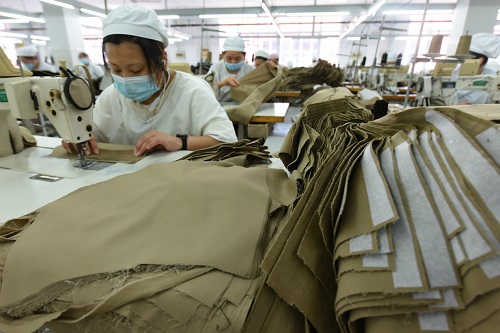 Co-author of the McKinsey report. Even investments made over this period could be wiped out due to such events. However, the biggest risk for apparel and textile companies would be to get back to business. For this, they should lay an operational roadmap for the next five years.
Companies can also strengthen their risk-management capabilities, build supplier and transportation network and strengthen their inventories. They can simplify their product makeup, create flexible production processes and bolster their bottom-line financial and operational capacity to quickly respond and react to supply-chain shocks. Barriball also advises companies to consider dual sourcing of raw materials and expanding supplier base.
Barriball feels, COVID-19 is also encouraging nearshoring amongst some companies and the fashion sector could benefit from this trend. For exploring the benefits of nearshoring, fashion companies need to make sufficient investments in the management of digital supply chains.
Companies need to engage in realistic scenario planning and take into account a variety of variables. They need to think about using the moment to break away from old way of doing business. And work with data they already have that’s probably buried in places that’s not readily accessible.
China’s growth slides, Vietnam’s share risesa
The McKinsey report indicates, China accounts for 29 per cent of the apparel sold globally. The country plans to modernize its manufacturing capabilities to move into higher-value production. In 2005, China exported 71 per cent of the finished apparel goods while by 2018 this share declined to 29 per cent. This was owing to the fact that technological advances in apparel manufacturing opened doors for global production in higher-wage countries.
China also posted the slowest rate of growth among all emerging countries from 2014 to 2019. The country’s growth slid using a baseline of 100 per cent in 2014 for all emerging countries having apparel and textiles production, McKinsey’s data showed that China’s growth slid from 100 percent in 2014 to up 88 percent in 2017 and then down further to about 75 percent in 2018 before rising slightly to 78 percent last year.
Amongst other emerging markets that captured the apparel and textiles market share include Vietnam, which registered $72 billion in exports in 2019, followed by Italy at $63 billion, Germany at $48 billion, Bangladesh at $44 billion, India at $39 billion, Turkey at $28 billion, the Netherlands at $26 billion, and Spain at $24 billion. Indonesia at $17 billion, Poland at $14 billion, Cambodia at $11 billion, Thailand at $8 billion and Mexico at $7 billion rounded out the list
Cambodia had the highest growth rate from 2014 to 2019, up 192 percent in the period. The share of Vietnam increased by 188 percent while that of Bangladesh increased to 160 percent, of Poland grew by 148 percent over the period. Ethiopia and Myanmar were cited as potential growth areas as well as regions where companies could diversify their sourcing away from China.
EU reimposes customs duty on Cambodian exports
The European Union has begun to reimpose customs duty on certain exports from Cambodia in response to what it said are concerns about the Southeast Asian country’s human rights record.
The European Commission, which supervises trade deals and relations on behalf of the 27 member nations of the world’s biggest trading bloc, said the duties would be put on clothes, footwear and travel goods.
Cambodian government spokesman Phay Siphan said the country would not compromise on matters of national principle to avoid the EU measures.
He said the government had prepared for the loss of 20 percent of its EU tariff privileges through measures to help garment factory workers and others who would be affected.
The commission announced in February that it planned to withdraw key tariff preferences amounting to about one-fifth of the 1 billion euros ($1.2 billion) worth of Cambodian exports that go to the EU each year due to “serious and systematic concerns related to human rights.”
Trade Commissioner Phil Hogan said the EU gave Cambodia opportunities to develop its export industry and create jobs, and that the bloc would continue to provide help to combat the impact of the coronavirus in the country.
Cotton production estimate for 2020 raised by 3%: USDA
According to the August 2020 World Agricultural Supply and Demand Estimates (WASDE) report by USDA, cotton production for the 2020 crop estimate has been raised 3 per cent to 18.1 million bales on NASS’s first survey-based production forecast.
The survey indicates lower harvested area and higher yield compared with last month’s expectations. Abandonment is expected to rise to 24 per cent, compared with 16 per cent in 2019. With reduced harvested area in the Southwest, US yield is projected at a record 938 pounds/acre – 14 per cent higher than in 2019.
Beginning stocks are raised 100,000 bales, as lower than expected 2019/20 U.S. mill use offsets an upward revision in exports. Expected 2020/21 mill use is reduced 100,000 bales, while ending stocks are 800,000 bales higher. The season-average price for upland cotton is forecast at 59 cents per pound – unchanged from the previous month.
This month’s 2020/21 world cotton outlook includes higher production and ending stocks, but lower beginning stocks, consumption and trade.
World production is 1.3 million bales higher, as lower production in Mali and Greece is more than offset by increases for India, the United States and Australia. Expected 2020/21 world consumption is 1.2 million bales lower this month, with declines in India, China, Pakistan, Brazil and Indonesia offsetting gains for Bangladesh and Turkey. Imports are projected lower in Pakistan, Indonesia and India, and higher in Bangladesh, Turkey and Malaysia.
This month, 2020/21 world ending stocks are projected 2.1 million bales higher than the previous month and 4.4 million bales higher than in 2019/20.
India faces rough weather due to UK recession
India may have to face rough weather from the economic crisis engulfing UK-one of its major trade partners. The United Kingdom reported a massive economic contraction, with the GDP shrinking 20.4 per cent in the first quarter of FY 2020-21. It is the worst quarterly slump on record for the UK, and the second one in a row, officially taking the country into recession. In the era of globalization, the UK’s recession may send rough winds towards India as well.
The UK is among the few countries with which India has a trade surplus and both nations share a trade relation of over $15 billion annually. The UK is a major market of India’s apparel, footwear, nuclear reactors, boilers, machinery, iron & steel, and pharma products, amongst others. Also, the share of India’s exports with Britain is nearly double the share of imports it has with the English nation. India exported goods worth $8.7 billion to the UK in the last fiscal, which was 2.7 per cent of India’s overall exports, according to the Department of Commerce.
UK and India called for deeper trading relations at the Cabinet-level summit held last month. Both nations agreed to explore opportunities for expanding and deepening bilateral trade relations including an enhanced trading partnership as the first step on a wider roadmap.
FBR can boost Pakistan’s textile exports: Clelia Rontoyanni
Addressing a consultative dialogue on textile sector’s competitiveness amid COVID-19,’ Clelia Rontoyanni, Program Lead Public Sector Specialist, World Bank said, the Federal Board of Revenue (FBR) has the potential to support exporters in these difficult times. Experts from public and private sectors, who participated in the dialogue, remarked that facilitation and appropriate taxation measures could play an instrumental role in enhancing the competitiveness of textile businesses and boosting exports.
According to Rontoyanni, tax authorities need to realize that two-thirds of imports are inputs for the manufacturing sector and therefore tariffs on inputs should be lowered. The World Bank official added that the tax system should be predictable and responsive to needs of the private sector.
Sharing his observations, Mohammad Raza Baqir, Former Member, FBR, said the textile sector was transitioning towards production of value-added goods. COVID-19 had adversely impacted the sector, hence, measures should be taken to facilitate it and overcome the unprecedented challenge, he said.
Another former member Raana Ahmed suggested that in view of COVID-19, the FBR could consider relaxing the burden of direct taxes on the textile sector. Dr Vaqar Ahmed, Joint Executive Director, Sustainable Development Policy Institute (SDPI) argued that the data regarding request for tax refunds should be made public and online as it would allow everyone to get a clear picture of the exporters’ refunds and in case there were delays.
Sweden’s TMAS members adopt new strategies to adjust to the new normal
Members of TMAS, the Swedish Textile Machinery Association have adopted a range of new strategies to assist manufacturers of textiles and apparel to adjust to a new normal, as Europe and other regions emerge cautiously from lockdown.
Amongst them are TMAS members of the ACG Group, who quickly established a dedicated new nonwovens fabric converting and single-use garment making-up plant to supply to the Swedish health authorities. From a standing start in March, this is now producing 1.8 million square meters of converted fabric and turning it into 692,000 finished medical garments each month.
Svegea, which has spent the past few months developing its new CR-210 fabric relaxation machine for knitted fabrics, has also successfully set up and installed a number of machines remotely, which the company has never attempted before.
Pär Hedman, Sales and Marketing Manager for IRO AB says, video conferences have taken a big leap forward, especially in development projects, and this method of communication is here to stay, but it will never completely replace personal meetings,”
Many garment factories now equipped with Eton Systems UPS work stations – designed to save considerable costs through automation.
Stores of large fashion brands in Manhattan remain closed
Many large brands, like Victoria’s Secret and the Gap, have kept their high-profile locations closed in Manhattan, while reopening in other states. For four months, the Victoria’s Secret flagship store at Herald Square in Manhattan has been closed and not paying its $937,000 monthly rent. JC Penney and Neiman Marcus, the anchor tenants at two of the largest malls in Manhattan, recently filed for bankruptcy and announced that they would shutter those locations.
Popular chains, like Shake Shack and Chipotle reported their stores in New York were performing worse than others elsewhere, investment analysts said. A few dozen subway locations have closed in New York City in recent months. Le Pain Quotidien has permanently closed several of its 27 stores in the city and plans to leave others closed until more people return to the streets, said Andrew Stern, co-chief executive of the chain’s parent, Aurify Brands.
A Gap store near Rockefeller Center has stayed closed and has not paid its $264,000 monthly rent. Two TGI Friday’s in prime locations, one near Rockefeller Center and another in Times Square, have remained closed while its restaurants elsewhere in the country have reopened.
New York’s stringent lockdown and methodical reopening may have brought the virus to heel, but it is also wreaking havoc on businesses with so few people going to work, virtually no visitors and many residents “a little loath to go out” and worried for their health. Landlords have started filing lawsuits against commercial tenants for not paying rent, accusing some national brands of trying to take advantage of the crisis.
Retail at Hudson Yards was off to a strong start before this crisis hit, and analyst firmly believe that fashion and retail will always remain core to the vibrancy of New York.
GADTS 2020 to focus on digital sourcing amidst COVID-19
To be held on September 23-24, 2020, the Global Apparel Digital Transformation Summit (GADTS) 2020 will focus on digital sourcing and digital supply chain innovation during COVID-19. Organized by ECV International, it will also discuss digital manufacturing transformation and advanced technologies innovation, impact of digitalization on the apparel industry amid COVID-19 and strengthening the implementation of digital strategy post-COVID.
Major international apparel brands, apparel manufacturers, excellent digital platform providers and technology innovators will share their insights and practices at this event and talk about the opportunities and challenges that brought by the digital wave.
Some topics to be discussed at this summit include: Current situation and the Prospect of Digital Transformation in Apparel Industry under the Impact of COVID-19 Pandemic; Trends and Prospects: The Development of Global Fashion Industry and Customer Insights in the Digital Age; The Power of Digital in Transforming and Revolutionizing the Apparel Sourcing and Supply Chain; In the Digital Age, Best Practice and Exploration of Digital Supply Chain of an Apparel Brand; Create an End-to-end Holistic Supply Chain, and Complete the Digital Transformation of Apparel Supply Chain; From Manufacturing-Driven to Data-Driven, How to Achieve Real Digital Production in Apparel Industry?; Fashion Supply Chain in the Future, How to Make Full Use of Digital Power to Improve the Performance of Apparel Supply Chain during COVID-19; A Digital Factory: How Technology is Transforming Apparel Manufacturing; etc.
Coats partners HeiQ for Viroblock technology
Coats, the world’s leading industrial thread company, has partnered HeiQ, a Swiss technology company, to incorporate its Viroblock technology into its engineered yarns. The Coats Innovation Hub – America in North Carolina, US, is adapting HeiQ Viroblock technology to create a new range of threads and engineered yarns suitable for application across a wide range of end-use products. Non-toxic and hypoallergenic, HeiQ Viroblock merges microsilver technology to attract virus particles which then combine with vesicle technology to break down the viral membrane within seconds. The microsilver technology uses recycled silver to enhance its sustainable offering, while the vesicle technology is bio-based.
The agreement also gives Coats exclusive global access to the technology for use in sewing threads. HeiQ Viroblock is among the first textile technologies in the world to be proven effective in laboratory testing against SARS-CoV-2, the virus from the coronavirus family that causes COVID-19.











