FW
Opinion divided on Lock Stock’s aim to revolutionize consumer buying behavior
 Earlier, Lost Stock, a UK scheme that repackages garments from cancelled western orders seemed to be a good idea to deal with unsold inventories. However, recently experts have been questioning the scheme’s efficacy as it not only burdens consumers with the responsibility of rescuing unemployed workers but also enables retailers to exploit contractual loopholes to deny payment, demand heavy discounts or compensation on completed and in-progress goods commissioned before the viral outbreak.
The scheme has proved more popular than was anticipated. However, not everyone is convinced about it. Mostafiz Uddin, Owner and Managing Director, Denim Expert, a jeans manufacturer in Chittagong, Bangladesh disapproves of the scheme fully. He feels factories are forced to sell surplus goods to Lost Stock because they have no other option. These goods are sold at highly discounted rates to get rid of the manufacturers’ huge bank liabilities. The payment received from their sale does not cover the total value including raw materials, worker wages, storage costs and bank interests.
The scheme negotiates a cash price with each factory in Bangladesh. This amount is further supported by financial assistance from the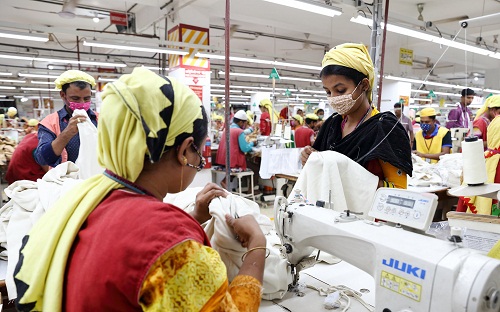 Sajida Foundation. When combined together, both these payments aim to exceed the originally agreed rates with retail brands.
No solution for core issues
Ayesha Barenblat, Founder and CEO, Remake believes, Lost Stock is an interim charitable act that doesn’t deal with the core issue of suppliers not being paid for their work. She believes the scheme offers a short-term hopeful solution of clearing up some of the inventory and getting immediate relief to workers. Though it allows consumers to feel good about their efforts for the garment workers, it does not shield them from unrelenting buyers.
The garments sold by Lost Stock are attached with the organization’s tag, which further obscures their origin and reason for being sold. Christie Miedema, a Clean Clothes Campaign advocate points out this conveys a wrong idea to brands that they can shop their way out of the crisis and responsibility for solving it lies with consumers. She affirms brands shouldn’t consider the work of garment workers as charity and pay them accordingly.
Aiming to change consumer behavior
Cally Russell, CEO of online retail platform Mallzee views Lost Stock as part of a broader movement that targets consumers from different backgrounds and different types of belief systems and approaches to action. She hopes in the long term, the scheme helps people deal with problems created by some of their previous choices.
Lost Stock recently launched a children’s version of its box. The scheme has even bigger ambitions for the future and plans to create something that would change the way people buy products. However, labor advocates, like WRC’s Nova, believe that the only way to protect the rights of the workers is to compel brands and retailers to fulfill their obligations.
Bangladesh’s export earnings increase by 44%: EPB
As per figures provided by the country’s Export Promotion Bureau (EPB), in July 2019, Bangladesh’s export earnings were $3.88 billion which in this July stood at $3.91 billion. The export earning this July is also around 44 per cent more than that of June.
Further, apparel export raked in $3.2 billion, which was 14.1 per cent more than the target set for July by the Commerce Ministry. However, it was less than the earnings of $3.3 billion registered in July last year.
Earnings from the knit items clocked a 4.30 per cent growth to touch $1.75 billion, but receipts from woven items suffered a decline of around 8.43 per cent to $1.49 billion during the month under review.
It may be mentioned here that export revenue in the apparel industry witnessed a year-on-year decline of 18.29 per cent in March, 82.85 per cent in April and 61.57 per cent in May, as economies the world over went under lockdowns in a bid to curb the spread of the coronavirus pandemic. However, as things started looking up a bit, restrictions were lifted and a state of normalcy returned to the global supply chain, when export earnings again picked up with receipts from apparel exports reaching US $ 2.71 billion in June, which was just 2.5 per cent less than what it was during the same period of the previous year.
Cotton demand in Pakistan rebounds after easing of lockdown
Cotton demand is fast rebounding after easing lockdown as textile companies are abuzz with reviving industrial activities to include Pakistan among the world’s top recipients of foreign orders post shutdown.
While textile and spinning mills keep purchasing cotton arrival remains slow due to rainfalls, sending prices up during the start of the week. Later on, however, prices decreased in the market as quality of lint dropped because of rain, traders said.
During the outgoing week, lint prices in Sindh remained at Rs8,200 to Rs8,300 per maund. In Punjab, the prices were in the range of Rs8,550 to Rs8,650, while price was between Rs8,350 to Rs8,375 per maund in Balochistan. Karachi Cotton Association’s spot rate committee increased the spot rate by Rs100 to Rs8,350 per maund.
In Pakistan, cotton production might fall in the country due to heavy rains in cotton growing areas of Sindh and Punjab, which might lead local mills to import more lint, said Ihsan ul Haq, chairman of Pakistan Cotton Ginners Association.
Cotton production in the Punjab, the biggest cotton producer, is estimated at around 7.5 million bales of cotton. Last year, cotton sowing in the country declined 18 percent in the country. In Punjab only, cotton sowing decreased 18.16 percent.
G-Star Raw goes into administration
Clothing brand G-Star Raw Australia went into administration in May as a result of the coronavirus crisis and the subsequent downturn in sales which was exacerbated by government-ordered lockdowns. About 200 Australian workers at the denim giant's 57 stores will now be out of a job.
G-star first launched in 1989 with raw denim jeans that have not been washed or treated. The brand has flagship stores across the world including in New York, Paris and London. Global superstars including Pharrell Williams and Jaden Smith have worked with the brand - which specializes in unwashed, untreated, raw denim as its base material.It follows dozens of Australian brand names entering administration since the start of 2020.
Even before the lockdown impact was felt, swimwear label Tiger Lilly, accessories retailer Collette, and stationery chain Kikki K were all placed into administration. Brands like Harris Scarfe, Bardot, Roger David, and Napoleon Perdis also collapsed last year - resulting in heavy job losses.
IAF, PRGMEA, underscores need for central task force
The International Apparel Federation (IAF) regional president and Pakistan Readymade Garments Manufacturers and Exporters Association (PRGMEA) chief coordinator Ijaz A Khokhar has underscored the need of establishing central, provincial and regional task forces to determine the issues confronted by the industry.
He said Pakistan could grab bigger share in the global market of value-added textile adding that without the due support of the government exporters were unable to grab the share of global market. The business community engaged with textile sector was making strenuous efforts for increasing the exports of the country despite heavy odds.
He suggested that government should exempt cotton yarn, dyes, chemicals from all types of taxes and duties for encouraging this value-added sector and apparel industry should be allowed to import fabric as the weaving industry was unable to fulfill growing demand of fashion wear.
Ijaz further told that currently garment sector having a limited product line for export market due to non-availability of the latest fabric at local level adding that foreign buyers demanding new garment based on G3, G4 and technical fabric material and under the circumstance there was a great need of product diversified to compete in international market.
For this purpose government should provide special funds for initiating research and development for each industrial sector to ensure product diversification and currently we need to offer more diversified producers, he added.
PRGMEA chief coordination reiterated that government should consider on the restoration of zero rated regime for five major export-oriented industries (sports, surgical, leather, carpet and textile) on the priority basis for the survival of exports of the country.
Ecommerce sites with active blogs record maximum traffic: Analysis
New analysis of 100 leading fashion e-commerce sites throughout lockdown has found that those with an active blog capitalized on the competition and made the most of the pandemic’s online shopping boom.
The research, conducted by digital marketing agency Impression, analyzed the top 100 leading fashion e-commerce websites, based on 26 factors including their domain rating (DR), number of top 10 organic Google rankings, average monthly traffic, and estimated traffic value to find the specific elements contributing to a fashion brand’s online presence.
Topping the study’s rankings was online US shoe retailer Zappos.com, closely followed by Gap.com and Nike.com, all performing well in the key areas.
The study found multiple factors that were pivotal to the success of Zappos.com in Google’s search rankings, including the amount of authoritative websites linking to the domain, the speed of the site and its accessibility for all visitors.
But, the factor to have the biggest impact on the success of all the top sites was an active blog or press page. An analysis of these 100 sites and 2,600 data points show that blogs had the biggest positive correlation with the amount of organic traffic to a site, which in turn means more potential customers. Those with an active blog page saw 277 per cent more traffic on average than those with an outdated blog page.
Vietnam surpasses Bangladesh in textile and clothing exports
Vietnam has surpassed Bangladesh in exporting textile and clothing products during the first six months of 2020. The country earned $13.18 billion in the January-June period by exporting textile and sewing products, according to the General Statistics Office of Vietnam.
Meanwhile, Bangladesh fetched $11.92 billion by exporting readymade garment products during the same period, data provided by Export Promotion Bureau of Bangladesh show. However, both countries have witnessed a decline in their export earnings.
Bangladesh’s apparel sector has saw a sharp decline during March, April and May as production and the supply chain were disrupted due to the lockdown enforced to stop the spread of coronavirus, said Mohammad Hatem, Vice President, BKMEA. Vietnam’s production was not disrupted much by the pandemic as the country did a better job of controlling the spread of the virus. Its ability to run factories amid the pandemic also helped in this regard.
Wildcraft to raise private equity to fund future expansion
Domestic outdoor adventure products maker Wildcraft is pursuing its journey of next phase of growth by raising capital from private equity investors in the next 12 to 24 months to fund its future expansion.
The company plans to shift to being an just an Indian-born firm to one completely relying on talent in India, with its manufacturing in India taking wings and possibly helping in a small way making an impact globally.
Moreover, it would also take the road less taken to reality by becoming the biggest lifestyle player in India this year, beating global majors like Nike, Adidas, Reebok and Puma and crossing the Rs 1,000 crore turnover mark.
In the wake of the pandemic, the company has also forayed into personal protective gear (PPG) category and launched its re-usable PPE coverall (Hz Series of Hazmats) and protective masks 'Supermask', deploying around one lakh workforce as it scales up manufacturing and distribution of these new products.
However, the bigger picture for the company is beyond these milestones and it wants to play its part in building a new self reliant-India in the post-COVID era.
Rent the Runway shuts all physical stores
The pandemic has prompted clothing subscription company Rent the Runway to shut all of stores for good. Rent the Runway made this decision in order to focus investments on digital segment and adding more drop boxes for customers. The company will turn its New York City flagship store into a permanent drop-off site, while stores in Chicago, Los Angeles, San Francisco and Washington, DC will be closed.
Rent the Runway plans to continue to grow its network of drop box locations. The company has partnered We Work, Nordstrom and West Elm so far. In March, it laid off all retail staff to reassess business model. Costs were cut by 51 per cent at the onset of the pandemic. And it rewrote the terms with its suppliers to pivot to a revenue-sharing consignment model, away from a wholesale model that required additional capital upfront, without a guaranteed payback.
Now a coalition to take on counterfeit goods retailed online
The Retail Industry Leaders Association (RILA) has formed a coalition to fight counterfeit goods on online platforms such as Amazon.com Inc. The coalition, called ‘The Buy Safe America Coalition’, will back legislation that would require digital marketplaces to verify information about third-party merchants on their platform, RILA said.
The lobbying push comes at a time when Amazon has been under scrutiny from lawmakers and the White House over sale of counterfeit items. In addition to RILA, the Toy Association, American Apparel & Footwear Association, the Fashion Jewelry and Accessories Trade Association and other industry groups are also joining the coalition.
RILA is the US trade association for leading retailers. The association partners with leading retailers to meet the challenges of a dynamic economy. Through collaboration and thought leadership, we advance ideas that foster free markets, competition, economic growth, and sustainability.