FW
Millennial to drive American retail recovery post lockdown
 The pandemic proved to be the final blow for the already-ailing apparel sector. Hit by declining sales, the sector saw shoppers buying apparels more through e-commerce and less through bricks-and-mortar stores. As a Coresight Research report suggests, 55 per cent shoppers avoided visiting malls in early September. However, US shoppers are gradually returning to stores. Till October 6 there was a 3.7 percentage point rise in the number of apparel store shoppers, says a Apparel Resources report.
However, this gain was offset by a 1.7 percentage-point decline in the number of people purchasing apparels through digital platforms during the same period. Coresight Research further estimates consumer spending on apparels, through bricks-and-mortar stores, e-commerce or any other platform, will slump 13.2 per cent this year. However, this year, shoppers plan to start their holiday shopping early. Though their total expenditure on apparels is expected to fall, there might be some improvement in the last quarter.
Enticing shoppers with holiday season sales
A survey conducted by First Insight in May indicated 54 per cent of American shoppers were keen to buy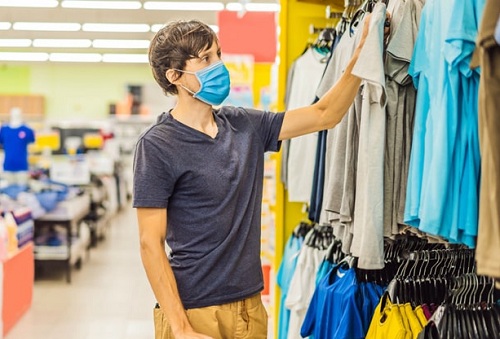 apparels from a store. The most enthusiastic shoppers were the millennials, 80 per cent of whom voted for restricting the number of people within stores while 79 per cent said wearing face masks would make them feel better and safe. Coresight Research survey confirms people’s willingness to shop for apparels, casualwear or apparels to be gifted.
To entice these shoppers, retailers are launching holiday shopping sales. Amazon launched its Prime Day sales this month while Walmart increased the inventory of athleisure, loungewear and sleepwear in October The retailer also recently launched a private clothing label ‘Free Assembly’ to catch the attention of shoppers. Similarly, Banana Republic announced a 50 per cent discount on most of its apparel products, while Old Navy launched the ‘Giftober’ scheme which offered 50 per cent discount on all its offerings.
Shopping expenditure to slump
As retailers continue to entice shoppers with new schemes, consumers’ response so far has been sluggish. As per a Deloitte survey, shoppers’ expenditure is expected to slump by 7 per cent Y-o-Y to $ 1,387 per household. Shoppers intend to visit just 5.2 retail stores on average during this holiday season. But as restrictions ease and offices reopen, there could be a surge in formalwear and partywear. A recent NPD survey shows, 27 per cent of men plan to dress more casually after the pandemic, compared to 16 per cent of women.
Shawn Grain Carter, Professor - Fashion Business Management, Fashion Institute of Technology and Tom Ott, Founder, Retail and Fashion Solutions believe though pent-up demand could increase clothing sales during the holidays, retailers and brands should focus on secondhand shoppers or those interested in renting their clothes. Ultimately, it is the consumer psyche that will determine the future course for the apparel market.
The Netherlands signs new denim agreement to strengthen circular economy
The Netherlands has taken a step forward in strengthening circular economy concept in denim industry.
Stientje Van Veldhoven, the country’s Minister for Environment and Housing, and State Secretary for Infrastructure and Water Management, recently signed an agreement with 30 companies in denim industry, committing more sustainable and eco-friendly environment.
In a letter submitted to the parliament, Van Veldhoven stated that the agreement emphasises on the use of more recycled materials in denim products.
She said that total emissions in the global textile industry are more than the collective emissions from maritime and aviation industry. It takes around 8 thousand litres of water to develop one pair of jeans and that needs to be reduced, drastically.
The new denim agreement will push brands such as MUD Jeans, Scotch & Soda and Kuyichi to jointly produce 3 million denim garments by using at least 20 per cent textiles that is recycled.
According to Van Veldhoven, the main strength of this denim deal is that it involves all major companies in supply chain who are hugely involved in manufacturing and processing of denim garments.
Penn Italia, Tessitura, ElasticiBesana launch new collection
Penn Textile Solutions/Penn Italia, internatiPonal company producing and developing innovative fabrics through warp and weft knitting technologies, Tessitura Colombo Antonio, famous for the processing of lace and ribbons dedicated to the world of corsetry, ElasticiBesana specialized in the production of narrow elastic for corsetry and underwear, have launched an innovative collection made with sustainable manufacturing process and a new set of incredible eco high tech innovations delivering a responsibility concept including also the end of life
Known as Eco connection, the collection, which underlines the importance of connect and come together for a sustainable project, features seven advanced knitted stretch fabrics by Penn Textile Solutions/Penn Italia, three precious laces by Tessitura Colombo Antonio and three functional bands by ElasticiBesana The collection is presented in its BIO -BOX that will be sent to selected brands at worldwide level.
More US fashion companies to use USMCA for apparel sourcing in 2020: Survey
According to a 2020 USFIA Fashion Industry Benchmarking study, more US fashion companies have agreed use the US-Mexico-Canada Trade Agreement (USMCA) for apparel sourcing purposes in 2020 than a year ago. For companies that were already using NAFTA for sourcing, 77.8 percent say they are ready to achieve any USMCA benefits immediately, up more than 31 percent from 2019.
Even for respondents who were not using NAFTA or sourcing from the region, about half of them this year say they may consider North American sourcing in the future and explore the USMCA benefits.
Nevertheless, when asked about the potential impact of USMCA on companies’ apparel sourcing practices, some respondents expressed concerns about the rules of origin changes. These worries seem to concentrate on denim products in particular.
It also remains to be seen whether USMCA will boost ‘Made in the USA’ fibers, yarns, and fabrics by limiting the use of non-USMCA textile inputs. For example, while the new agreement expands the Tariff Preference Level (TPL) for U.S. cotton/man-made fiber apparel exports to Canada (typically with a 100 percent utilization rate), these apparel products are NOT required to use U.S.-made yarns and fabrics.
Myanmar urges raw material producers to invest in garment factories
Myanmar is urging raw material producing factories such as buttons and thread manufacturers to invest in Myanmar, said U Aye Thaung, Chairperson, Shwe Lin Pan Industrial Zone.
Currently, garment manufacturing in Myanmar is carried out in a cut-make-pack style, where fabrics and accessories are imported and then cut, sewn and styled. The finished products are packed for exports to big fashion brands overseas.
Myanmar's garment exports have declined by more than $60 million in fiscal 2019-20 compared to the previous year and will continue to be under pressure in the current fiscal year, said U KhinMaungLwin, Assistant Secretary,Ministry of Commerce.
The sector first started facing difficulties when the supply of Chinese raw materials needed for garment manufacturing began to face disruptions. Meanwhile, order cancellations from major importers like Europe also affected production. That culminated in factory closures, job losses and declines in export revenue.
Around 70 percent of Myanmar-made garments are exported to Europe, while the remaining is sent to Japan, Korea, the US and China.
Since the pandemic started, operations at around 500 garment factories in Myanmar have been seriously affected. Meanwhile, those that reopened are only able to employ a third to half of their workforce due to COVID-19 risks and restrictions, said Thaung.
He added that most factories have not received any new orders in recent months and since the second wave of the virus started in Myanmar in September, the factories which have been permitted to reopen are working on older orders.
The factories that produce shoes and bags are facing the most difficulties, U Aye Thaung said. Things have deteriorated further since the recent lockdown in Yangon, under which all factories were instructed to close for two weeks. Many orders were forfeit during this period.
Mimaki showcases new textile printers at Innovate Textile & Apparel
Visitors browsing Mimaki Europe’s interactive virtual booth at Innovate Textile & Apparel Virtual Trade Show can see the best-selling dye-sublimation printer TS55-1800 and the new hybrid printer TX300P-1800 MkII in action. Both printers offer cost-effective innovative textile technology. Visitors will also be able to take advantage of some special promotions; including a special deal for the TS300P-1800 and a chance to win the Mimaki TS30-1300 entry-level sublimation printer. They will also be able to hold one-on-one discussions on the latest market trends and solutions to meet current demands.
Dye sublimation is a breakout technology in textile printing, allowing high quality, vivid prints on a multitude of fabrics, such as polyester or elastane, all on-demand. Mimaki’s TS55-1800 combines this ground-breaking technology with Mimaki’s renowned expertise and innovation. The printer offers industrial scale production and incorporates Mimaki’s core technologies; such as NCU (Nozzle Check System) and NRS (Nozzle Recovery System), nozzle control and restoration systems; that ensure automatic detection and replacement of clogged nozzles without interrupting production.
Additionally, MAPS (Mimaki Advanced Pass system), a system created to prevent banding; uses a special algorithm at each print pass and calculates the most effective way to jet the ink droplets according to colour, coverage and speed. Available with the Mini Jumbo Roll option that can help save up to 25% on paper costs and a 10L bulk ink system; the Mimaki TS55-1800 offers the lowest running cost in the market; and is the ideal production model for small- to medium-sized companies. At Innovate Textile & Apparel Trade Show, Mimaki will launch a special promotion for this printer, making it even more appealing to those companies looking to diversify their business during these challenging times.
Indonesia’s textile exports to Turkey decline
Indonesia is seeing a steep decline in textile exports to Turkey due to the additional duties and the coronavirus pandemic’s effect on global trade.
In the January–August period, Indonesian textile exports to Turkey declined by nearly 50 percent year-on-year (yoy) at $168.9 million, said MarthinKalit, secretary of the foreign trade director general at the Indonesian Trade Ministry
Indonesia’s overall textile exports reached only $7.03 billion over the same period, marking an annual decline of 19.92 percent.
The decline in Indonesia’s textile exports to Turkey come at a time when both countries are dealing with the COVID-19 pandemic. The World Trade Organization expects global trade to decline by between 13 and 32 percent this year as a result of the pandemic.
To keep its domestic industries afloat amid the economic downturn, Turkey introduced in April additional duties of 4 to 50 percent on textile products imported from countries with which it has no trade agreements. The duties are to remain in place until the end of the year.
Bangladesh apparel exporters seek government support amid second COVID-19 wave
Bangladesh’s apparel exporters fear a fresh setback due to the second wave of the coronavirus pandemic in the western countries and sought support from the government to face the imminent shock.
Exporters said that the export-oriented readymade garment industry was on a recovery track in the last two to three months with a compromised price level but the second wave would slow the export orders as the major markets in EU — France, Germany, Spain and Italy — were going for partial lockdown to contain further outbreak of the virus.
RubanaHuq, President, BGMEA, said that due to the second wave of the pandemic in the western countries, the volume might drop as well, buyers might hold back placing new orders — meaning factories might end up with idle capacity after they had already been in a weak financial position after sustaining price hits. This might give rise to a situation which would be extremely difficult for the industry to cope with, she added.
Due to the worldwide outbreak of the pandemic, the global fashion buyers and retailers started cancelling orders since March this year. Bangladesh faced halt or order cancelation worth more than $3 billion up to May and from June buyers started reviving their cancelled orders.
Country’s apparel exports was back on the positive track with the revived orders, but the second wave will bring further shock, said Mohammad Hatem, First Vice-President, BKMEA
MdFazlulHoque, Managing Director, Plummy Fashions said the country’s readymade garment exporters were running their units on loan and the government would have to continue support to the sector realizing the global situation. According to data from the Export Promotion Bureau, Bangladesh’s apparel exports in financial year 2019-20 declined by 18.12 per cent, or $6.18 billion, to $27.95 billion from $34.13 billion in FY19 as the coronavirus pandemic hit the global business hard
Amazon’s Diwali sales off to a good start
Amazon posted very strong sales during its Prime Day event held in the country in August and its ongoing Diwali sales were also off to a good start.
The US-based online retailer posted a 37 per cent YoY growth in international sales to $25.2 billion in the quarter ended September 30, while profits from the international segment shot up to $407 million.
In comparison, Amazon’s international sales in the third quarter of 2019 stood at $18.3 billion on a loss of $386 million. Olsavsky said high volumes and leverage in markets like the UK and Germany were creating profits in the international segment ahead of schedule.
He added that investment in its international business, including in India, should get back to previous levels once the pandemic subsides.
Its international business has turned profitable only after the Covid-19 pandemic, having made a rare operating profit of $345 million in the second quarter.
Overall, Amazon reported record sales in the three-month period, with revenue growing by 37 per cent to $96.2 billion and profit almost trebling to $6.3 billion, on strong sales, resurgence of digital advertising and robust performance of its cloud computing business, Amazon Web Services.
Indian Direct-to-consumer brands target $100 billion turnover by 2025
 Avendes Capital, the leading investment banking arm of financial services firm Avedus Group expects, COVID-19 related restrictions will prompt consumers to discover new Direct-to-Consumer (DTC) brands that may collectively achieve $100 billion turnover by 2025. In fact, over 600 DTC brands have entered Indian market since 2016. These include: Lenskart, Zivame, Boat, Wow Skin Sciences, Mamaearth, among others. The sector is likely to witness consolidation in the next three-to-four years with many large consumer goods companies buying D2C brands.
An equal mix of retail channels
Starved for variety, Indian consumers have largely turned to online shopping, says Pankaj Naik, Co-head, Digital and Technology Investment Banking Practice, Avendus Capital. He feels, horizontal and vertical e-commerce players, social media marketing, plug-and-play supply chain and logistics options have created a strong ecosystem for these brands. However, to add more customers, they would have to reach more households and provide an equal mix of online and offline retail channels.
Growing at 4 per cent annually, the Indian e-commerce market is expected to be worth over $200 billion and shift to organized retail in the next five years, says Avendus. The market is currently dominated by unorganized small players. With COVID-19 accelerating the adoption of online shopping, DTC brands in the beauty and personal care category are emerging strong contenders.
Another category where DTC brands can make their presence felt is the foods and beverages category. Leading DTC brands in these categories have witnessed over 100 per cent growth to pre-COVID levels. The pandemic has accelerated sales of DTC brands in India. It has strengthened their entire ecosystem from logistics to warehousing.
Limited scale and false targets pose challenges
However, despite their popularity, DTC brands also face certain challenges. One of them is their limited scale. Indian consumers still prefer offline shopping over online purchases. For such consumers, DTC brands should open physical stores, once they achieve a certain turnover, adds Sreedhar Prasad, Bengaluru-based independent internet business expert.
Moreover, they should target the right group of consumers. With some brands being into nutrition or healthy food products, they cannot depend on earlier target groups which classified consumers on the basis of their age or socio-economic category.