


FW
Bangladesh continues to lag in the high-end apparel production
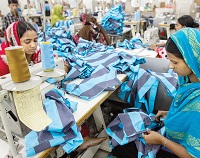 Despite majority of its garment factories complying with international quality standards, Bangladesh has not been able to secure orders for high value-added or high-end apparels. The country is still stuck with the production of basic fashion items. Its shift to high-end apparel production is happening slowly and on a small scale.
At the bottom of fashion pyramid
Average Bangladeshi apparel makers are still stuck with the bottom three producers in the country, says Fahim H Rahman, Former Executive Director, New Asia Group and Managing Partner of Noksha Capital. The country’s share in global high-end apparel production is as low as 20 per cent as high-end apparels are expensive due to the raw materials, fits, detailing etc, explains Rubana Huq, President, BGMEA. The share of high-priced apparel is still as low as 20 per cent. Bangladesh currently manufactures premium or upper-middle jackets, suits, denim, sweaters, etc for upper middle brands including: Burberry, Tommy Hilfiger, and Marks & Spencer, etc
One reason, Bangladesh has not been able to capture the high-end market is its factories have been manufacturing low-end or upper-middle garments for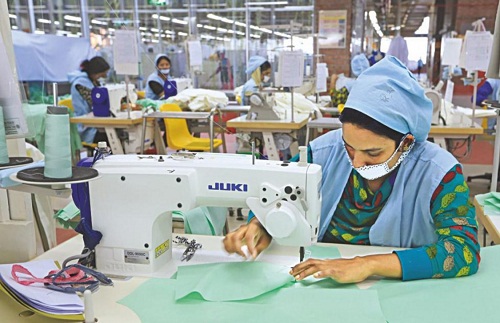 decades. They need to be trained to handle complex designs. For instance, Tarina Mannan, President, Sunman Group used to earlier make samples in New York and then get them tested for viability in China and Bangladesh.
New courses for design development
For almost 35 years, Bangladesh has been copying the samples of basic products from global counterparts. To produce high-end products, the country needs to develop its own designs. To achieve this, BGMEA offers various courses at the University of Fashion and Technology and a few private institutions. Yet, it still does not manufacture designer outfits at a significant level. Its value in the global market remains low as it still does business in the traditional method.
After Rana Plaza tragedy, Bangladesh factories not only increased their capacity but also became compliant with Accord and Alliance. COVID-19 impacted their market severely. From July 2019-June 2020, the country raked in $28.82 billion, according to the General Statistics Office of Vietnam and the Export Promotion Bureau (EPB) of Bangladesh. Lack of local raw materials
One major issue that Bangladeshi RMG makers face is the lack of local raw materials which prevent them from producing premium or high value-added products. Also, for basic products, Bangladesh usually gets a four-month lead time. But for premium products it gets a maximum 60 days and it takes 90 days to source yarn, fabric, and cotton.
Inefficient infrastructure
Another issue is traffic jams roads and the absence of five-star hotels near the airport. If buyers plan to visit two factories, they end up visiting only one due to severe traffic congestion. BMEA currently is in talks with the Institut Français de la Mode (IFM) in Paris and the Ministry of Commerce to address this issue. Together these companies plan to take up projects on developing fashion wear by using indigenous textile materials like Jamdani, Taant, etc.
USAID, IBPF sign new MoU to help female workers in US
The US Agency for International Development (USAID) deputy administrator Bonnie Glick announced a new memorandum of understanding (MoU) with a consortium of the US retail, apparel and footwear companies as well as industry associations in the US's third annual Indo-Pacific Business Forum (IBPF).
The MoU intends to pursue much-needed relief to the predominantly female workers in the US companies' supply chains in Bangladesh, Cambodia, Sri Lanka, and Vietnam.
The participating companies and industry associations are Carter's Inc, Gap, Global Brands Group, Levi Strauss and Company, Nike, Tapestry, Target, VF Corporation, Walmart, AAFA, the National Retail Federation, the Retail Industry Leaders Association, and the US Fashion Industry Association.
The MoU establishes an objective for the USAID and the consortium to work together over the coming year to alleviate hardships, faced by the AFFA sector workers in Bangladesh, Cambodia, Sri Lanka, and Vietnam. Such efforts, in collaboration with local partners, will aim to create a more resilient AFFA sector and workforce, enhance the rights and welfare of workers in the AFFA factories, and empower women in the AFFA workforce.
China stops cotton exports from Australia
All cotton exports by Australia to China have reportedly stopped following Beijing's ‘unofficial’ rebuff to the former’s cotton producers recently. Australia’s cotton industry is now preparing for a leaner situation ahead after officials confirmed Chinese mills had been ordered to halt Australian lint purchases due to ‘apparent changes to export conditions’.
As over three-fifths of Australian cotton crop is normally exported to China every year on an average, efforts are under way now to boost export ties with other Asian countries, where demand has risen steadily in recent years.
China, the world's largest importer of cotton, buys increasing volumes of US cotton as part of its Phase I trade commitment on agricultural imports with the United States.
Until recently, Chinese textile activity and demand for Australia's high grade lint was gaining momentum after the coronavirus lockdowns as China returned to near-normal economic conditions.
Next upgrades full-year profit guidance
British fashion retailer Next upgraded its full-year profit guidance for the third time in as many months after quarterly full-price sales rose by a better-than-expected 2.8 per cent, although it is cautious on Christmas trading.
The company raised its pretax profit guidance by €65 million to €365 million, though it expects fourth-quarter sales to be 8 per cent lower than a year ago due to the impact of the pandemic on the high street and pressures on online capacity. The best case scenario was for flat sales in the final quarter, with stock levels limiting any further upside.
Even after the upgrade, profit this year will be half the level of 2019-20. The retailer said the biggest risk was whether England, Scotland and Northern Ireland would follow the decision by Wales to shut non-essential retail shops as part of tougher, short-term lockdown measures. Online sale were strong in the quarter, showing a rise of 23.1 per cent.
ITA postpones inaugural outreach program
The International Textile Alliance (ITA) has postponed the dates of its inaugural dual-city outreach program, created to supplement its November Showtime event. Designed to connect more wholesale fabric, leather and trim suppliers with buyers who do not want to or cannot travel to North Carolina for its bi-annual fabric market, Showtime North will now run January, 26-27, 2021, at the MahWah, NJ Marriott Courtyard. It had been set for November 16-17, overlapping the High Point event.
During Showtime North, mills and converters will be seen by appointment for showings of new collections of textiles, leather and trim for the home furnishings sector – residential, hospitality and contract markets – just as at November’s traditional Showtime.
Through its partnership with the venue, the ITA has arranged for Showtime North to provide safe, personal and private environments in which fabric brands and buyers will be able to meet and show product. The association plans to support this expanded venue as a one-time supplement to its ongoing North Carolina shows and looks to make “even broader connections virtually,” according to an earlier release about the event.
Munich Fabric Start plan second edition of Fabric Days
The organizers of Munich Fabric Start Exhibitions GmBH are planning to organize the next round of the Fabric Days trade fairs for Spring/Summer 22 season. Their aim is to recognize View Premium Selection as a complimentary preview textile fair to the main trade fair that would follow six weeks later in Munich.
Over the past few days the situation has changed drastically. Current COVID-19 developments and the uncertainty of any changes are driving organizers further away from organizing View professionally just a few weeks time. Further measures such as extended travel restrictions are not foreseeable at this point in time.
Fabric Days has proven that a trade fair is possible despite the great challenges of a pandemic. However, against the background of the current development, organizers no longer consider a trade fair at the beginning of December as being justifiable or responsible.
Levi Strauss makes top level executive changes
To increase focus on the direct-to-consumer channels, Levi Strauss & Co. has announced several changes in its leadership. Chief marketing officer Jen Sev is now being promoted as brand President effective from November 30. In this new position, Sey will lead the Levi Strauss’s marketing, design, merchandizing and brand experience operations and bring them all in one place.
Levi Strauss has also decided to promote Liz O’Neill as the chief operations officer. She will oversee the ongoing rollout of the company’s F.L.X. technology, while driving digitization, sustainability and agility in its global supply chain. Similarly, Seth Ellison, previously executive vice president and president, Europe will be promoted to chief commercial officer (CCO), where he will lead the company’s global commercial operations.
Finally, Marc Rosen, Executive Vice President and President, Americas, will take on additional responsibility of the new Digital Enterprise Office. Earlier this month, Levi Strauss announced a surprise profit thanks to a surge in online sales. The company also benefited from important wholesale partnerships and the success of new product categories.
Polyprint SA showcases direct-to-garment products at Innovate Virtual Trade Show
Specialized direct-to-garment (DTG) printer manufacturer, Polyprint SA is showcasing latest products at Innovate Virtual Trade Show, on from October 15-30, 2020. As per Kohan Textile Journal, Polyprint will exhibit solutions including TexJet shortee2 and TexJet echo. However, the main attraction will be the new automatic pre-treatment machine-PreTreater Pro:
Launched in July 2020, PreTreater Pro is the key to top-quality prints, consistency in repeated jobs and improved washability, while saving on liquids. Its 41x60cm true spray area, precision spraying capabilities with ‘Linear’ & ‘Grid’ edit modes, accurate liquid quantity selection per ml, 4 large diameter flat nozzles for uniform spraying and an auto re-circulation system for liquid homogeneity will seamlessly prepare garments for amazing prints.
The tradeshow will enable attendees to interact with industry professionals through live chat, witness its latest technological breakthroughs at our booth and schedule video meetings to address their every question.
Through this event, organizers World Textile Information Network (WTiN) plan to reconnect its visitors and exhibitors to reconnect, without limitations.
Pitti Immagine urges government for practical and sustainable solutions
Raffaello Napoleone, CEO, Pitti Immagine has urged the Italian government to find sustainable and practical solutions for current problems by involving local entities and regions. He said cancellation of events reinforces the uncertain climate and risks stopping the preparation phase leaving little time for companies and buyers to plan and organize their travels and participation in trade shows.
Napolean said they have already taken necessary measures as per strictest security protocols requested by authorities. They plan to trace buyers’ path, their accesses to sites and plan pavilions and booths. They have also devised fittings in order to guarantee distancing. Pitti Immagine has also collaborated with Florence hotels and restaurants to guarantee the safest conditions as international trade shows aimed at economic insiders only are controlled and planned events with minimal accident rates. The collections that will be presented in these months will be sold starting from next fall.
LVMH seeks to reduce Tiffany’s deal price
LVMH has urged Tiffany’s to reduce its deal price to enable LVMH to buy the US jeweler. The original price for the deal was $135 per share, or about $16 billion in total. By taking control of Tiffany, LVMH would gain better access to the worldwide luxury jewelry market. Reduction in deal price would allow the companies to avoid a courtroom battle after the deal they struck a year ago turned sour amid COVID-19’s upheaval of global luxury spending.
LVMH had argued that Tiffany has botched its response to COVID-19 and this has created a material adverse effect that will allow it to invalidate the agreement. Tiffany had countered that its sales are improving and the deal should proceed as planned. The deal had been cleared by European Union antitrust officials earlier this week. However, LVMH applied for the regulatory review saying that it was unable to complete the transaction due to the French government’s request to delay it.
The Louis Vuitton owner said that its move to proceed with the EU filing for regulatory approval showed that it was acting in good faith, which Tiffany had earlier questioned.











