


FW
Top global brands looking for new sourcing hubs
Major clothing and shoe companies are moving production to countries closer to their US and European stores and away from manufacturing hubs in Asia like China or Vietnam. This is because of the massive shipping logjam that is driving up costs and forcing companies to rethink their globe-spanning supply chains. Spanish fashion retailer Mango has accelerated the process of increasing local production in countries such as Turkey, Morocco and Portugal. In 2019, the company largely sourced its products from China and Vietnam. Similarly, US shoe retailer Steve Madden has pulled back production in Vietnam and shifted 50 per cent of its footwear production to Brazil and Mexico from China. Clogs maker Crocs is moving production to countries including Indonesia and Bosnia.
Bulgaria, Ukraine, Romania, the Czech Republic, Morocco and Turkey are some of the countries drawing new interest from clothing and shoe producers. In Turkey, apparel exports are at an all-time high, driven by a spike in orders from the European Union. Guatemala’s clothing exports are up 34.2 per cent from 2020 and 8.8 per cent higher than in 2019.
However, China continues to produce a large share of apparels for US and European clothing chains. Many companies are still heavily reliant on Vietnam.
Adidas Q3 inventories down 22 per cent
German sportswear brand Adidas third quarter inventories decreased 22 per cent. Operating working capital decreased 17 per cent. Average operating working capital as a percentage of sales declined five percentage points to 20.1 per cent.
Revenues grew three per cent in the third quarter. At the same time, sales in Asia-Pacific declined eight per cent, reflecting the impact from the extensive lockdowns in the region. In Greater China, the geo-political situation, resurgence of Covid-related restrictions as well as natural disasters weighed on the company’s top-line performance and led to a revenue decline of 15 per cent. As a percentage of sales, operating overhead expenses decreased 27.2 per cent. In the first nine months of 2021, revenues grew 21 per cent.
Adidas performed well in an environment characterized by severe challenges on both the supply and demand sides. As a consequence of successful product launches it is experiencing strong topline momentum in all markets that operate without major disruption. In total, the challenging market environment in Greater China, extensive Covid-related lockdowns in Asia-Pacific as well as industry-wide supply chain disruptions reduced revenue growth. From a channel perspective, the company’s top-line development was driven by growth in its own direct-to-consumer channel.
Apparel hubs turn to sweatshops
Much of the clothes made today come from countries where workers’ rights are limited or nonexistent. The problems include: dangerous working conditions, 18 hour workdays, no breaks, less than living wages and more are rife. The apparel industry employs 60 million workers around the world, nearly 75 per cent of whom are women.
Human rights violations have increased in the past four years. Since the beginning of the pandemic, health crises, disasters, conflict and widespread human rights violations have increased, straining global supply chains. Over the past five years, issues such as child labor, forced labor, health and safety, and the exploitation of migrants in the workplace have worsened globally for the industry. Apparel manufacturing hubs such as Bangladesh, Vietnam, and Cambodia have all gone from high to extreme risk for modern slavery.
Agricultural workers are actually the lowest paid in the garment supply chain. While garment factory workers are paid around half the living wage, agricultural workers get paid even less in all the four countries. On an average, in Asia, garment workers get about one-third of the minimum living wage. But consumers, in general, are becoming more conscious about how and where their clothes are made. A growing trend for workers’ rights and sustainability seems to be having a knock-on effect for businesses.
Nearshoring gains in the US
For the nine month period US imports of blue jeans from the western hemisphere rose 43.46 per cent.
Imports from Mexico rose 46.53 per cent. The countries of the Central American Free Trade Agreement (CAFTA) combined for an increase in imports of 32.69 per cent. Among CAFTA countries, shipments from Nicaragua rose 34.57 per cent while imports from Guatemala were up 24.73 per cent. Imports from Colombia were up 25.52 per cent.
The western hemisphere supply chain for textiles and apparel is a core pillar of the partnership between the United States and the countries of the Dominican Republic-Central America-United States Free Trade Agreement. The CAFTA-DR rules of origin provide the certainty needed by industry to invest and expand operations in a way that promotes economic opportunity for both US workers and those in the region. The US textile industry has invested over $20 billion in the United States and billions more in the hemisphere over the past decade to grow economic opportunities in the US and in the region.
Meanwhile US imports of jeans from Bangladesh increased 31.4 per cent in the nine month period. Shipments from China rose 15.02 per cent. Imports from Pakistan were up 63.4 per cent.
Techtextil India 2021 makes a grand return post pandemic with hybrid exhibition
 Making a grand return post-pandemic, the upcoming edition of Techtextil India will be held in a hybrid format from November 25 to 27, 2021 at the Bombay Exhibition Centre in Goregaon, Mumbai. The event will attract all leading technical textile players from across application areas. Some top technical textile brands participants are: JB Ecotex, PARK Nonwoven, Loyal Textiles Lenzing, Mehala, Meera Industries, etc. The event will also host a few leading German brands in the German pavilion.
The juxtaposition of a physical exhibition and online business matchmaking platform will offer greater networking opportunities to visitors. The ‘MFI virtual app’ will host live knowledge sessions and product demonstrations for visitors unable to attend the event physically. The event will also offer visitors access to specific products like fibers, yarns, nonwovens, machinery, coated textiles. Visitors to the physical event will have to follow government-authorised safety protocols of ‘MFI SafeConnect’. These protocols will enable visitors to engage in secure face-to-face interactions with exhibitors and witness the latest technical textile technologies and innovations in-person.
Tie up with Tamil Nadu government
The nodal agency for investment promotion and facilitation for the Government of Tamil Nadu – Guidance has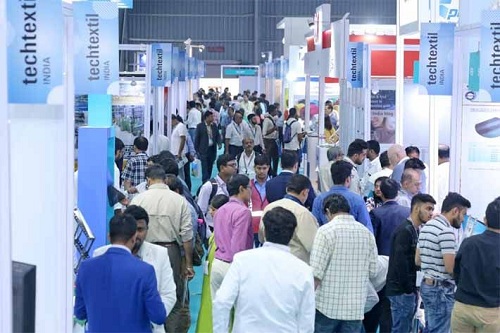 signed up for Techtextil India 2021 to reduce import dependency and bring investments in R&D, manufacturing, innovation by partnering with global technical textiles companies, says Pooja Kulkarni, IAS MD & CEO, Guidance Tamil Nadu.
International exhibitors
Techtexil India 2021 edition will feature an exclusive German Pavilion showcasing products and technologies from top German manufacturers, including Autefa Solution Germany GmbH, DILO Systems GmbH, Emtec Electronic GmbH, Georg Sahm GmbH & Co, Karl Mayer Verwaltungsgesellschaft mbH, Merz Maschinenfabrik GmbH and Oerlikon Barmag Zweigniederlassung der Oerlikon Textile GmbH & Co. the Indian representatives of brands from Austria, China, Italy, Spain, Taiwan, Turkey, the UK and the USA are also participating at the exhibition.
Product launches and live demos
New product launches and latest technological offerings from brands will be one of the major attractions at Techtexil India 2021. The physical exhibition format will showcase a series of key product launches from brands, including like Autefa Solutions, DiloGroup, Meera Industries, Sicam, Suntech Geotextile and Weavetech, etc, while the virtual exhibition format will feature live product demonstrations exclusive for the visitors tuned in live.
Raj Manek, Executive Director and Board Member, Messe Frankfurt Asia Holdings says, Techtexil India 2021 aims to provide a collaborative atmosphere that the industry needs to get back on its feet and look ahead towards the future. The return of face-to-face exhibition combined with the virtual model will open doors to excellent sourcing, collaborative and learning opportunities for professionals.
WGSN releases color forecast
Trend forecasting firm WGSN’s Fall/Winter 2023-2024 palette developed with color authority Coloro, colors reflect the different journeys consumers will encounter as they adjust their lifestyles and set new directions for the future. The colors have been chosen for their renewing and energizing qualities. The colors are described as motivational forces that will help consumers reconnect with qualities they might have lost sight of during the pandemic, like healing, discovery, transformation, simplicity and pleasure.
The gender-inclusive hue of Astro Dust is expected to update outerwear, knitwear and makeup. Glossy finishes, stained wood effects, anodized and leather applications will dial up the color’s richness and tactility. It also serves as a promising commercial and directional color for the interior category, suitable for large-scale furniture, carpets and bedding.
Galactic Cobalt, a new hyper-bright shade of blue, makes a natural choice for functional outerwear, consumer tech and virtual experiences. Galactic Cobalt’s richness, however, lends itself as a key jewel tone for occasion wear, accessories and cosmetics.
Sage Leaf is a quiet and settling green that instills a sense of contemplation, rest and reflection. The color will be important for reductive, considered design in the home as a color for walls and furniture. Apricot Crush, a mid-tone orange, is a natural companion to neutral colorways in bath and bedroom products while its gender-inclusiveness is fit for loungewear, active wear and outerwear.
Transporters strike in Bangladesh hampers RMG exports
A strike in Bangladesh by truck and van owners has caused losses to RMG exporters. Many factories are facing a raw material crisis, while some are resorting to costly air freight for shipments to meet buyers’ deadlines. No exporter is able to shift goods to washing plants or embroidery units while at the same time factories are facing a shortage of accessories. BGMEA Vice-President Rakibul Alam Chowdhury feels exporters are worried about shipments as of raw material shortage has hampered production. Similarly, Mohamad Hatem, Executive President, Bangladesh Knitwear Manufacturers and Exporters Association (BKMEA) reported, at least three exporters have had to bring back their goods from Chattogram port to send by air.
Air freight accounts for 55 per cent of a product's export price. Following a hike in diesel and kerosene prices, transport owners and workers called for an indefinite nationwide strike, demanding either a rise in fares or a reversal of the hike. They have halted the transport of goods across the country until their demands are met.
Meanwhile export orders remained stuck at ports. Goods-laden containers are not leaving the ports. Most products are readymade garment exports. As many as 300 Indian trucks carrying goods remain stranded at Bhomra port in Satkhira following the truck crisis on Bangladesh’s side amid the nationwide transport strike. Because of the strike, importers are unable to unload imported goods from the Indian trucks.
Diesel launches program for resale of restored jeans
Denim brand Diesel has launched a resale program and so far collected and re-conditioned some 900 jeans. Upon collection, the pre-owned jeans are shipped to a facility, washed and treated with Polygiene’s ViralOff and OdorCrunch technology, a combined treatment featuring anti-microbial and odor-resistant properties that the denim brand began using during the Covid-19 pandemic. The treatment helps mitigate the need for water- and energy-intensive home washing, further lowering the jeans’ environmental impact. Each restored pair features a red logo stamped across the back of the garment to indicate its resale status. A rating system provides insight into the condition of the garment ranging from one, or slightly worn to three, or like new.
The buyback program began in Italy, with plans to expand to other countries. For spring/summer 2022, Diesel has launched an evergreen collection of genderless garments backed by responsible manufacturing methods, including fabrics made with low-impact components such as organic and recycled fibers and finishing treatments using water- and chemical-reducing techniques.
The secondhand market has been growing and shows no signs of slowing down. Brands such as Levi’s, Madewell and Guess have followed the movement, each recently launching its own take on a resale program.
Polyester imports irk Indian yarn makers
Polyester spun yarn manufacturers association NITMA India is protesting zero duty imports from Indonesia and Vietnam. On the other hand polyester staple fiber is not included in the free trade agreement and is cleared at the full duty rate of five per cent.
The domestic industry wants a level playing field. Domestic mills say that in the presence of this anomaly they have no chance of competing with imported goods. Imports have grown from 486 tons a month in 2015 to 5,109 tons a month in 2020-2021. Estimates are that the current market share of imports has reached 25 per cent of total domestic consumption. The domestic polyester spinning industry fears it will be wiped out very soon.
Industry representatives have suggested alternatively removal of basic customs duty on polyester staple fiber or its inclusion in the Asean FTA would also give a level playing field to the domestic industry. As both these options would take a long time to materialize, they feel that the anti-dumping duty be imposed till such time the FTA is modified to include polyester staple fiber or till such time that the basic customs duty on polyester staple fiber is removed. Since the rate of duty on input raw material and finished goods need to be the same, which is currently not the case, an early imposition of the anti-dumping duty is required.
Nike aims for total renewable energy by 2025
Nike plans to use 100 per cent renewable energy by 2025. Currently, Nike already uses 80 per cent renewable energy. Nike is looking to improve its sustainability credentials by focusing on materials. Almost 80 per cent of the brand’s carbon footprint comes from the sourcing materials and manufacturing. Nike is one of the largest users of recycled polyester in the world.
The company did its first recycled garment in 2006. But now recycled polyester alone reuses more than a billion plastic bottles a year. Space Hippie, a new shoe line Nike debuted last year, is made of 90 per cent recycled materials. Seventy per cent of all products made by Nike have at least some recycled material in them, but Nike wants to aim higher. Nike tracks the percentage of recycled material used in each product. Nike has an alternative to leather called Flyleather. Currently, Flyleather is made from 50 per cent recycled leather material.
While Nike’s commitment to 100 per cent renewable energy by 2025 applies only to own offices, stores and factories, encouraging manufacturing partners to make the switch to renewable energy will help bring down the company’s overall emissions. Nike has also been focused on using the weight it has in the manufacturing space to influence its partners.











