


FW
MSMEs revenues decline 27 per cent in FY21: SIDBI Survey
Around 67 per cent of MSMEs were compelled to shut operations in FY21 due to the pandemic, said Narayan Rane in a Lok Sabha session. This caused a 27 per cent decline in their revenue he added citing a SIDBI survey. Over 50 per cent of the respondent units witnessed a 25 per cent decline in their revenues in 2020-21, he added. The survey was initiated by the Ministry of MSME to gauge the impact of the pandemic on the country’s small businesses. It showed a decline in profitability of around 66 per cent of respondents.
Surveying 1,029 MSMEs across 20 states and two Union territories, the findings revealed that around 65 per cent MSMEs had availed the benefits under the Emergency Credit Line Guarantee Scheme (ECLGS). Further, around 36 per cent had also taken loans under the Credit Guarantee Fund Trust for Micro and Small Enterprises scheme (CGTMSE).
Rajiv Chawla, Chairman, IamSMEofIndia, said, SIDBI’s findings reflect the plight MSMEs faced during the last financial year. He urged the government to help entrepreneurs and micro firms struggling to sustain their operations. The MSME sector employs 40 per cent of the country's workforce, contributes 30 per cent of its GDP, and is responsible for 50 per cent of India’s exports, he added.
India: Bhilwara Technical Textiles Q3 net profit declines to Rs 4.0921 crore
In its third quarter ended December, 2021, Bhilwara Technical Textiles’ net Profit declined to Rs 4.0921 crore as against net profit of Rs 7.0321 crore posted during second quarter ended September 30, 2021. The company’s total income increased to Rs. 5.4338 crore during the third quarter ended December 31, 2021 as compared to Rs. 3.4157 crore during second quarter ended September 30, 2021.
On a year-on-year basis, Bhilwara Technical Textiles’ net proft declined to Rs 4.0921 crore for the period ended December 31, 2021 as against net profit of Rs 6.1762 crore for the period ended December 31, 2020. The company’s total income increased to Rs 5.4338 crore during the period ended December 31, 2021 as compared to Rs 3.2768 crore during the period ended December 31, 2020.
Withdraw 12% GST on textile, urges CAIT
Confederation of All India Traders (CAIT) has urged NirmalaSitaramanan, Union Finance Minister, to withdraw the proposed 12 per cent GST tax rate on textile which was suspended by the GST Council on December 31 last year for implementation till February.
BC Bhartia, National President, CAIT and Praveen Khandelwal, Secretary-General, said that the proposed hike should be withdrawn in the larger interest of consumers of the country.
According to the trade body, a hike will load an extra burden of a 7 per cent tax rate on general consumers and will also hit the traders by blocking their capital with the department in the shape of refunds.
There was no tax on textile and fabrics for a number of years. Bringing the textile Industry back under the tax net itself was a big blow to the entire textile industry, the trade body added.
Further, the goods which are lying in stock of the businessmen and sold on MRP the additional burden of 7 per cent will be on the businessmen, it said.
The trade body believes that an increase in tax rate will not only hamper the domestic trade it will affect the exports adversely. Already the textile industry is not at a competent status with Countries like Vietnam, Indonesia, Bangladesh and China.
Reduced COVID impact, industries’ reopening to boost textile demand in FY23: Ind-Ra
Textile demand is likely to get a boost in FY23 from the reduction in impact of COVID-19's third wave, as well as accelerated re-opening activities, says a report by India Ratings and Research (Ind-Ra).
According to the ratings agency, reduction in logistics issues for export demand will aid in keeping healthy demand.
Demand for all the textile sub-sectors in the domestic market continued to improve in from 2QFY22, after a slight dip in 1QFY22. This along with the supply chain issues has increased the realisations, the report adds.
Increased demand in 2HFY21 led to reduced opening stock for the new cotton season. The rise in prices of cotton has led spinners to accumulate the stock, it adds
Furthermore, it says, that demand for MMF (man-made fibre) has continued to increase, mainly due to the rise in cotton prices, leading to a shift of demand from cotton to MMF, to an extent.
In addition, the agency cites that textile exporters in the cotton yarn segment continued to witness an improvement during 7MFY22 with volumes exceeding 47 per cent YoY over FY21.
Ind-Ra expects export volumes to remain higher for FY22 over FY20 and FY21, on back of an increasing demand for Indian yarn. Fabric and apparel exports are also likely to sustain with the the opening up of economies and the adoption of 'China Plus One' strategy by importing countries, it adds.
Fashion companies aim for a strong growth platform in 2021: Report
As per Fashion’s Newest CEO-the annual report published by Nextail, in 2021, fashion companies chose to hire CEOs with deep sector knowledge and leadership experience, as they sought to create a strong platform for growth and digital transformation.
Published with a view to highlight the expectations for 2022, the report analyzes all the major hires in the sector. It highlights the broadly conservative choices businesses have made when changing leadership in 2021. Furthermore, the appointments have been predominantly male and have, in the majority of cases, operational experience, as opposed to design or marketing.
With lockdowns and restrictions still in place at the start of the year, and the effects of the pandemic being felt throughout, it seems fashion businesses have chosen the tried and tested executive. These seasoned executives can have an immediate impact as they can steady the business and reset the foundations. It is also worth noting that there were 20% fewer new CEOs appointed in 2021 versus 2020.
Over 90 per cent of the incoming CEOs had fashion sector experience and almost 75 per cent of them had C Suite experience. Of the reasons given for hiring a particular candidate the most cited option was to deliver digital transformation and growth.
The luxury market was particularly active in bringing in new CEOs, with an 80 per cent YoY growth in appointments and accounting for close to 20 per cent of the total.
GartexTexprocess India to make its Mumbai debut in May 2022
GartexTexprocess India and Denim Show will make its Mumbai debut from May 12 – 14,2022 at the Jio World Convention Centre.. Taking centre stage this year will be the show’s ‘Fabrics and Trims’ segment along with the co-located Screen Print India exhibition.
While the focus segments under GartexTexprocess India will draw attention to innovations in garmenting and apparel machinery, Screen Print India will track technological advances in digital textile and screen-printing technologies expanding the machinery showcase. As fashion evolves, the need for variety in every aspect of garmenting increases, and the ‘Fabrics & Trims Show’ is a much-needed platform for bringing different fabrics, trimmings, embellishments and accessories on one plate.
The denim industry in India has evolved significantly with ever changing fashion trends making its way into other utility-driven products. With strong support from the Denim Manufacturers Association, the platform will celebrate the coming together of India’s biggest brands and denim mills. Innovative, fashionable, sustainable will define the Denim Show as the industry will get together to showcase their prowess at the Mumbai launch.
Jointly organized by Messe Frankfurt Trade Fairs India and Mex Exhibitions, the platform will also host a series of insightful sessions on the latest developments in textile, garment machinery and screen printing with the objective to encourage investments, new market development and enable India to be a globally competitive textile manufacturing destination.
Primark launches new collection with high street food chain
Irish fashion retailer Primark has launched a 11-piece collection in collaboration with high street food chain Gregg.
As per a Textile Value Chain report, the apparel range will be be introduced on February 19 in 60 Primark stores.
The retailer also plans to open a pop-up boutique on Dean street in London’s Soho. Tim Kelly, Director, New Business Development, Primark, says, the company aims to give its customers incredible store experiences by offering them collections from their favorite brands.
The partnership will also see Greggs launch ‘Tasty by Greggs’, which will be its largest ever branch inside Primark’s Birmingham flagship.
Earlier this week, globally well-known fast-food brand Burger King (Spain) also teamed up with Pull & Bear clothing retail company Inditex fashion group to invest in fashion.
Primark generated £7.79 billion in 2019, and is known for kidswear, womenswear, menswear, homeware and footwear, amongst others.
Growth momentum of Bangladesh garment exports to India to continue: BGMEA
Bangladesh’s garment export to India will continue to grow, saysFaruque Hassan, president of the Bangladesh Garment Manufacturers and Exporters Association (BGMEA).
Bangladesh garment shipments increased by 58.07 per cent to $365.95 million in the July-December period of the current fiscal year from the $231.53 million recorded in the same period a year ago, according to data from the Export Promotion Bureau.
Of the total, knitwear exports surged by 66.46 per cent to $161.69 million in value. The shipments of woven garment surged 52 per cent to $204.26 million at the same time.
Exporters say the demand for Bangladeshi garment items is rising in India because of the expanding middle-income groups in the world's second-most population nation. Many prefer garment items produced in Bangladesh as they cannot afford expensive Indian high-end garment items.
MdShahidullahAzim, Managing Director, Rupa Knitwear, says a lot of Indian businessmen are placing a good number of orders in Bangladesh to re-export to other countries.
Sharif Zahir, Managing Director, Ananta Group, adds, his group sells $10 million worth of garment items, mainly denim, ladies underwear, woven shirts and knitwear items in India every year
Bangladesh denim exports to the US rise by 42.25% in 2021
Bangladesh has surpassed Mexico and China in denim apparels exports to the US. In 2021, it exported denim apparels worth $798.42 million worth to the US, noting 42.25 per cent Y-o-Y growth.
In 2021, US’ total denim apparel imports increased by 31.36 per cent to $3.68 billion in 2021. Bangladesh’s share increased to 21.70 per cent in 2021 from 15.65 per cent in 2019, despite US not being able to surpass its 2019 import values in denim apparel category.
As per Apparel Resources, Mexico shipped denim apparels worth $ 654.87 million to the US, increasing by around 39.60 per cent on yearly basis, while China slipped to 5th position in just two years and managed to clock $387.91 million from its denim apparel export to the US in 2021.
Despite short-term disruptions created by COVID-19 in Vietnam, the country clocked its 3-year highest export revenues in 2021 in the mentioned category as its shipment valued $402.29 million, as compared to $368.18 million in 2020 and $372.02 million in 2019.
Bangladesh regains global position as the second largest RMG exporter
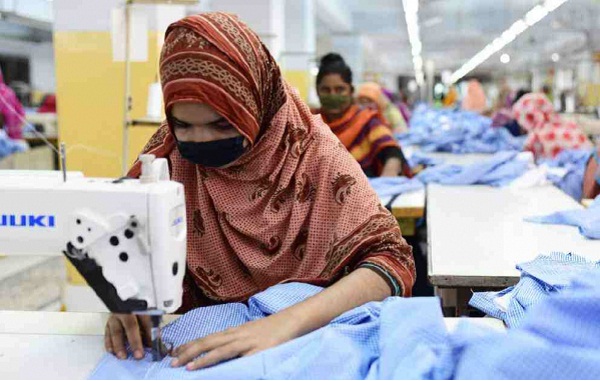
Bangladesh is back to being the world’s second-largest apparel exporter. Latest Export Promotion Bureau (EPB) statistics show, Bangladesh’s apparel exports surged 30.30 per cent to $23.99 billion from July to January 2021-22. Knitwear exports surged 32.89 per cent to $13.27 billion. On the other hand, export of woven garments surged 27.23 per cent to $10.71 billion.
In 2021, Bangladesh’s apparel export earnings grew 30.36 per cent to $35.81 billion. The country’s earnings from apparel exports surpassed Vietnam’s export earnings of $32.75 billion, reveals the General Statistics Office. The surge in apparel export earnings was dominated by knitwear exports that rose 37.72 per cent to $19.59 billion compared to $14.22 billion in the same period last year. During the year, Bangladesh’s exports of woven products also surged 22.46 per cent to $16.21 billion, says Faruque Hassan, President, BGMEA.
Lower prices, on-time delivery boost orders
In January 2021, Bangladesh’s apparel export earnings grew 42.71 per cent to $4.08 billion, says a Textile Today report. This was the highest ever single month apparel exports achieved by the country. Exports of both knitwear and woven garments grew 40 per cent year-over-year. Despite, pandemic related challenges, exporters showed tremendous resilience and efforts to boost business. One reason, Bangladesh managed to increase exports in 2021 was the ability of manufacturers to keep factories operational during the year. Also, exporters accepted orders at lower prices and shipped them on time, adds Hassan.
Exporters also upgraded their technology, production capacity and product quality, which helped gain more orders, Hassan explains. Their commitment to execute bulk orders encouraged many buyers to relocate purchases to Bangladesh.
Chinese investment crucial to sustain growth
Exporters currently have enough work orders to retain their second position in the global apparel market, adds Shahiduallah Azim, Vice-President, BGMEA. He hopes Bangladesh apparel industry reaches new heights in the next five years. However, to achieve this, Bangladesh needs to attract Chinese investment as well as buyers relocating their purchase destinations, he feels. They need to veer Chinese investors away from Vietnam and Myanmar.
Cautious planning, skill development needed
Azim believes, the recent leap in Bangladesh’s garment exports may not last and advises exporters to be cautious while planning capacity and expansion. Exporters should also make a qualitative shift in their business through diversification, innovation, design, technology up-gradation and capacity building.
They should encourage more skill development amongst workers and professionals and negotiate prices cautiously, he adds. Maintaining safety and sustainability will also help exporters maintain and improve current production standards, he sums up.











