


FW
IFAI includes UTIC and members into the association
Industrial Fabrics Association International (IFAI) has included Upholstery & Trim International Council (UTIC) and its members into the association. The association comprises manufacturers and distributors of fabrics and accessories for applications in the automotive, marine, industrial and contract markets.
According to Brian Joyner, Chairman, UTIC, the council aims to protect and advance the interests of businesses providing aftermarket products and services to all their markets. UTIC educates, informs, serves, and provides networking opportunities for companies that manufacture or distribute interior and exterior fabrics, associated hardware and other specialty products.
UTIC’s annual convention focuses on building relationships between the premier trim wholesalers and exhibitors in the auto industry. This year’s UTIC Convention is scheduled for November at the Westgate Las Vegas Resort and Casino.
Footwear excluded from 1,157 products in the India-UAE CEPA
Footwear has been excluded from the 1,157 products included in the India-UAE Comprehensive Economic Partnership Agreement (CEPA), finalized on May 1.
According to FAQs prepared by the Commerce Ministry on the pact, the CEPA is likely to benefit about $26 billion worth of Indian products subjected to 5 per cent import duty by the United Arab Emirates.
The pact has also stringent product-specific rules of origin that reflect the requirement for substantial processing. The certificate of origin, a key document required to avail the duty benefits under the pact, will be issued by the UAE ministry of economy to prevent circumvention of the rules of origin criteria.
The agreement has built-in protection to ensure that no third country product enters Indian market through the UAE and benefit from concessional tariffs without being substantially transformed, the FAQ document added.
The agreement is operationalized and implemented through a joint committee, which would meet biennially to review the agreement to consider additional measures to further enhance the pact.
Denim, still a favorite amongst shoppers: True Fit
Denim is still a favorite amongst shoppers despite the recent rise in demand for loungewear, shows recent data by size and fit platform True FitThe data was culled from over 90 million active registered consumers while shopping across the platform’s network of retail partners between December 2020 and December 2021.
The survey report names, Bode quality, the omnichannel shopping experience launched by Old Navy in August 2021 as consumers’ favorite-fitting brand overall and consumers’ favorite-fitting brand in the U.S.
Bode quality provides consumers a more inclusive shopping experience online and in stores. The merchandising strategy is carried into Old Navy’s website, which has aimed for “less size segmentation to give fluid buying journeys to all shoppers, whichever size they wish to buy.”
True Fit stated that the retailer’s inclusive women’s size range (0-30 and XS-4X) arrives as demand for plus-size fashion rises in the U.S.
Old Navy’s new FitsYou 3-in-1 denim also addresses fit and size fluctuation, which has become a hotter topic as consumers order more online and update their closets to fit their post-pandemic bodies. The high-rise skinny jean is offered in sizes 0-00, 2-6, 8-12, 14-18, 20-24 and 26-30. Additional features include a contoured extra-high-rise waistband and “secret-smooth” front pockets that provide a slimming effect.
American Eagle, which did $2 billion in Q4 denim sales, ranked No. 3 in the U.S. Recent collections centered on loose fits, comfort stretch and authentic washes have drawn attention from older audiences outside of their comfort zone with a teen specialty retailer.
Adidas AG, Foot Locker expand partnership
Adidas AG and Foot Locker have expanded their partnership.
In a joint announcement released by the Herzogenaurach, Germany-based athletic brand and the U.S.-headquartered retail chain, the companies attributed product innovation, elevated experiences and deeper consumer connectivity as the impetus for the enhanced partnership. According to the new agreement betweenthe two companies Foot Locker will be the lead partner for Adidas in basketball. It will also include “hype launches” and the development of key franchises in women’s and children’s, as well as apparel among other initiatives.
Spanning all Foot Locker banners in North America as well as Europe, the Middle East and Africa and the Asia Pacific regions, the strategic partnership aims to reach more than $2 billion in retail sales by 2025, nearly tripling last year’s figures. This year, Adidas expects to generate up to €100 million, due to the new partnership.
Last year, the global market for athletic apparel generated about $193 billion in revenue. These revenues are expected to grow to $270 billion by 2028, according to Statista.
Kasper Rorsted, CEO, Adidas, says, the brand is strengthening the partnership as it continues to execute its ‘Own the Game’ strategy.” With 61,000 employees globally, Adidas generated €21.2 billion in sales last year.
Richard Johnson, Chairman and CEO, Foot Locker highlights, how the “close partnership” will result in the retailer bringing “consumers even more unique, pinnacle products from iconic brands,” while accelerating its push into apparel and attracting more customers.” With about 2,900 stores in 28 countries, Foot Locker Inc.’s portfolio includes Foot Locker, Kids Foot Locker, Champs Sports, Eastbay, Atmos, WSS and Sidestep.
Jerry Lorenzo, Founder and Designer, Fear of God will lead the Adidas basketball range at Foot Locker. Lifestyle and performance products will be in the mix including exclusive designs, as well as key Originals franchises like NMD, Superstar and Stan Smith. Foot Locker will also have an integral role in the launch of Adidas’ new sportswear product division that is geared more for lifestyle shoppers than hard-core athletic ones.
Bangladesh RMG exports to the US surge by 62.23% in Q1FY22
Bangladesh’s apparel exports to the US grew in terms of both value and volume during the first quarter of 2022.
Bangladesh’s RMG exports to the US surged by 62.23 per cent Y-o-Y to $2.47 billion during Q1FY’22, according to OTEXA, an affiliate of the US Department of Commerce.
The country's apparel exports also sustained a 50.12 per cent growth in terms of volume to 909.25 million square metres during January to March, up from 605.68 million square metres during the corresponding period of 2021.
Despite the COVID-19 pandemic, Bangladesh exports apparels worth $7.14 billion to the US in 2021, keeping the market as its single-largest destination without any duty preference.
The 2021 RMG exports also surpassed those of the pre-pandemic level in 2019, when Bangladesh earned $5.92 billion.
Biancallani launches two new textile finishing machines
Biancalani has launched two machines that offer solutions for difficulties faced during textile finishing process.
The first of these is the IDRA, a combined modular washing and milling machine. This textile finishing machine with independent channels is designed to independently wash and mill woollen fabrics of different compositions.
In the different IDRA channels it is possible to load fabrics of varying composition, width and weight because the parameters used in each individual channel do not influence those of the others.
The greatest innovation is that each channel is completely independent, so each will complete its pre-programmed cycle automatically, while the others will continue to operate until their own milling cycle reaches its conclusion, allowing the milling of woollen fabrics with different weights independently.
The other machinery is MILLA a combined washing and milling machine. Both machineries created by Biancalani Textile Machinery are milestones of woollen fabric manufacturing. In this short video we show and explain you how our combined washing and milling machine MILLA works.
IDRA and MILLA are equipped with an air-jet device – patented and constantly innovated by Biancalani – that ensures the absence of creases and permanent strains in the fabric. In addition to this, milling time has been significantly reduced with special attention to limit consumption and thus preserving the environment.
Furthermore, IDRA & MILLA can be used both for heavy fabrics and lightweight articles manufacturing, ensuring a deep milling action on the first and a safe one on delicate fabrics. Obviously, the milling step is at the core of wool manufacturing and thus of what we see in big brand stores. Nowadays, brands are attentive to details and their motto is “always demand the best and never settle for anything less.
ErmenegildoZegna’s Q1 FY22 revenues grow by 25.4%
The Q1 FY22 revenues of the Italian luxury group ErmenegildoZegna grew by 25.4 percent to €377.6 million.
Over the course of 2021, the ZegnaGroup achieved a number of milestones, says GildoZegna, Chairman and CEO. In December, the group listed on the New York Stock Exchange after a business combination with Investindustrial Acquisition Corp. and a rebranding of Zegna, which reworked the logo, dropping the first name of the founder, revisiting its store concept and communications.
Assuming no further deterioration or geographic extension of the war in Ukraine, a normalization of the COVID-19 pandemic in Greater China before the summer, and no other unforeseen events, the group confirmed its outlook for the year, expecting a growth in revenues in the low-teens and continued improvement to adjusted earnings before interest and taxes. This can be achieved building on the accelerated expansion achieved in 2021, when the group delivered an adjusted EBIT of 11.5 percent on revenues, exceeding its own guidance of around 10 percent.
In the first quarter, the revenues of the Zegnasegment grew b 27.1 percent Y-o-Y to €283.5 million with “robust performance” in all product lines.
The Thom Browne segment rose 22.3 percent Y-o-Y, with revenues totaling €98.1 million with consistent performance in both direct-to-consumer and wholesale channels.
Revenues of Zegna-branded products, which include apparel, bags, shoes and leather goods, as well as licensed goods and royalties, surged by 22.1 percent Y-o-Y to €224 million. The group attributed this gain in large part to the growth in luxury leisurewear and shoes, and a strong rebound of made-to-measure.
Revenues of the group’s textile business rose by 64.6 percent to€ 30.2 million.
Zegna also saw a 56.8 percent increase in revenues for the third-party brands, which reached 24.4 million euros, reflecting its strong supplies capability.
Rising cotton cost compel Indian fashion retailers to hike apparel prices

The uncontrolled rise in cotton prices for the last one year is compelling most fashion retailers like Shoppers Stop, Celio and Arvind Fashions to increase apparel prices. Despite efforts to be cost-efficient, retailers have not been able to absorb the entire surge in input costs, says Kulin Lalbhai, Director, Arvind Fashions and Executive Director, Arvind Limited. Menswear Celio has revealed plans to increase prices of upcoming winter collection. As per Satyen Momaya, CEO prices are expected to go up around 6 per cent.
Other apparel retailers too are following the same track of hiking prices by around 5-15 per cent. Departmental-store chain Shoppers Stop pushed up prices 10-12 per cent and plans further hike to control rising inputs costs, indicates Venu Nair, Managing Director and CEO.
Demand in value segment gets affected
Cotton forms 50 per cent of the materials used to make casual wear items like denim. Other clothing products such as T-shirts also contain 40-50 per cent cotton. A surge in cotton prices affects profit margins of all these products. And as Nair points out, even though the price hike has not affected demand for new apparels in India, demand in the value segment has declined.
Price rise fuelled by decline in end stocks
The rise in cotton prices, since the last one year is attributed to tight global supplies and increasing demand in international markets. The hike has been a cause of concern for most fashion retailers in India Reaching its peak, cotton futures price on the Intercontinental Exchange (ICE) has surpassed $1.5 per pound, reveals Crisil data. Average cotton prices in India have increased 45 per cent Y-o-Y to reach Rs 8,220 per quintal compared to Rs 5,728 per quintal last year. Pushan Sharma, Director, CRISIL Research opines, one of the main reasons for increase in cotton prices is the estimated decline in end stock at both global and national level.
As per United States Department of Agriculture (USDA) estimates, global end stocks will decline by around 7 per cent in 2021-22. The Cotton Corporation of India estimates, cotton end stock in India will fall 36 per cent to 45.46 lakh bales in 2021-22. In the 2021-22 season spanning October-September, international cotton prices increased 150 cents per pound as against 85 cents per pound in previous season. The increase is attributed to decline in output of key producers, including China and West Texas; supply-chain hurdles, restriction on China’s Xinjiang cotton by Western countries among others. v Sustained demand to boost prices further
Reopening of economies is sustaining cotton demand despite constrained supplies. This is adding more pressure on cotton prices that have been rising uncontrollably since the last year, affirms Rajani Sinha, Chief Economist, CareEdge. While Indian apparel makers continue to battle high cotton prices, exporters plan to boost global cotton supplies. This is likely to fuel further price rise of the commodity. To control the hike, government is toying with the idea of banning cotton exports temporarily.
Mumbai to host Gartex Texprocess 2022 from May 12 showcasing latest technologies
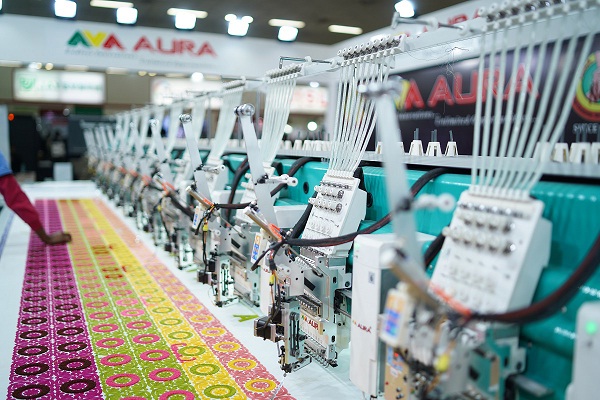
Upcoming Gartex Texprocess 2022 fair to be held from May 12-14, 2022 at the Jio World Convention Centre, Mumbai will highlight advanced and sustainable garment manufacturing technologies in India. The fair being jointly organized by Messe Frankfurt India and MEX Exhibitions will display innovative products showcased by 120 exhibitors. An exclusive one-day conference, Denim Talks will highlight latest digital manufacturing and bio dyeing techniques. Denim Show, Fabric & Trims Show and Screen Print India will be also be held simultaneously with Gartex Texprocess. Together, the three fairs will showcase innovations in textile and garment making machinery, denim, trimmings and screen-printing verticals.
Popular brands make a presence
The fair will be attended by popular brands including: Baba Textile Machinery (India), Balaji Sewing Machine, Cotton Council International, EH Turel & Company, Felix Schoeller, Gayatritex Engineers etc. Design studios, fashion designers and merchandisers, trade body representatives, distributors, machinery importers, wholesalers et al will also be there. The fairs are being supported by industry bodies including Apparel Export Promotion Council (AEPC), Retailers Association of India (RAI), Denim Manufacturers’ Association (DMA) and the Gujarat Garment Manufacturers’ Association (GGMA).
Vijoy Kumar Singh, Additional Secretary, Ministry of Textiles, Government of India points out, the textile industry is dependent on imported machines, the industry needs to step up manufacturing in the country. The Ministry of Textiles is formulating a scheme to incentivize textile machinery production in India. The scheme will not just incentivize local innovation but also encourage reputed international manufacturers to set up bases in the local market, he adds.
Machines on display
The fair will showcase some state-of-the-art machines for textile and garment industry including the Go Green machine by Ramsons. This machine is extremely efficient in achieving wet processing of garments in a sustainable manner. TS 1800 Digital Thread Dyeing System by Orange-O-Tec that dyes thread in millions of colors on demand with precision will also be on display. Textile manufacturer Mehala will showcase The Procut 1800, a highly precise automatic cutter for large quantities of apparel from Bullmer. Similarly, Bruce will display the R6000 digital feeding smart lockstitch machine.
Focus on sustainable denim trends
Denim Show 2022 being held simultaneously will showcase innovative, fashionable and sustainable denim trends. The show supported by Denim Manufacturers’ Association will reunite India’s biggest denim brands and mills under one platform. Hyosung India, Jindal Worldwide, Arvind, Ginni International, Raymond UCO Denim, Bhaskar Denim, LNJ Denim, Oswal Denims, KG Denim, Nandan Denim, and Ashima Group are lining up latest denim collections for the exhibition.
Scheduled on May 13, ‘Denim Talks’ series will discuss topics like flash dyeing of indigo, digital manufacturing and bio dyeing and sustainability initiative by Levi Strauss. This one day conference will highlight sustainability initiatives and innovations in denim manufacturing.
Making the right choice
Fabrics & Trims show will highlight the importance of selecting right fabric, styling, embellishments and manufacturing processes to create apparels of the future. It will feature fabrics, trimmings, embellishments and accessories.
Innovations in digital screen printing
Screen Print India 2022 will bring forth technologies in digital textile and screen-printing. Leading brands will showcase their innovative screen printing, digital sublimation, heat transfer, textile printing, and garment decoration techniques. Among the exhibitors are: Dhaval Color Chem, Konica Minolta, Skyscreen International, Stovec Industries, Epson India, etc. They will offer textile, garment and screen-printing industry a comprehensive platform to discover new production technologies.
Testex opens new office in Vietnam
Testex has opened a new office in Ho Chi Minh City in Vietnam which will enable the Swiss testing and certification institute to deliver its premium services in a country with great economic potential and a strong textile industry.
Vietnam is among the top textile producing countries and apparel exporters in the world, and the garment and textile industry is one of the key industries in Vietnam with the second-largest export turnover in the country, contributing to 16 percent of total GDP. In the past five years, the textile industry has continuously grown at an average rate of 17 percent annually.
As many of Testex’scustomers from other Asian countries are increasingly producing and investing in Vietnam, there is increased demand for auditing services in particular. With a branch office in Vietnam, TESTEX is now able to give its customers a more comprehensive service locally.











