FW
AATCC announces winners of Student Merchandising Competition
AATCC has announced the winners of the 2022 AATCC Concept 2 Consumer® Student Merchandising Competition. This is a digital poster competition that will allow students the opportunity to demonstrate their skills in business, marketing, and merchandising.
This year, AATCC received 12 entries, with 34 students participating! This year's theme asked students to merchandise a sustainable travel wear line that incorporated recycled materials, sustainable manufacturing, and antibacterial and/or odor-control properties.
The first price was awarded to Danielle Klinedinst from the University of Delaware. She was awarded US$1000 from AATCC, US$300 from Farhan Patel, and one-year free AATCC Student Membership. Klinedinst is pursuing a degree in Fashion Merchandising and Management.
Samantha Blocher from the Washington State University was awarded with the second prize. She received $750 from AATCC, $200 from Farhan Patel, and one-year free AATCC student membership. She is pursuing graduation with a BA in Apparel Merchandising, Design, and Textiles.
Amber Mills, TemueraQueypo, ShingYo Tsai, and Emma Raz from the Oregon State University bagged the third prize. The group was awarded with $250 from AATCC, $100 from Farhan Patel, and one-year free AATCC student memberships.
Novozymes launches first range of biopolishing fibers
Novozymes has launched the first range of biopolishing fibers with Fiberlife® to minimize fuzz and pilling in viscose, modal and lyocell. Biopolishing enables enzymes to remove loose fiber ends, leaving a clean, new-looking surface, which lasts for at least 60 washes. It can also improve print quality in daily wash and wear.
Fiberlife®, gives MMCF fabrics the wash and wear durability that consumers demand, prolonging the time the garments look and feel new. This is a better solution for the fashion and broader textile industry, consumers, and the planet,” says Dina Lipp, Global Marketing Manager at Novozymes.
Novozymes has been working intensively on making MMCF biopolishing possible for viscose, modal and lyocell. It offers consumers longer lasting garments made of fibers from nature, says Pedro E. G. Loureiro, Global Business Development Manager, Novozymes.
Fiberlife® also helps textile producers improve on quality and sustainability while strengthening the connection towards a growing number of eco-conscious consumers.
Kitex to expand in Telanagana with a third garment unit
After launching a textile park in Kakatiya, Telangana, Kitex Garments plans to expand and set its third unit in the state. Manufacturer of infant wear, Kochi-based Kitex Garments will invest Rs 2,400 crore in Telangana over three years to set up two integrated fibre- to-apparel manufacturing clusters in the State. Earlier, it had planned to invest Rs 1,000 crore but increased its investment seeing the response of Telangana government. The company’s initiatives will help create employment opportunities for 22,000 people. Kitex has set a target to ship three million pieces made in Telangana to the export markets.
On May 7, Kitex launched its Kakatiya Textile Park unit. Within a month, it announced plans to expand even further. The government also plans to invest Rs 1,000 crore in the state, encouraging Kitex to expand its facilities further in the state.
Asahi Kasei brand Roica to participate in Interfiliere Paris
Asahi Kasei's iconic premium stretch fiber manufacturer Roica™ has strengthened its presence in the underwear and swimwear markets by establishing new partnerships, will participate in the upcoming Interfilière Paris. The company will exhibit ROICA™ EF, a sustainable recycled stretch fiber obtained from pre-consumer materials and ROICA™ V550, a sustainable degradable stretch fiber which smartly breaks down without releasing harmful substances, based on the Hohenstein Environmental Compatibility Certificate, and boasting the Gold Level Material Health Certificate by Cradle-to-Cradle Product Innovation Institute.
The company has achieved a milestone in the world of stretch by introducing various innovative fibers including ROICA Colour Perfect ™, ROICA Resistance™, ROICA Feel Good™, ROICA Eco-Smart™, ROICA Contour™. These fibers help enhance a contemporary wardrobe made of groundbreaking principles that are easily conveyed and transparently visible to the end consumer.
Indeed, by creating cutting-edge tools, such as the hangtags that provide, through simple and well-designed icons, clear and concise functional information showing for each application the values and performances of each ROICA™ family. Dresdner Spitzen (C042), which will showcase its latest collection of lace, featuring new designs, filigree patterns and bright colors, geometric motifs and eye-catching floral designs. The range includes, among others, items made from recycled polyamide yarns in blend with the recycled stretch fiber ROICA™ EF.
The company is also introducing an allover lace made from recycled polyamide yarn and ROICA™ EF, in colours such as red, mint blue and off-white, as well as a 23cm lace galloon containing ROICA™ V550, in stock in colours such as white, black and wine.
Curated Meetings announces first list of confirmed brands
To be held from September 5-6, 2022 at NEC Birmingham, Curated Meetings at Autumn Fair has announced its first round of confirmed brands for the fair. The fair will showcase product including eco-conscious and tech innovations, statement jewellery, crafted leather bags, aromatherapy and candles, artwork, books and games, to pre-approved and budget-holding buyers from retailers including WH Smith, Paper Tiger, Brown Thomas, FY!, Harvey Norman Ireland, Lark London, Ragdale Hall Spa, Nest, as well as international retailers including Manor Pharmacy from Switzerland, and Lithuanian store group Kosmelita.
Attracting brands and buyers from across the UK, Europe and rest of the world, Curated Meetings will hold pre-scheduled15-minute meetings between qualified buyers and relevant suppliers based on a mutual interest to drive new business opportunities together. The fair will hold hundreds of pre-scheduled meetings across the two days of the UK’s leading marketplace for wholesale Home, Gift and Fashion.
Arvind slashes garmenting capacity in Ethiopia
Halting of duty-free exports from the country and reduction in traffic has led to Arvind reducing garmenting capacity in Ethiopia. Last year, Arvind restricted some facilities across India and started reducing capacity in Ethiopia. Cancellation of AGOA Treaty led to the company reducing its installed capacity in Ethiopia to about 50 million pieces, notes Samir Agrawal, Chief Strategy Officer.
Introduced in 2000, the AGOA treaty offers duty-free access to the US from sub-Saharan African countries. Although the treaty was renewed in 2015 till 2025, it still faces uncertainty over further renewal. To compensate for the reduction of garment capacity in Ethiopia, Arvind plans to augment capacity in India during FY23. The company will invest Rs 200 crore towards capacity augmentation in advanced material division and garmenting businesses, besides cost optimization projects for fabric business.
India: Punjab to set up 1.000 acre textile park in Ludhiana
The Punjab government plans to set up a textile park spread over 1,000 acre in Ludhiana to boost exports. As per The Tribute, the textile park will house seven mega industrial estates to be built at the cost of Rs 4,445 crore. Approved under the PM Mitra Scheme, the ambitious industrial project will be a joint venture between the Centre and the state. It will be completed over five years by 2027-28, for which the requisite funds have been approved under the scheme.
The three textile clusters in the state: Ludhiana, Jalandhar and Amritsar, export textiles and garments worth almost Rs 12,000 crore every year. In 2019-20, the three clusters exported textile products worth Rs 11,639.63 crore to the US, UAE, UK, and Australia. Sibin C, Director & Secretary-Industries and Commerce says, Punjab has over 1,200 textile and apparel units employing 1.2 lakh people. The state is home to major textile players such as Trident, Nahar, Vardhman, Shingora, Sportking, Nivia, Savi, Avani Textiles, JCT Mills, and Indian Acrylics, he adds.
Nearshoring benefits manufacturers as demand for Made in USA products rise
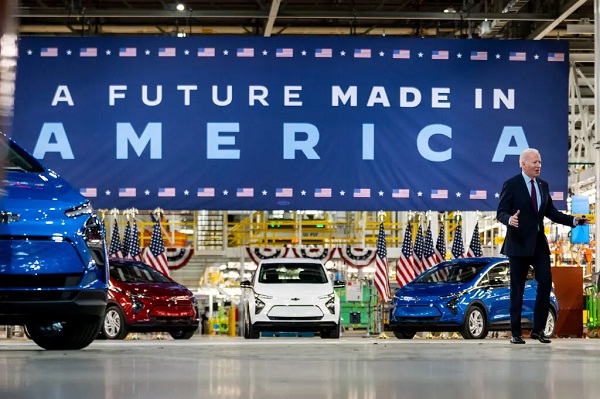
As COVID-induced lockdowns in China snap the links of global suppliers, US manufactures are benefitting from growing ‘Made in USA’ sentiment among consumers. Established in 1992, New Jersey-based Unionwear saw a rapid surge in business this year. With 100 per cent local supply chain, the manufacturer of customized baseball hats, scarves and backpacks, the company witnessed a surge in buyers no longer able to import goods due to lockdown.
About 70 per cent respondents to a survey by the Reshoring Institute showed preference for US-made products over imported goods; 83 per cent are willing to pay over 20 per cent more for locally-made products.
Realizing the benefits of nearshoring
As per information on BR Logistic website, container rates for China-US routes have surged almost three times of the pre-pandemic rates to about $18,000 per 40-foot container. Oil prices have also increased due to the Ukraine-Russia conflict, leading to sharp rise in shipping costs. However, localized manufacturing is helping Unionwear sell products at competitive rates. Before pandemic, baseball caps would cost about 40 per cent more than products imported from China. Currently, they are being sold at $10 per unit in wholesale.
Bigger companies in the US are also realizing the benefits of nearshoring as a more secure and reliable option for manufacturing, says a April report by Thomasnet.com.
Meanwhile some non-resident companies also aim to step up investments in the US. South Korea-based Samsung Corporation plans to invest $17 billion to set up a new facility in Texas for producing advanced semiconductors. To be operational in late 2024, the facility would stabilize global semiconductor supply chain. Released in 2022, the Kearney Reshoring Index shows, 79 per cent manufacturers based in China have either shifted a part of their production to the US or plan to do so in the next three years, and another 15 per cent are planning to follow suit.
Reshoring to make supply more sustainable and carbon-neutral
Meanwhile re-shoring trend in the US has intensified due to the tariffs imposed by Trump government on Chinese imports, says William Reinsch, Industry Expert - International Trade, Center for Strategic and International Studies. Bringing these companies back to the US would help them shorten supply chains, making them more resilient to natural and manmade disasters, explains Nick Vyas, Associate Professor -Operations and Supply Chain Expert, University of Southern California Marshall School of Business.
A domestic supply chain also helps make US companies more sustainable and carbon neutral. He advises companies to adopt the triple bottom-line mindset that also takes into account a company’s resiliency and sustainability besides costs. US companies also need to strengthen relationships with suppliers in the Caribbean, South America and Canada in order to become insulated from rising production costs, Vyas affirms.
Valentino appoint Alessandro Beretta as new Head-Europe
To expand both its retail and wholesale business in the region, Italian luxury group Valentino has appointed Alessandro Beretta as the new Head-European Business
Starting his career at Procter&Gamble, Beretta further moved to Nike as its Partner-Management Director –Europe. He will report to Laurent Bergamo, Chief Commercial Officer, Valentino for the Americas, Europe, Middle East and Brazil.
Founded in 1960 by Valentino Garavani, the group has revamped its operations since mid-2020 and appointed new managers. Controlled by Qatar Investment Vehicle Mayhoolam the company also added Jacopa Venutrini as its new Senior Chief Executive during the pandemic times.
The group's revenue increased by 3 per cent to €1.23 billion last year over the pre-pandemic levels of 2019.
Zara, Guess offer least sustainable collections: Moincoins
Test conducted by Moincoins over the last six months on four of the most popular fast fashion brands show, Zara and Guess offer the least eco-friendly collections while Pull & Bear offers the best. The fourth brand tested was H&M.
Conducted from November 2021 to January 2022, the test included testing T-shirts, jeans, sweaters and dresses from the brands’ eco collections. The testers looked into the sustainability of the materials, textile certifications, quality and durability, as well as the product information given in the online shop and on the product tags. All items were worn, washed, handled and cared for according to the care instructions by Moincoins employees.
The results show that the Guess Eco collection lacked transparency and used the least amount of sustainable materials. The clothing from Guess was the most expensive but had the best quality. Zara’s products were the worst in terms of quality and durability, but some items had textile certifications. H&M Conscious Choice scored average and was the cheapest of all brands tested. Pull&Bear was the surprise winner, ranking highest when it came to sustainable materials and product information.