FW
UK fashion entrepreneurs adopt unique ways to help RMG workers affected by COVID-19
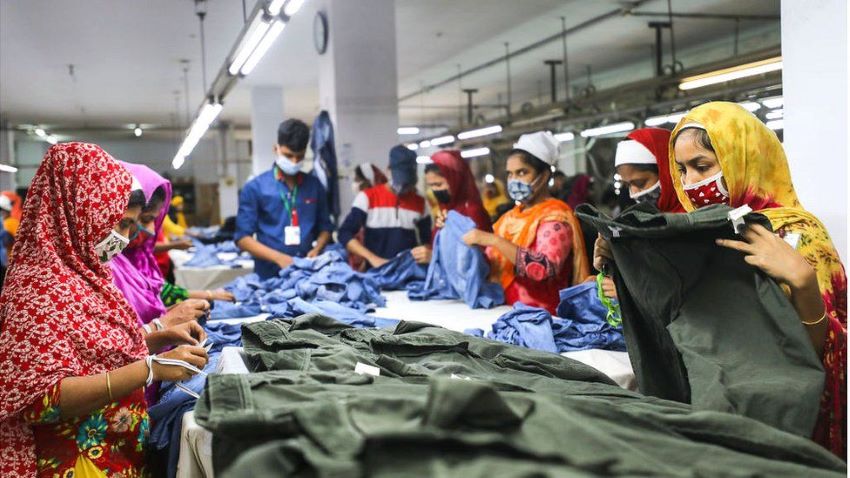
Fashion entrepreneurs in UK are developing different ways of helping garment workers during the pandemic. Edinburgh-based Cally Russell has set up the Lost Stock initiative, which sells garments from orders cancelled by UK fashion retailers by purchasing garments directly from manufacturers in Bangladesh. A Lost Stock box of clothes costs £39. Almost a third of it is donated to the Sajida Foundation, which gives food and hygiene parcels to Bangladeshis struggling due to the pandemic. For maximum transparency, Lost Stock also provides a price breakdown that outlines the costs to the manufacturer, the charity and the initiative itself.
Some fashion marketers are also encouraging brands to adopt a cool-to-care ethos as seen with the UK’s weekly clapping for key workers. Businesses in numerous sectors are already focusing their marketing message on supporting NHS workers to capitalise on this spirit of collective solidarity. Fashion marketers are also channeling people’s desire for self-gratification towards buying clothes that contribute to the social good. For example, TOMS (Tomorrow’s Shoes) donates a pair of shoes to the needy for each of its pair sold.
On the other hand, Snag Tights, supports NHS frontline workers with a free pair of tights for every order placed. Another emerging trend is of swapping clothes. London Fashion Week hosted a fashion swap shop in February for the first time. Similarly, the flagship Selfridges store on London’s Oxford Street began selling second-hand luxury fashion and high-end brands with resale site Vestiaire Collective in 2019.
There has also been a rise in fashion libraries that rent fashion garments and accessories, allowing consumers affordable access to higher quality and luxury items. Fashion retailers could move in this direction, while also supporting customers by hosting workshops for upcycling garments into something new.
Burberry reports a 33.1 per cent gap in mean gender pay for April
In line with the UK government’s gender pay gap regulations, fashion brand Burberry reported a 33.1 per cent mean gender pay gap for fixed hourly pay as on April 05, 2019. The organization currently has 9,862 employees. The UK government’s reporting regulations require organizations with 250 or more employees to publish the differences in mean and median hourly rates of pay for male and female full-time employees, the gap in men and women’s mean and median bonus pay, the proportions of male and female employees awarded bonus pay and the proportions of male and female full-time employees in the lower, lower middle, upper middle and upper quartile pay bands.
Due to the pandemic, gender pay gap reporting regulations have been suspended for the 2019/2020 reporting period, however, some organizations have chosen to do so voluntarily. Burberry’s median gender pay gap for fixed hourly pay is 10.3 per cent as in April 2019. On average women, earn 90p compared to every £1 their male counterparts earn. The brand’s mean gender pay gap for bonuses paid during the reporting period is 40 per cent while its median gender pay gap for bonus payments is 23.2 per cent.
Over the reporting period, 78.7 per cent of the brand’s female employees and 76.3 per cent of its male employees received bonus payments. Around 56.4 per cent of employees in the highest pay quartile at Burberry are female, compared to 67.6 per cent in the second quartile, 59.7 per cent in the third quartile and 78 per cent in the lowest pay quartile.
Escada struggles under new owner
Escada, the once high-flying brand synonymous with the big-shouldered Eighties and the Dynasty set, is reportedly struggling under its new owner Regent LP and is in an increasingly bad financial shape. Escada was acquired by Regent LP, a Los Angeles private equity firm last November. Since then, the brand has closed several of its retail stores in North America and laid off or furloughed nearly its entire retail force besides drastically reducing its corporate headcount.
While some of these outcomes are due to the coronavirus pandemic that forced nonessential retail to close for the last several months, things were already looking grim for the retailer in December and January. A multitude of its typical operating bills have been piling up, since the acquisition, like payments to in-store seamstresses, UPS delivery services and electricity bills of stand-alone retail stores.
Before Regent’s takeover too Escada was already struggling financially but its bills were being paid, unlike today. Regent’s round of layoffs at corporate headquarters in Germany have reduced headcount by at least 50 people, but by some accounts it was by as much as 100 people. All corporate roles in the US have been eliminated as well, leaving roughly 150 corporate employees remaining in Germany.
Escada is facing a current loss of at least $100 million. In a Companies House filing in the UK for 2018 last year, Escada made its mandatory annual financial disclosure where it listed a loss of 7 million pounds, or $8.8 million at current exchange. That was just for operations in the UK however, where it has five points of sale, only one of which is a stand-alone store.
BTMA urges anti-dumping law against yarn imports from India, Pakistan
Bangladesh Textile Mills Association (BTMA) is urging the government to initiate anti-dumping law on export of low-cost yarn by competing countries, like Pakistan and India. As per BTMA, dumping of yarns not only adversely affects their production and marketing but also defies international trading practices under the WTO rules.
In its recent letter to the Finance Minister, BTMA alleged that India has started exporting yarn to Bangladesh at dumping prices. Considering the international prices of cotton and the cost of other components for production, the BTMA claimed that India was exporting its 40- count combed yarn at rates lower than the production cost. This is creating undue competition for Bangladeshi manufacturers.
Bangladesh's primary textile sector, estimated to be worth $8 billion in investment, is working as a dynamic backward linkage industry and supplying 80 per cent of knit and 35 per cent of woven fabrics to the export-oriented readymade garment sector. Experts say, with the use of local inputs, the value of RMG export increased to $35 billion from $26 billion in the last five years. However, lately, with Coronavirus hitting the industry hard, exports of garment and textile products are feared to slump by as low as 40 per cent to the European Union alone, the largest export market for Bangladesh.
In such a situation, if backward linkage factories, such as the textile mills, are adversely affected by dumped imports, this key feeding-industry would be fraught with untoward barriers to produce even on a limited scale. Hence textile millers now want the government to initiate anti-dumping duty on yarn import.
Post COVID-19 new era for as brands with seasonless, digital fashion: Study
 Delineating the post COVID-19 fashion world, eco-friendly fabric brand Liva’s new report ‘A Brave New World’ emphasizes on the need for brands to upgrade their old school brick and mortar store shopping experiences for consumers who are now becoming more sensitive about the financial and sustainability costs of their fashion choices.
Surveying 440 people across cities in India such as Mumbai, Pune, Delhi, etc, the report states social media platform has become a primary resource for around 29 per cent consumers during back-to-back lockdowns. On their part, brands are adapting to the changing scenario by creating engaging online content with videos and Instagram lives besides rolling out sales and gift cards. The report says, trend of discount shopping will rise post COVID-19 as 35 per cent shoppers plan to opt for discount shopping, while only 14 per cent are willing to shop despite lack of discounts. The survey observes shoppers are engaging in thoughtful purchases more than ever before.
Investments in sustainable brands, natural fabrics to increase
The survey highlights post COVID-19, brands will focus on seasonless fashion to keep their buyers fixated. Gucci recently announced its intentions to veer away from multi-seasonal cycle to showcase only two seasonless collections in a year. Similarly, Yves Saint Laurent also announced its exit from Paris Fashion Week’s busy seasonal cycles. Council of Fashion Designers of America (CFDA) and the British Fashion Council (BFC) have also urged the fashion industry to focus on creating timeless and great quality products.
The report indicates be it advocating slow fashion or sustaining local, homegrown brands, consumers will inch towards making more responsible fashion choices post COVID-19. Around 40 per cent consumers will invest in sustainable brands, while 72 per cent will opt for natural fabrics, 48 per cent want to opt for biodegradable fabrics, and 37 per cent for recycled fabrics.
Digital events for techno-savvy consumers
The access to new collections, sales, multi-currency checkout, and multi-variable product filters on her website, while designer Payal Khandwala created a specialized virtual shopping experience for her consumers to shop from the comfort of their homes. report further indicates post-COVID-19, fashion will largely be showcased via digital platforms as around 50 per cent consumers will rely on augmented reality apps to try clothes while 48 per cent will search for online styling tips and guides.
This shift to digital is already visible with London, Paris, Milan, and even India announcing full-fledged online fashion weeks. Recently, Chanel organized an online presentation to showcase its latest collection instead of a physical Cruise show that was scheduled to be held in Capri. Similarly Zegna announced plans to showcase its Spring ’21 collection via a digital presentation.
In India, designer Payal Singhal launched several new initiatives such as limited exclusive
APTMA rejects budget proposals
APTMA has rejected the proposed budget for FY 20-21 as it completely failed to address serious industry issues in the light of the worldwide COVID-19 created crisis. This is likely to lead to large scale unemployment and closures and as the market dynamics have changed Post COVID-19 situation. APTMA has demanded the following provisions from the government
Elimination of 1.5 percent turnover Tax: This tax increases cost of exports by an average 5-6 percent as the tax is levied on the same goods multiple times as it passes through the value chain. The Textile Industry works on very slim margins and turnover tax acts as an accelerator to early closure of mills.
Seven per cent custom duty on MMF & Polyester Staple Fiber: There is 7 per cent customs duty on the import of polyester staple fiber with total import expenses in the range of 20 per cent including antidumping duty. More than 60 per cent of world textile trade is in MMF materials and this duty protection given to obsolete plants in Pakistan is denying the Pakistani industry any chance to compete in this growing majority section internationally or domestically. Any protection to domestic polyester plants may be given directly by the government and not at the cost of our country’s economic future.
DLTL: With refunds of approximately 5 percent due on $ 10 billion exports the quantum of DLTL due will be Rs 80 billion. This was also the amount requested for allocation by Ministry of Commerce. The budget has allocated only Rs 10 billion for DLTL. DLTL is a calculation of government taxes component in the cost of exports and if this is not catered for will further weaken our export competiveness.
TUFF: Rs 4.5 billion are pending under TUFF scheme whereas amount allocated in this budget for TUF scheme is only Rs 400 million. The amounts have been due for the past 7 years and this sort of delay annuls industries’ faith in Government commitments.
New Textile Policy: Implementation of the in principle approved Textile Policy is required in true letter and spirit for Pakistan to maintain and increase employment and exports.
French textiles companies seek government help to sell surplus masks
The French textile companies have sought government assistance to sell 20 million surplus masks that lie with them currently. They have asked the the government for assistance in promoting and finding buyers for the unsold output of the industry's national effort.
Hundreds of textile and clothing manufacturers answered the government's call for millions of masks superior to homemade versions. President Emmanuel Macron last month sported a military-tested model embroidered with the tri-color national flag to advertise the "Made in France" masks.
Yet within weeks, demand dried up for the domestically produced masks that sold for a few dollars at supermarkets and pharmacies or were available in bulk for free distribution by businesses and local governments. Manufacturers and the government acknowledged that many suppliers and consumers still opted for cheaper disposable masks from Asia.
To deal with this situation, Thomas Delise, owner of Chanteclair, the knitwear manufacturer behind the mask Macron called for trade barriers to large imports, and coordination within Europe to buy Europe-made masks.
Two-third of Britishers to shop for clothes post lockdown: GlobalData
According to data analytics firm, GlobalData, around 16 per cent of UK consumers plan to spend time shopping for non-food items, with over two-thirds looking forward to purchasing apparel post lifting of the lockdown, as they anticipate more social activities and buy into new season trends.
GlobalData’s monthly survey of 2,000 nationally representative UK consumers conducted in May found one of the biggest difficulties to be encountered across the clothing sector is the concern regarding fitting rooms, with the government stating that shoppers should not be allowed to try on items in store due to hygiene issues.
As fit and comfort are integral factors when buying new clothing items, this is likely to be a put-off, and may become a barrier to purchase, GlobalData thinks.
Therefore, retailers operating within this sector must identify innovative solutions, such as augmented reality mirrors, or virtual catwalks via their apps, to ease the shopping process and provide more inspiration for consumers.
The Children's Place to close 300 stores by 2022
With about 95 per cent of stores still closed due to the pandemic, the Children's Place plans to close 300 of its stores in malls by the start of 2022. The retailer's mall-based portfolio will represent less than 25 per cent of its total revenue, CEO Jane Elfers said.
The brand will close 100 stores by the end of the second quarter of the total 200 closures this year, and another 100 set to close in 2021. About half of the first set of closures will take place in the next month and a half, with most of them expected to open briefly for liquidation sales.
The company reported a 38 per cent decline in its first quarter net sales. The retailer swung to a $114.8 million loss from $4.5 million in net income a year ago, with a gross loss of $19.7 million from gross profit of $152 million last year. That was a 990-basis point downswing to 26.8 per cent of net sales, primarily due to the higher costs of e-commerce fulfillment, along with the fixed expenses of closed stores.
Première Vision Paris digital to be held in September
Première Vision Paris will be held as per schedule from September 15 to 17 at the Parc des Expositions de Paris Nord Villepinte. However, the physical show will be supplemented with a digital show providing exhibitors with greater visibility across the globe. In addition, the physical show will meet all required government health protocols through the use of digital badges, disinfectant gel and masks, and an updated, spacious layout for social distancing procedures.
The show will also include its B2B e-commerce platform launched in 2018, which will feature Fall/Winter 2021-2022 collections and online business discussions in preparation for show visits. It would also feature a denim village at the marquee event to supplement the May Denim PV show that was forced to cancel.
The digital show will include a program of content, services and digital tools to support the creative fashion industry and address the strategic questions on how to move forward through the unprecedented times.