FW
Texworld arrives next week
Texworld Evolution will be held in France, February 6 to 8, 2023.
There will be 750 exhibitors from over 20 countries and the exhibition center will concentrate in one place most of the global sourcing for fashion brands, from ready-to-wear to luxury.
The event presents an opportunity for buyers to measure the new balance between the major international sourcing zones after the transformations related to the Covid crisis. There will be 220 Chinese companies, 122 Turkish manufacturers, 43 Korean companies and 45 Indian companies. Thai embroiderers and Indonesian manufacturers will also be visible. Africa will be represented by 270 companies. The African continent will also be represented with companies from Ethiopia and Ghana.
Several round tables and conferences will open debates on themes such as the contribution of Web3 in the fashion and clothing industry, secondhand markets, or ways to make a company sustainable without compromising its competitiveness. Other highlights will revolve around the issues raised by sustainable fashion and recyclability. A conference on the sourcing offer in Ghana will finally allow uncovering the industrial potential of this country.
The February edition also includes a revisited sustainable sourcing itinerary. This will bring together a hundred companies that have implemented CSR initiatives in an operational manner.
Ralph Lauren launches C2C Gold cashmere sweater
Ralph Lauren has launched a cashmere sweater that is certified Cradle to Cradle (C2C) Gold.
It is being made available under the men’s brand Purple Label and the women’s brand Collection and is the first of five C2C products planned by the company. It is woven from fine cashmere fibers, dyed in rich hues and featuring a transformed signature label cut from organic cotton. The sweater has gone through a multi-step certification process with the Cradle to Cradle Products Innovation Institute, a non-profit that has set the global standard for products that are safe, circular and made responsibly.
The kind of luxury Ralph Lauren stands for has always been about timelessness, authenticity and a life well-lived. Since the brand believes true luxury encompasses not only a product’s beauty and quality, but how it was made and how it will endure, it created the industry’s first C2C-certified luxury cashmere product.
As part of the C2C certification process, Ralph Lauren has also launched a recycling program for 100 per cent cashmere in partnership with Prato of Italy – a leading textile production company combining science and technology to create a circular economy manufacturing system for high-quality wool and cashmere. The program, initially available in North America and Europe, allows consumers to ship their 100 per cent cashmere items from any brand to Prato to be recycled.
UK show to present creative brands
Pure London (UK, February 12 to 14, 2023) will be bringing together the most forward thinking and creative brands from around the world. The aim is to celebrate beautiful craftmanship, design and style and also highlight the importance of ethical and sustainable fashion.
Contemporary fashion brand Emme Marella is designed for dynamic and style savvy women. Italian style merges with the latest trends to create an energy-filled collection which celebrates colour and texture. Sophisticated cuts and creative details create an exuberant yet feminine range. Persona by Marina Rinaldi will feature elegant everyday women’swear that is modern, laidback, and youthful. An easy-going spirit runs through the line which features printed separates, relaxed tailoring, directional knitwear, and chic dresses.Queens of Archive will feature show-stopping, timeless and feminine pieces that are designed in-house using bespoke prints and fabrications. The brand evokes a hybrid culture fusing design, music and creative storytelling to bring a layered, more considered product and story. iBlues is a feminine brand with an eye-catching collection in striking bold colours. Designs are full of attitude made from high quality fabrics with attention to detail.
Pure London is the UK’s leading trade fashion buying event and has the largest women’swear offering in the UK and the largest offering of international brands as well as exciting onsite trend partner and new sustainability initiatives.
EU’s clothing, textile sector expected to face headwinds in 2023: Euratex Report

After a strong first half of the year, the EU economy has now entered a much more challenging phase. The EU is among the most exposed advanced economies, due to its geographical proximity to the Russo-Ukrainian war and heavy reliance on Russian gas. The energy crisis is eroding households' purchasing power and weighing on production. Economic sentiment has fallen markedly. Growth in 2022 was better than previously forecast and GDP growth in the EU was on the upside in the first half of 2022. Expansion continued in the third quarter, though at a considerably weaker pace. The potent momentum from 2021 and strong growth in the first half of the year have lifted real GDP growth in 2022 as a whole to 3.3 per cent in the EU (3.2 per cent in the Euro area).
Growth expected to slacken
However, the growth outlook for 2023 is significantly weaker and higher for inflation compared to the European Commission's Summer Interim Forecast. Growth will significantly contract at the turn of the year. Amid higher uncertainty, energy price pressures, erosion of households' purchasing power, a weaker external environment and tighter financing conditions were expected to tip the EU, the euro area and most member states into recession in the last quarter of the year.
As inflation keeps cutting into households' disposable incomes, the contraction of economic activity is set to continue in the first quarter of 2023. Growth is expected to return to Europe in spring, as inflation gradually relaxes its grip on the economy. However, with powerful headwinds still holding back demand, economic activity is set to be subdued, with GDP growth reaching 0.3 per cent in 2023 as a whole in both the EU and the euro area. By 2024, economic growth is forecast to progressively regain traction, averaging 1.6 per cent in the EU and 1.5 per cent in the Euro area. The predicted inflation in 2023 will be around 7 per cent; current inflation in the EU is 9.3 per cent and 8.5 per cent in the Euro area.
Strong labour market remains undaunted
The surprising fact in the report is about EU’s labour market. The robust labour market seems unaffected despite the challenging environment brought on by the looming recession and inflation. Currently, employment and participation are at their highest and unemployment at its lowest in decades. The forceful economic expansion pulled in an additional two million people into employment in the first half of 2022, raising the number of employed persons in the EU to an all-time high of 213.4 million. The unemployment rate remained at a record low of 6 per cent in September. Labour markets are expected to react to the slowing of economic activity with a lag but will remain resilient. Employment growth in the EU is forecast at 1.8 per cent in 2022, before coming to a standstill in 2023 and moderately edging up to 0.4 per cent in 2024.
Weak outlook for clothing sector
Derived from the EU Commission’s September 2022 survey on European Business Cycle indicators and Business Consumer Survey (subsector database), the EU Business Confidence indicator for the months ahead deteriorated, reflecting these energy-related challenges and increased economic uncertainty. Managers’ confidence fell sharply in the textile industry, going markedly below its long-term average and to pre-Covid level in the fourth quarter of 2019. The textile industry’s confidence indicator for the months ahead dropped substantially (-6.3 points), resulting from managers’ more pessimistic views on their production expectations, on their appraisals of stocks of finished products (accumulation of stocks), and of order-book levels.
The indicator in the clothing sector decreased more moderately and in September 2022 was down by -1.1 points. The decrease in confidence resulted mainly from negative developments in manager’s appraisals of the order-book levels. By contrast, entrepreneurs’ production expectations for the months ahead improved, as their assessments of the adequacy of finished products stocks (reduction of stocks). The employment expectations and the assessment of export order-book levels, which are not included in the headline indicator, worsened. To summarise, the EU’s clothing and textile sector is set to contract and this contraction will negatively impact on a wider scale through supply chains from other nations.
Superdry revenue up 24 per cent
Superdry’s revenue was up 24 per cent in the nine weeks to December-end.
The British brand saw sustained demand over the Christmas period as sales at stores caught up to pre-pandemic levels. However Superdry expects to broadly break even this year compared with its earlier forecast for a profit since its wholesale segment underperformed amid higher uncertainty during the last quarter.
The retailer’s adjusted loss before tax widened further in the half year from the same previous period. Superdry doesn’t expect market conditions to become easier any time soon, but with a new financing package in place, and the brand in great health, it is approaching the year ahead with optimism.
Premium British fashion brand Superdry has products like apparel, fragrances, body sprays and body plus hair washes. The UK market represents around 50 per cent of Superdry’s weekly sales and the US around ten per cent. Despite the revenue increase, Superdry is cautious due to increased cost inflation and the worsening conflict in Ukraine, as operating margins are certain to come under pressure.
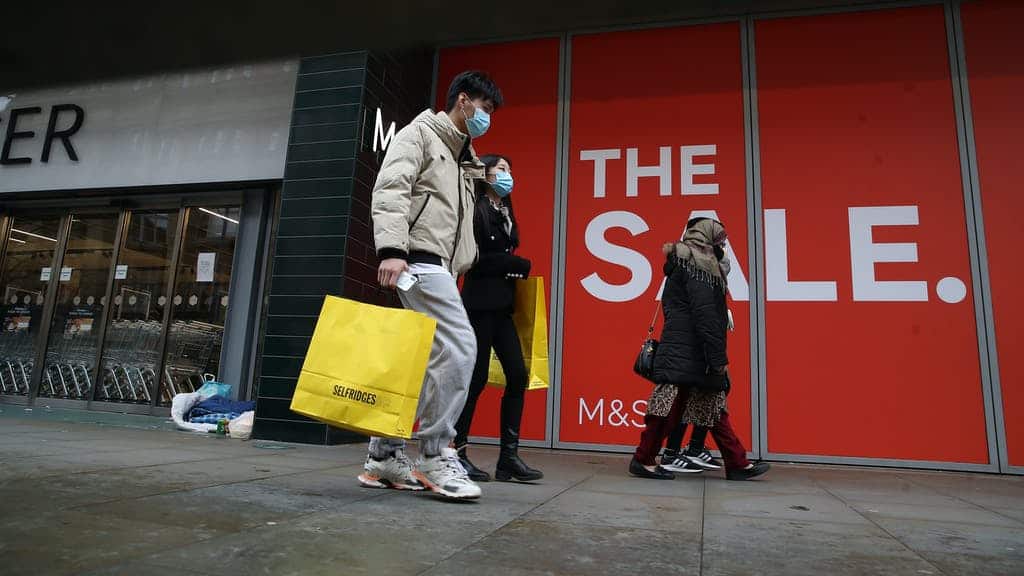
Inflation-pinched British consumers cut their shopping in December 2022 by the most in at least 25 years, dashing hopes of a Christmas boost for the country’s flagging retail sector.
India extends time for viscose quality checks
India has extended the implementation of the quality control order for viscose staple fiber by 60 days. The extension is upto March 29, 2023.
In order to check the imports of low-quality viscose staple fiber, the order was issued on December 29, 2022, which was to be implemented within one month of notification. However, looking at the import dependency of India on viscose staple fiber, especially some nominated categories, and the various procedural issues being faced by the user industry, a request was made to extend the deadline for the applicability of the notification by the Confederation of Indian Textile Industry(CITI) and other industry associations. This was to ensure a smooth transition and also to make sure that the viscose staple fiber orders which were already shipped were not impacted.
During this extension Indian manufacturers will get time to meet their prior commitments and to ensure complete compliance with the prescribed quality control standards.Viscose staple fiber is a manmade, bio-degradable fiber used for manufacturing various textiles.
In Tamil Nadu over two lakh power looms have switched over to 100 per cent viscose staple fiber and contributed significantly to fabric exports. Manmade fabric is expected to be the future growth engine of Indian textiles and the clothing sector.
Indian T&A imports up 48 per cent, B’desh contributes most
Indian imports of textiles rose by as much as 48 per cent until November 2022 this fiscal year. Outbound shipments, however, shrank by 13 per cent.
India has traditionally been an exporter of garments and textiles. This growth in imports was driven by purchases of inputs like raw cotton, fabrics, and manmade textiles as well as of finished products.
Apparel imports shot up 53 percent in the first eight months of this fiscal. Over 40 per cent of these imports came from Bangladesh, where several Indian firms have set up units to take advantage of its duty-free access to markets like the US and the EU. Another 20 per cent of imports originated from China.
A shortage of cotton in the domestic market not just pushed up imports of the fiber but also affected the production capacity of several units in the value chain. The spurt in cotton prices, too, drove up the import value of both inputs and finished products. However this situation is expected to improve in the next fiscal once investments made under the PLI scheme start giving results, with India’s recent trade deals with the UAE and Australia as well as expected improvement in cotton production also helping.
The share of apparel and textiles among the total merchandise exports of India declined to eight per cent in December 2022 from nine per cent the previous year.
India takes up technical textile projects
Some 15 technical textile projects have been cleared in India.
These cover key strategic areas such as specialty fiber, protective textiles, high-performance textiles, geotextiles, medical textiles, sustainable textiles and textiles for building materials.Among these are seven projects of specialty fibers, two of protective textiles, two of high-performance textiles, one from geotextiles, one from medical textiles, one from sustainable textile, andone from textiles for building materials.
The country is encouraging young engineering minds to pursue technical textiles. A broad guideline under the start-up scheme may be finalised on priority, targeting aspiring innovators, entrepreneurs and young scientists. Technical textile machinery and equipment development has been a major challenge which needs collaborative interventions from the government, industry and academia, including commercialisation of the developed machines.
Textile manufacturers and institutes are being encouraged to come together to indigenously develop strategic and high-value technical textile products. In addition, the way forward and action plan for propelling India’s technical textiles sector includes wider field-level outreach programs for research in fundamental, applied, and machine development across premier institutes and industry associations, development of new BIS standards; enacting new quality control orders, rationalization of HSN codes, mandating of technical textiles’ items across line ministries and departments, and identification of specialised skill requirements in the sector.
H&M profit down 87 per cent
H&M’s operating profit fell by 87 per cent in the fourth quarter.
The hikes in raw materials and freight costs combined with a historically strong dollar resulted in extensive cost increases for purchases of goods.
The Swedish retailer launched a cost-cutting program in 2022 that included 1,500 job losses. Sales in the fourth quarter were up ten per cent but were flat in local currency terms. Sales from December 1, 2022, until January 25, 2023, increased by five per cent in local currencies. Since sales in the new financial year have started well, the group hopes sales, profitability, and inventory levels all improve this year since external factors are still challenging but are moving in the right direction.
The goal for next year is that of a double-digit operating profit margin from 3.2 per cent in 2022. The Swedish retailer has often ended up with large amounts of garments it has had to discount. H&M is increasing its production in Europe and looking at Latin American countries as part of an attempt to do more near-shoring and be able to respond more quickly to fashion trends.The retailer expects to have lower inventory in 2023 but capital expenditure is expected to increase 50 per cent.
Cambodian exports to EU may decline
Cambodia’s exports of garment, footwear, and travel goods to the European market are likely to decline.
Among the reasons are spillover effects from the war in Ukraine, with an especially sharp downward revisions for economies most dependent on Russian gas supply. If the energy crisis in the EU gets resolved, it will be a good sign for Cambodia’s exports to the EU. The euro area economy grew by 5.2 percent in 2021 and 3.1 percent in 2022. It is projected to grow only at 0.5 percent in 2023.
The European Union is one of the biggest markets for Cambodia’s garment products. In 2022, Cambodia exported over $9 billion worth of garments, footwear, and travel goods. The garment, footwear and travel goods industry is the largest foreign exchange earner for Cambodia. The sector consists of roughly 1,100 factories and branches, employing about 7,50,000 workers, mostly women. The garment sector is a crucial part of Cambodia. But it also sees challenges of competition that need to be addressed and require attention to keep the production chain in the garment sector.
The share of Cambodia’s exports to some other markets – outside the US and the EU – increased to 33 per cent in 2021, from just 28 per cent in 2020.