FW
China exporting goods to the US through Vietnam
Goods are arriving in the US claiming to be made in Vietnam while they are in fact made by Chinese companies. They are indulging in this practice to avoid high tariffs. Many of them have shifted production from China to Vietnam to avoid the 25 per cent levy imposed by the US on Chinese goods amid a spiraling trade war.
Dozens of fraudulent product-origin certificates have been discovered on goods including textiles, fisheries, farm products, tiles, honey, iron, steel and plywood. Chinese plywood was discovered being shipped to America through a Vietnamese company. Vietnam says the trend has affected the reputation of its businesses and goods. The country has threatened to crack down on Chinese companies illegally using made in Vietnam labels on goods shipped to the US to avoid high tariffs.
Vietnam has long been a manufacturing hub for cheaply-made goods from Adidas sneakers and H&M dresses to Samsung smart phones and Intel processors. Those exports have soared this year as China and the US have escalated tit-for-tat tariffs on billions of dollars worth of goods. In the first three months of this year, US imports from Vietnam rose 40 per cent from the same period last year.
Birla Cellulose does product mapping
Birla Cellulose has completed a life cycle assessment (LCA) of products in its portfolio. The LCA exercise has assessed the environmental footprint and its effects on human and animal health and the environment, such as ozone layer depletion, mineral use and use of nitrogen and phosphates.
A member of the Sustainable Apparel Coalition, Birla Cellulose uses the Higg Index Tool to monitor manufacturing units’ performance on environment and social scales. The index monitors energy and water consumption, reduction in effluent discharge and transport distance. For all 11 of Birla Cellulose’s manufacturing units, Higg scores have been completed along with a benchmark analysis.
Birla Cellulose works with global brands to drive initiatives to trace the source of raw materials and help them trace their complicated supply chains in India. From Forest to Fashion is the first supply chain mapping project of its kind in the apparel industry. It has provided clarity on value chain sourcing from India and improved transparency of different players involved in the supply chain of some major brands. The next step will be to digitise the entire process. Birla Cellulose is now focusing on projects within the supply chain to reduce resource use, especially water and chemicals, in different stages of the Forest to Fashion process.
Mimaki Engineering to showcase digital print technologies at ITMA 2019
Mimaki Engineering, a leading manufacturer of inkjet printers and cutting systems, will showcase its broad portfolio of cutting-edge digital print technologies at ITMA 2019. This will include the first global showcase of its new hybrid digital textile printer featuring both direct-to-textile and direct-to-transfer print capabilities. These features enable textile and garment manufacturers to achieve unparalleled flexibility and enhanced application opportunities for increased business growth. To facilitate these benefits, the new Mimaki printer also allows multiple sets of inks to be loaded simultaneously, supporting increased fabric range versatility and maximum product variety.
TA Job Controller Software: Specifically designed for textile production environments, this TA Job Controller enables users to connect one-on-one to the RIP and other devices, for an automated workflow from design to pre-print, print and post print processes.
Mimaki Tiger-1800B MkII : This industrial digital textile printer combines Mimaki’s Japanese expertise in electronics with La Meccanica’s know-how in building solid and robust belt printer bodies with ‘made-in-Italy’ design. It enables users to produce extremely high-quality products at up to 385sq m/h print speed, without the need to compromise on production and throughput.
From its advanced TR series, Mimaki will also showcase the TR300-1850C coating machine and the TR300-1850S steaming machine, and the benefits of a total solution for textile print production. Providing the equipment needed to operate the entire digital textile workflow, Mimaki’s all in on solution ensures complete technology compatibility, as well as increased productivity, print quality and reduced production costs.
Mimaki will also use ITMA 2019 to showcase its wide range of flagship solutions addressing different textile market segments. These include:
Mimaki TS55-1800: This dye-sublimation business-enhancing printeraddresses the entry and mid-level markets offering continuous operation and an unprecedented price-quality ratio. Equipped with Mimaki’s core technologies, the printer achieves high productivity and high-quality print with vibrant colours and vivid imagery and is suitable for interior fabrics, sports and fashion apparel and soft signage.
Mimaki UCJV300-160: A roll-to-roll UV LED inkjet integrated printer/cutter, featuring a white ink capability. A versatile printing system, the UCJV300-160 uniquely enables four-layer printing for transformative backlit applications, and five-layer printing, allowing different designs to be viewed on both sides of a substrate simultaneously. Visitors at ITMA 2019 will see the UCJV300-160 printing wallpapers live.
Bangladesh: Future of RMG exports is positive, albeit with a few challenges
"The RMG sector in Bangladesh has witnessed tremendous growth over the last one decade. The country has emerged as the second largest RMG exporter to the world with around 85 per cent of its export earnings achieved through this sector. This growth in the country’s RMG sector has created many new employment opportunities in the country with around 4 million Bangladeshi people currently being employed in the sector reveals an exclusive study by Wazir Analysis and Textile Magazine."
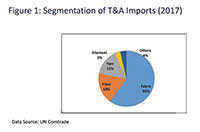 The RMG sector in Bangladesh has witnessed tremendous growth over the last one decade. The country has emerged as the second largest RMG exporter to the world with around 85 per cent of its export earnings achieved through this sector. This growth in the country’s RMG sector has created many new employment opportunities in the country with around 4 million Bangladeshi people currently being employed in the sector reveals an exclusive study by Wazir Analysis and Textile Magazine.
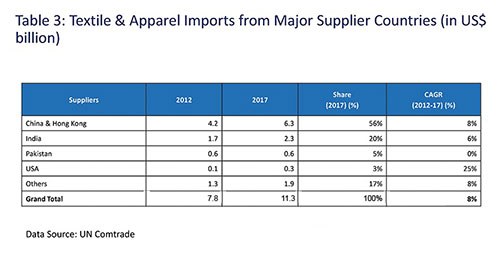
The textile and apparel exports of Bangladesh increased at a CAGR of 8 per cent from $25 billion in 2012 to $36 billion in 2017. The country, which enjoys preferential access in the European Union (EU) under the ‘Everything but Arms’ (EBA), gained around 61 per cent market share in the region for textile products. Other than the EU and US, Japan and Russia are the other flourishing countries with their market share growing at a CAGR of 36 per cent and 28 per cent, respectively. Through its export competitiveness and duty free access, Bangladesh has attracted many international brands in recent years, reveals the study. The country’s apparel exports have grown at a CAGR of 14 per cent since 2005. These are further likely to grow at a CAGR of 12.5 per cent to reach $100 billion by 2025.
Fragmented textile value chain hampers growth
The Wazir Analysis and Textile Magazine study also reveals, Bangladesh faces many challenges that affect its export growth. Firstly, the country has a fragmented textile value chain which is highly dependent on import of raw material for textile and apparel commodities. Also, issues like increasing wages, lower output, low product quality, etc plague export growth in the country. To counter these issues and remain competitive in the global market, Bangladesh needs to focus on the following aspects:
Integration of operations to enhance market power, position
Backward & forward integration could help Bangladesh companies to control not only their buyers but also their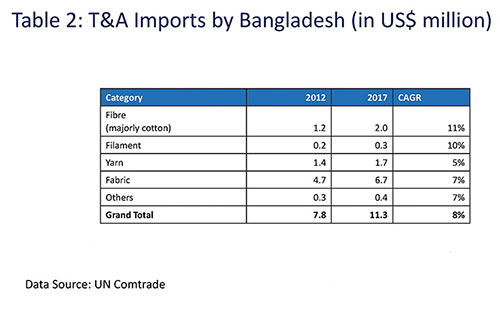 suppliers, distributors and customers. It can also enhance their market power and position, reduce import of fabric and yarn and internal consumption of products, increase value-addition at all stages of the textile value chain, reduce in costs, lead times, increase employment avenues for local population and better margins for the manufacturers.
Dealing with quality, design and delivery issues
Another area that Bangladesh needs to focus on is offering superior quality products with innovative designs, customisation, on-time delivery, technology innovations and after-sales service. This can be achieved through major transitions in manufacturing set-up and workforce development. The main components of this transition include Streamlined manufacturing process can help Bangladesh deliver high variety, low volume orders
Reducing mishaps through concepts like Right First Time, Zero Defect, Quality Control can help the country to improve its products and processes Operaters need to take ownership of their equipment and also simply their processes to increase their capacity and also improve the quality of their offerings.
The manufacturing units should adopt information systems like Business Process Management (BPM) to improve their capacity. They should also involve their employees in their production processes
Companies need to adopt market intelligence to keep up with the latest trends and developments along with competitor analysis. They need to introduce low-volume high fashion products. They also need to create a proper work culture in their companies by training their labor as well as middle management.
Lastly, Bangladeshi apparel manufacturers should focus on catering to the demand of Indian market which is expected to grow at 12 per cent CAGR by 2025.
Kornit Digital to launch Kornit Presto System at ITMA 2019
"Kornit Digital, global market leader in digital textile printing innovation, will commercially launch the new Kornit Presto, the only industrial single-step solution for direct-to-fabric printing at ITMA 2019. The Kornit Presto solution eliminates the need for pre and post treatment of fabric and allows for high-quality printing on an extraordinarily broad variety of fabric types and applications."
 Kornit Digital, global market leader in digital textile printing innovation, will commercially launch the new Kornit Presto, the only industrial single-step solution for direct-to-fabric printing at ITMA 2019. The Kornit Presto solution eliminates the need for pre and post treatment of fabric and allows for high-quality printing on an extraordinarily broad variety of fabric types and applications. The Kornit Presto does not consume water in the printing process, making it the most environmentally friendly solution available for direct-to-fabric textile printing today.
The new Kornit Presto comes with the ground-breaking NeoPigment Robusto, the best Pigment-based ink  available in the Industry. Implemented into the renowned Kornit NeoPigmentTM process, the Robusto provides above industry standard wash and rub results and exceptional color fastness across a wide fabric and application range. The Robusto enjoys faster physical and chemical bonding characteristics, enabling a significantly shorter curing time, while providing industry-leading quality and a wide color gamut. The NeoPigment Robusto ink was developed with sustainability priorities and is ECO PASSPORT and GOTS V5 approved.
The Kornit Presto solution suits a wide range of business and application needs in a variety of industry segments, including fast growing segments within the on-demand fashion and home décor markets. It is a highly productive solution, available in multiple configurations and able to print 450 square meters per hour.
Imogo to launch its new Dye-Max spray dyeing technology at ITMA 2019
 Imogo, a Swedish company involved in textile processing technology will launch its new Dye-Max spray dyeing technology at ITMA 2019 in Barcelona.
While still at the prototype stage, and with a first full-scale line currently under construction and due to be demonstrated this Autumn before delivery, the DyeMax nevertheless promises to slash the use of fresh water, waste water, energy and chemicals by as much as 90 per cent compared to conventional jet dyeing systems.
Spray cassettes: Its application unit consists of a closed chamber containing a series of spray cassettes with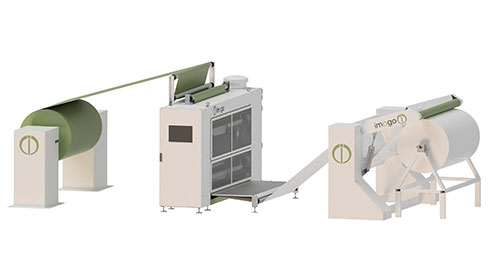 precision nozzles for accurate and consistent coverage, in combination with the patented imogo pro speed valve that controls the volume to be applied. The chamber is equipped with an exhaust system and droplet separator to ensure that the environment around the unit is free from particles.
There is one set of spray cassettes for each of the three separate dye dispersion feed lines and they can be easily exchanged without the need for tools in less than a minute. This allows for extremely fast changeovers between different colours without the need for cleaning.
Mini-Max: With the Mini-Max it is possible to run miniature production tests to set the precise colour recipe. This frees up valuable production time by avoiding wasteful pre-runs. The user simply sets the recipe with the Mini-Max and transfers the parameters to the Dye-Max recipe database for the system to be fully production ready.
Welspun sales growth slows down last quarter
In the last quarter Welspun’s sales growth has slowed down to three per cent. Growth in profits before depreciation, interest and tax margin is at a wafer-thin 1.8 per cent. Welspun India buys its Egyptian cotton from a single vendor in that country, moving the rest of the processes of producing yarn and fabric fully in-house, ending outsourcing. The company has also rolled out a patented system for tracking its cotton textiles products to their origins, involving multiple audits by consultants. It also tied up with Oritain, a company that specialises in tracing cotton back to the tract of land on which it is grown.
The Welspun group spans textile exports, steel pipes and infrastructure. In 2003, it launched Spaces, a branded towel and bed sheet brand with a premium positioning. New mass market textile products have been launched for the local market under the Welspun brand. The domestic market contributes around nine per cent of Welspun’s sales. Welspun is making disposable towels and wet wipes out of non-woven textiles. There are other applications of non-woven textiles the company wants to address in automobiles and the aviation industry as well. Another big bet is on flooring material. Alongside there are plans for carpet tiles and artificial grass.
Zara’s revenues in Vietnam increase to VND 1.7 trillion in 2018
Vietnamese fondness for fast fashion led to a big jump in Zara’s revenues to VND 1.7 trillion ($73 million) last year, six times the 2016 figure. The Spanish company has only two stores in Vietnam – in Hanoi and Ho Chi Minh City – yet local brands like Tam Son Fashion and Mai Son International Retail are trailing far behind. Its products have been distributed by Indonesia's Mitra Adiperkasa Group since it ventured into the country in 2016. However, despite the rapid increase in its revenues, pre-tax profits of Zara Vietnam were a mere VND98 billion ($4.22 million), or 6 percent of revenues, since selling expenses are high.
Statistics Portal, a German market analysis firm, has forecast the compounded annual growth rate of the Vietnamese fashion industry in 2017-2022 will be 22.5 percent. A survey by Nielsen last year found that clothes were Vietnamese consumers’ third spending priority after food and saving. The survey also shows Vietnam ranks third globally in the number of people fond of branded goods after only China and India.
US fashion retailers struggle with tariffs affecting sales
US fashion retailers are suffering since the trade war with China escalated. Most of these fashion retailers work with factories in China, and investors are worried about tariffs pushing up their costs. They are struggling to retain customers in the face of intensifying competition. The sector has fared far worse than tech, chip and automaker stocks.
J. Jill, the women’s clothing and accessories retailer, saw a 3.3 per cent decline in first-quarter same-store sales. Its share price has plunged 83 per cent cumulatively over the last year. The retailer expects a two to four per cent drop in same-store sales for the full fiscal year. Gap’s same-store sales fell four per cent in the first quarter. It expects full-year same-store sales to contract further. A&F’s same-store sales rose by one per cent in the first quarter, far below the nine per cent growth in the same period of last year. Its share price has plunged by 43 per cent over the last month. Americans spent 1.3 per cent less on apparel last year. It was the only category that reported a decline among all consumer products. Millennials in America spend around 18 per cent less on clothing than those born in 1960s and 1970s.
Tintex Textiles to participate in the UN Global Compact Initiative
Tintex Textiles will participate in the upcoming United Nations Global Compact initiative - a voluntary leadership platform for the development, implementation and disclosure of responsible business practices. This forum will feature expertly controlled processing, and advanced dyeing and finishing solutions that drive material innovation to create responsible supply chains to transform fashion systems.
The Tintex Department of Sustainability optimises fashion solutions that not only provide high performance nature based textiles, but enable Tintex to arise as global leaders striving toward superior responsible fashion systems that are transparent and fully traceable throughout the supply chain. Constantly striving for a responsible change in the textile industry, Tintex concretely contributes to a more stable and inclusive global market. It aims to achieve qualitatively better and less impactful results to implement a structured strategical plan that foresees innovative approach, smart sourcing and ongoing research and development continuous experimentation, shared and interconnected internal actions and the ability to move and to react faster to the market needs.