FW
USAID to partner with W-GDP for a model apparel factory
The US Agency for International Development (USAID)-funded West Africa Trade & Investment Hub (Trade Hub) will partner with Women’s Global Development and Prosperity (W-GDP) to establish a model factory with Ethical Apparel Africa and Maagrace Garment in Ghana
This factory will advance the goals of the Prosper Africa initiative, with increased apparel production primarily satisfying the demand for uniforms for healthcare workers in the United States due to COVID-19.
Ethical Apparel Africa will receive a $1.35-million grant underpinning an equity investment in Maagrace’sKoforidua factory. Co-funded by USAID/Ghana and USAID/West Africa, this partnership will expand Ghana’s apparel manufacturing industry by providing modern equipment and technical expertise to Maagrace.
Once its model factory is fully operational with new equipment and more efficient processes, Ethical Apparel Africa will export $19 million over the next three years, with at least 80 per cent of exports targeting the US market duty-free under the African Growth and Opportunity Act (AGOA).
The partnership will also focus on placing women in supervisory roles to change gender norms in the garment industry and ensure that over 50 percent of factory middle managers are women.
Retail giant Arcadia to close 31 shops resulting 700 jobs cuts
Arcadia, the group behind Topshop, Burton and Dorothy Perkins, is set to close another 31 shops after falling into administration. The stores, including 21 Outfit shops, will not reopen once lockdown is lifted, resulting in 700 job cuts.
Deloitte, appointed to run Arcadia group, are seeking buyers for some or all of group stores. Arcadia had about 444 UK stores when it went into administration, putting about 13,000 jobs at risk. The retail giant, which also owns Miss Selfridge and Wallis, saw sales slump during the Coronavirus amid temporary store closures.
Despite that, experts expect the group to be broken up, with bidders taking different parts of the business, and brands potentially hived off. The deadline for bids passed recently, with retail chains such as Next and Frasers Group reportedly in the running to buy some parts of the group out of administration.
The Outfit chain is made up largely of out-of-town shops selling a mix of products from the group's other brands under one roof, so may not have drawn interest from bidders. Although some bidders including Australian collective City Chic and Next have shown interest, they prefer to buy only a fragment of the brand resulting in more losses and job cuts.
Arcadia was once a darling of the High Street, but long before coronavirus, Sir Philip's brands were struggling against newer, online-only fashion retailers. Boohoo, for example, has also been reported as having an interest in acquiring Arcadia brands.
In 2020, it bought the online businesses of Oasis and Warehouse, adding to Karen Millen and Coast, which it acquired in 2019.
Frasers increases stake in Hugo Boss to 15 per cent
Mike Ashley-led Frasers has increased stake in German luxury fashion house Hugo Boss to 15.2 per cent through stocks and derivatives, part of Ashley's on-going drive to take the British sportswear retailer upmarket. Frasers, is raising stake for the second time increasing it to 10.1 per cent in late June after disclosing an initial 5.1 per cent holding earlier that month. The company said it now held 3.6 million shares of common stock, representing 5.1 per cent of Hugo Boss's total share capital. It also has 3.4 million shares via contracts for difference and 3.7 million shares via the sale of put options, which together represent 10.1 per cent of the Frankfurt-listed company's share capital.
Frasers said its maximum aggregate exposure relating to stake change was about €275 million after taking into account the premium it will receive under the put options. In mid-2020 the number was €204 million. This investment reflects Frasers Group's growing relationship with Hugo Boss and belief in Hugo Boss's long-term future. Frasers Group intends to be a supportive stakeholder and create value in the interests of both Frasers Group's and Hugo Boss' shareholders.
Karl Mayer presents endless possibilities with new 4D-KNIT warp knitted fabrics
Karl Mayer has launched the 4D-KNIT generation of warp knitted fabrics. The new type of fabrics opens up previously unknown possibilities in design and product development. Karl Mayer is a textile machinery company that offers solutions for the fields of warp knitting and flat knitting, technical textiles, warp preparation for weaving and digitalisation.
The fabrics’ striking features are distinctive relief-like surface designs; the machine is based on using the double bar Raschel technique. An RDPJ 6/2 EL with a clever guide bar arrangement and technical configuration is used to produce these eye-catching articles. The double needle bar Raschel machine does not produce a classic spacer textile with monofilaments for spacing, but the space between the cover surfaces is filled with a bulked yarn. In addition, differently shrinking yarns are processed in intelligent combinations on the front and rear side of the warp knitted textiles and different lapping techniques are used.
During the finishing process, this leads to high-low effects with differentiated markedness. Voluminous fabrics with small and flat reliefs or deep and bulky shapes with various motifs are created. Strict geometric arrangements with high-low effects are just as possible as expansive plastic wavy arrangements, sparkling fruit looks or complex imaginative designs with different height profiles. Even hole patterns can be seamlessly and freely placed incorporated into the textiles. Functional clothing and shoes in particular provide breathability and a stylish look with the mesh parts. Additional colour and shape effects can be achieved when using suitable yarns.
Nine Asian apparel, textile associations team up to promote better purchasing practices
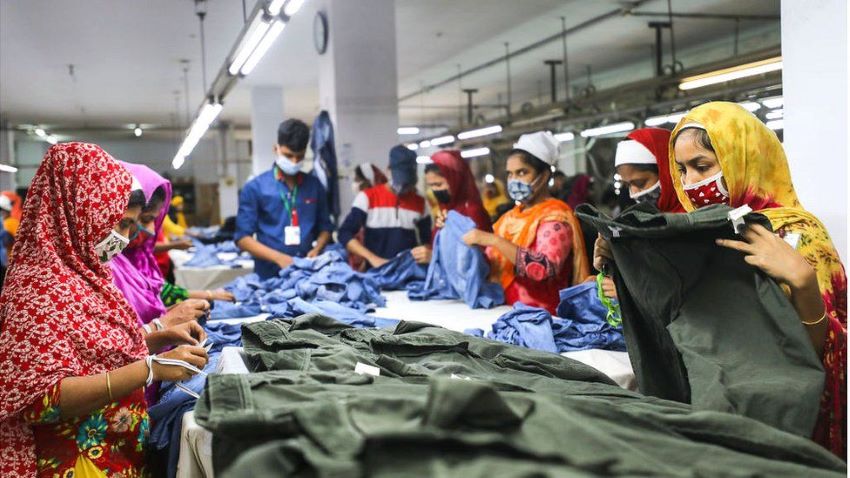
Apparel and textiles manufacturers of six Asian countries, including Bangladesh, have come together for an initiative to push for better global buyers’ purchasing practices. The nine member associations from six countries have: China National Textile And Apparel Council (CNTAC), Myanmar Garment Manufacturers Association (MGMA), Pakistan Textile Exporters Association (PTEA), Pakistan Hosiery Manufacturers and Exporters Association (PHMA), Towel Manufacturers Association of Pakistan (TMA), Vietnam Textile and Garment Association (VITAS), Bangladesh Knitwear Manufacturers and Exporters Association (BKMEA), The Bangladesh Garment Manufacturers and Exporters Association (BGMEA) and the Garment Manufacturers Association of Cambodia (GMAC).
The textiles and garment industry is characterised by power imbalance between the brands and buyers on the one end and the textile and garment producers on the other and this had increased amid the pandemic. They wanted to come together as associations and manufacturers in Asia, to agree on common positions regarding payment and delivery terms so that they have a stronger voice in individual and in collective discussions with brands and buyers on improving purchasing practices.
The platform hops the common position would be powerful as the countries represent over 60 per cent of all global apparel exports by manufacturers. Until March 2021, the platform would work in five working groups — defining the ‘red lines’, requests and recommendations on topics such as payment and delivery practices, planning and information exchange and third-party negotiations. Based on the output of the working groups, the second phase of the initiative would drive the roll-out in the industry.
Drop in Pakistan’s cotton output affects domestic textile industry
The continued and massive decline in the output of cotton crop is posing serious threat to Pakistan’s textile exports. Pakistan was the fourth largest producer of cotton in the world however cotton production in the country has declined to its lowest level mainly due to inconsistent policies.
Cotton cultivation area has recorded over 33 per cent drop during the last few years and the crop has come down to its lowest level in the last three decades, reaching 0.5 million bales from 1.5 million cotton bales, according to data from Pakistan Cotton Ginners Association (PCGA).
Currently over 60 per cent ginning industry is closed due to lower cotton production. The massive decline in production is a complete failure of government policies and lack of concentration to the cotton crop. If the government does not take serious steps for increase in cotton crop, Pakistan will be completely deprived of cotton cultivation and accordingly textile exports.
According to PCGA the government should formulate a special policy to modernize the cotton industry. In addition, new verities of cotton should be introduced to get more crop yield. PCGA also urged for facilities like textile sector and concessional power tariff for ginning factories. It said that due to the low level of cotton production, a total some 8 billion would be imported to meet the domestic industry demand and it will cost 3 billion dollar foreign exchange. India, Bangladesh, Brazil, Sudan and other countries have surpassed Pakistan by supporting and modernizing their cotton industry, while Pakistan is still relying on old technology.
Brazilian textile and apparel industry projections indicate recovery in 2021
Abit (Brazilian Textile and Apparel Industry Association) announced the numbers for the Brazilian textile industry in 2020, in addition to the sector recovery projections for 2021. With the pandemic, production was affected and many companies started producing masks and other PPE to avoid stopping in the period. The sector closed 2020 with an estimated 1.87 million tons of manufactured products by 2021, this figure is expected to increase to 2.09 million tons and 5.81 billion pieces. The figures are similar to those presented in 2019, when the country produced 2.05 million tons and 5.94 billion pieces.
In the annual revenue, it is estimated R$ 55.3 million in textile manufactured and R$ 152.1 billion in clothing products, which will represent, respectively, increases of 10.5% and 24% compared to the figures recorded in 2020. The association says, although the numbers seem high, in fact the comparison is on a low basis. This is because the sector had been trying to recover since 2010 and in 2019 it was regaining a more solid growth, but was hit by the pandemic, being one of the most affected.
Another highlight is the number of jobs, which after a significant drop in 2020, will grow again in 2021. The expectation is of 25 thousand new jobs, around 65% of the volume reduced last year. The association also points out that this growth will be gradual.
Even with the challenges of the year, the textile and apparel sector can contribute to the pandemic by making masks for sale and donation. The number of the produced item jumped from 6.5 million to 140 million in four months, with around 140 companies converting their production to this demand.
Brazilian companies host first digital edition of Colombiatex de Las Américas
The first fully digital edition of Colombiatex de Las Américas, the largest event of the textile sector in Latin America, took off on a positive note. It hosted 21 Brazil participates, supported by Texbrasil (The Internationalization Program of the Brazilian Textile and Fashion Industry) – the result of a partnership between Abit (Brazilian Textile and Apparel Industry Association) and Apex-Brasil (Brazilian Trade and Investment Promotion Agency).
The 33rd edition event is fully digital where brands have the possibility to exhibit their launches and innovations and negotiate with people interested in their products. According to the event’s organization, more than 2000 qualified buyers, from Colombia and all over the world, are participating.
To support the brands Brazilian companies at Texbrasil will perform several digital actions. In line with the theme of the edition, which will highlight innovation and sustainability in 2021, the program has developed an exclusive e-book with content presented by the companies.
Year 2021 marks the 20th anniversary of Texbrasil’s participation at the event, confirming the commercial importance between Brazil and Colombia and the success of their partnership. In 2020, the 44 companies that participated in the physical edition made $8.96 million in business and prospected another $62.84 in sales.
Against all odds Gujarat cotton yarn makers see revenue cross 2019-20 mark
Despite the pandemic cotton yarn makers in Gujarat are set to surpass their 2019-20 revenues. As per All Gujarat Spinners’ Association (AGSA) estimates, the industry’s turnover was Rs 29,000 crore in 2019-20. Spinning units in the state already achieved this by the end of third quarter of 2020-21, riding on increased demand and higher prices of cotton yarn.
Cotton yarn prices have increased 56 per cent from April to November 2020, when prices stood at Rs 265 per kg. Cotton yarn price was Rs 195 in the first half of March 2020, after which it fell to Rs 170 in April soon after the lockdown. With a sharp increase in prices recently, the industry regained momentum. At this price, realisation from orders has increased for cotton yarn makers. Consequently, revenues of Q4 of 2020-21 will be growing at 25% from the corresponding quarter last year, stated AGSA.
Cotton yarn prices rose over the past two months or so due to an unprecedented increase in demand, especially in the export market. Pipeline stocks dried up a few months of the lockdown and demand sharply increased. Currently, all units are operating at full capacity while at least 70% of the stock is being exported to countries like Vietnam, Bangladesh and China.
The surge in demand also helped industry players make up for revenue lost during the lockdown and after it. Industry players said that with fatter margins due to higher prices, the industry turnover for 2020-21 will grow by 10% against 2019-20. Gujarat is home to at least 140 spinning units with an installed capacity of some 50 lakh spindles according to AGSA. Daily production is at 40 lakh kg.
Post-pandemic Retail Relevance: Brands look at digitalisation, building image
 How has the pandemic accelerated digitalisation, nearly 100 fashion brands shared their plans for the future and strategies until 2023 on the Zalando platform with Zalando Marketing Services (ZMS). The study was a peer-to-peer intelligence-share comprising quantitative survey data and interviews. And as Michele Pilati, Head of digital Transformation at Karl Lagerfeld explained Zalando condensed the feedback of all the brands into one strategic direction for the industry.
Investing on own platforms
Not depending fully on wholesale, Karl Lagerfeld and others that sell on Zalando, like Coach and Vivienne Westwood, are taking greater control of their e-com businesses. They are investing on own DTC platforms and customer journeys while marketplaces are fast becoming shop windows that can express brand DNAs. Brands expect online sales to account for 57 per cent of all sales by 2023. With consumers still looking for experience, and convenience, brick and mortar stores will still be very important.
Brands also agreed long-term investments in brand image and relevance is as important as short-term sales wins. They emphasized accountability matters and brand relatability and experience needs to prove itself commercially and adhere to a set of clear performance goals.
Especially smaller brands need to focus on commercial performance for the next two years. Almost 69 per cent surveyed brands say they plan to invest in ROI driven sales campaigns versus only 45 per cent with an annual turnover of $100 million or greater.
Almost 84 per cent digital leaders in the study are planning to focus more on campaigns along whole user journey. While only 20 per cent of those who do not deem themselves at all prepared to digitalise are ready to think long term and bigger picture. This highlights “the more digital a fashion brand is, the more set up it is to build and retain loyal customers. This also suggests that digital brands are more likely to become a consumer-centric flywheel that doesn’t need to repeatedly bring in new customers at the top of the funnel.”
And as Andreas Antrup, SVP advertising at Zalando says this reflects the purpose-led consumer-centric view. “It’s now less about a transactional view and more about customer lifetime value.”
The study also shows “going forward, storytelling and experiences that provide emotional connection, education and brand content will come from an increasing amount of touchpoints, and at various stages of the journey.” And digital fragmentation, accelerated by social media, sees the journey no longer linear, meaning brands need to plan for an omnichannel customer journey that travels around a constellation of touchpoints (offline and online).
Moreover digital brands are using data for quick decisions. Decisions on varied topics including budgets are also being facilitated. However, constant evolution in digital marketing requires precise planning with 85 per cent brands prepared for digitalisation and prioritizing agility.
The study highlights brands foresee digitalisation naturally affecting how they market and sell. However, only 39 per cent expect this to have a strong impact on their overall organisational structure, while only 25 per cent see digitalisation having an effect on product. As Antrup points out, digital retail has the capacity to test and scale new products in a way that brick-and-mortar can’t. “The scale of opportunity and loss is much greater than with bricks-and-mortar. You aren’t asking how much more could I have sold? You get more data earlier on in the funnel.”