FW
PG Denim launches new concepts for S/S 2021 season
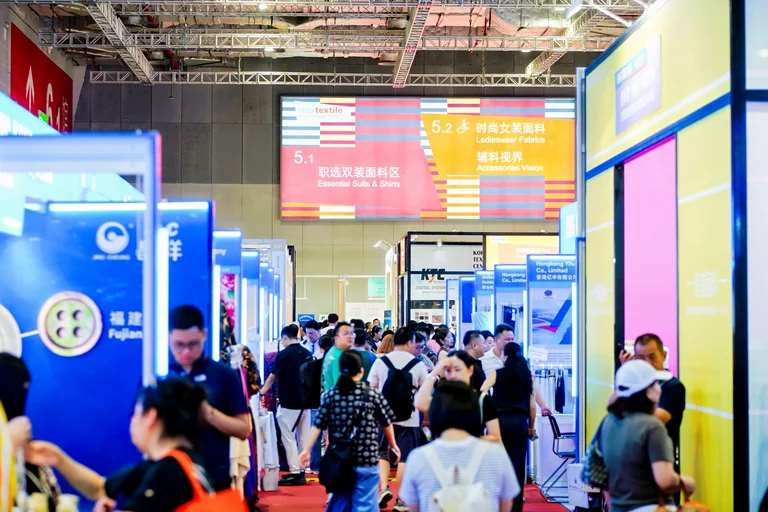
PG Denim, the designer project by Paolo Gnutti, is presenting new concepts developed for the S/S 2021 season at the Munich Fabric Start exhibition, being held from September 03-05, 2019(Munich, 3-5 September 2019). The company is focusing on circularity, seen from a dual perspective: the product with the no longer traditional alternation of seasons, and a sustainability oriented approach.
The collections by PG Denim are a ‘mix of products without seasonality.’ Their focal points are innovation alongside the concept behind the initial idea, as opposed to just the season. These collections have been designed starting form macro-trends and present fabrics for garments that are easy to wear and suitable for both warm and cold temperatures. The lines for the previous season are thus reintroduced and restyled playing with weights and sizes, within a range where flock meets ultra-light fabric bases, or where vinyl is combined with typically summer weights which shift the fabric towards the world of “paper” with crispy touches, resulting in extraordinarily lightweight and strong items at the same time. Also, the Garage Denim theme has been upgraded with fluid and smoothed touched for garments which are easy to wear and have a strong personality.
The PG Denim season has also partnered with The Denim Window project, which has resulted in a limited series of Creative Capsule collections, derived from the idea of bringing together companies which had already worked or were working together, trying to highlight – through small capsule collections – the best of what had already been produced by traditional businesses. This has resulted in three trailblazing capsules, two of which designed in partnership by PG Denim and companies the likes of M&J Group, Cadica and Greenwear.
Italian womenswear brand awarded with PEF certificate
Italian womenswear brand Chiara Boni La Petite Robe has received the Product Environmental Footprint (PEF) certificate for its completely local supply chain, high quality and authentic sustainable approach.
The brand uses Sensitive® Fabrics to create around 80 per cent of its collection mostly comprising dresses. Breathable, shape-retaining, stretchable in all directions, wrinkle free and long lasting, these fabrics are exclusively crafted for the eight iconic pieces selected for the PEF measuring procedure. These eight pieces are the most recognisable essentials of Chiara Boni La Petite Robe signature offerings that include formal dresses, gowns, jumpsuits and separates.
These ‘Measuring for a Sustainable Future’ pieces are identified by a customised handtag and three PEF indicators, which are essential for the calculation of the ecological footprint.
Brands in China facing tough competition on digital platforms
"The Chinese fast fashion market has been in doldrums since the last two years with overseas brands struggling with declining profits. Brands like H&M and Forever 21 have been rolling back planned expansions as the recent annual report of H&M reveals. The brand’s net sales have declined from 7 per cent in 2016 to 3 per cent in 2017 and the brand was also forced to scale back on its physical expansion. In the first half of 2019, it closed two more stores. British fashion retailer Topshop exited the Mainland China market last November by pulling out all its products from Tmall."
 The Chinese fast fashion market has been in doldrums since the last two years with overseas brands struggling with declining profits. Brands like H&M and Forever 21 have been rolling back planned expansions as the recent annual report of H&M reveals. The brand’s net sales have declined from 7 per cent in 2016 to 3 per cent in 2017 and the brand was also forced to scale back on its physical expansion. In the first half of 2019, it closed two more stores. British fashion retailer Topshop exited the Mainland China market last November by pulling out all its products from Tmall. Forever 21 has also shut its online presence besides closing all stores, thus completely backing out of the country.
Though many overseas fast fashion brands had entered the Chinese market quite enthusiastically, they faced a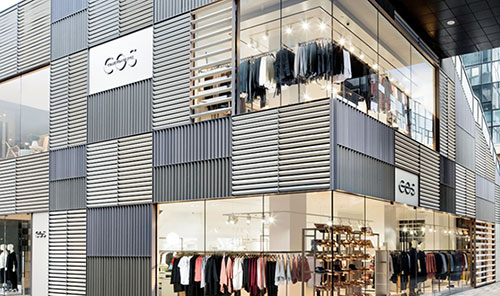 tough time competing with local online retailers on websites like Tmall and Taobao. The tastes of Chinese consumers also shifted towards more elevated options, which hurt the operations of many fast fashion startups.
Growing middle class offers huge opportunity
According to McKinsey & Company, the growing middle class will constitute around 75 per cent of Chinese urban consumersby 2022. This offers a huge opportunity to many fast fashion brands targeting the middle-end market, However, it is essential for these brands to understand the segmentation within this demographic to ensure the success of their initiatives. Constituting seasoned shoppers having a long-standing relationship with online retailers like Tmall and Taobao, these consumers are in search of new options not available online. On the other hand, local customers are losing interest in fast fashion due to the bad quality and noncompetitive prices offered by these brands.
High-end fast fashion brands, planning to enter the Chinese market, now have to choose between digital and brick-and-mortar operations. For example, & Other Stories opened its first sales platform on Tmall unlike its sister brand COS which opted for a physical store instead. This saves the brand a considerable amount of money as against building and operating physical stores. The platform charges a deposit of around $14,000 (100,000 RMB) for a flagship store, an annual service fee of $8,362 (60,000 RMB), and a commission of 3 to 5 percent.
Digital market influenced by past customer experiences
However, a digital-only strategy requires an extremely strong product, since the overseas brands have to compete with a wide range of offerings online. The digital market in China is being continuously influenced by a variety of similar options suggested by Taobao, as well as product reviews from previous customers. This makes it extremely difficult for newer players to enter the market. Premium fast fashion brands tend to stand out from the competition thanks to higher quality and elevated product design, but these brands still need to find alternative channels where they can communicate their identities to Chinese consumers.
It is easier for brands to build their physical presence once they establish themselves online as their online operations enable them to interact with consumers even further. For instance, “COS Fitting Room” has been commended by Chinese customers on the much-hyped social app and e-commerce platform Little Red Book for its minimal interior design, attractive lighting, and ample space, positioning the brand as more luxury than fast fashion. This invaluable in-store shopping experience reaffirms COS’ philosophy of timelessness while also impressing customers.
Having already established its presence in the European and North American markets, & Other Stories has now entered China. Though the brand’s price and positioning match well with China’s market gap, it faces many challenges from domestic fast fashion brands and the growing demands of Chinese customers. Whether the brand can deliver advanced products and unique experiences needs to be seen as what the emerging middle-class consumer looking for is a high-end experience whether in terms of a digital or in-store experience.
Shandong Ruyi Group signs the Fashion Pact
China’s Shandong Ruyi Group has signed the newly created Fashion Pact with more than 30 other global fashion and textile firms, as the group formed to promote sustainable socio-economic development, and foster a better relationship between the fashion industry and the environment.
The Fashion Pact focuses on three primary areas of earth protection. The first includes stopping global warming by creating an action plan for zero greenhouse gas emissions by 2050, in order to keep global warming below a 1.5°C pathway between now and 2100.
Second, the pact plans to restore biodiversity, by restoring natural ecosystems and protect species. The third goal is to protect the ocean by removing the fashion industry’s usage of single-use plastics.
The other Fashion Pact companies are: Bestseller, Burberry, Capri Holdings, Carrefour, Chanel, Ermegenildo Zegna, Everybody & Everyone, Fashion3, Fung Group, Galeries Lafayette, Gap Inc., Giorgio Armani, H&M Group, Karl Lagerfeld, Kering, La Redoute, Matchesfashion.com, Moncler, Nike, Nordstrom, Puma, Ralph Lauren, Salvatore Ferragamo, Tapestry, Selfridges Group, and Stella McCartney.
Gap between MCX and physical price for cotton widens
Also though the overall physical market sentiment for cotton remained weak, MCX future for current month tried to support the physical market price. However, the physical market did not follow MCX with 1:1, so MCX & physical price spread widened. In market, traders raised a question on MCX spot prices as well, asking to justify, the spot pries taken by MCX trade. These prices are much higher than the spot price given by local regional bodies, which was main cause to take MCX upside without aggressive demand in physical market. Weak rupee too played an important role to support flat cotton prices in India otherwise prices could get lower from here. ICE is trading in narrow range from last two weeks, which has potential to go further lower after announcement of duties on each other in US-China trade war.
Due to satisfying monsoons, Indians expect a bumper cotton crop with better yield this year. Recently Indian monsoon covered well all across cotton growing regions in India, this rainfall was most required for standing crop which gave a boost to the crop, as of now crop condition is reported very good, except few small regions affected with diseases in Maharashtra.
As cotton arrivals are shortly expected from northern India, mills have enough stock for coming days and are not in hurry to buy immediate cotton from the current crop.
US consumer spending up in July
Consumer spending on clothing and footwear rose 0.6 per cent in the US in July. Clothing and accessories store sales were up 0.8 per cent on a month-over-month basis.
July’s strong results are consistent with a confident consumer. Households are in good shape with spending and that should continue as long as the labor market remains healthy. However, the impact of volatile financial markets and increased trade tensions in recent weeks may put a wind of caution in consumer spending in 2019.
Within goods, recreational goods and vehicles were the leading contributor to the increase. Within services, the largest contributor to the increase was spending for household electricity and gas. Disposable personal income , a key indicator for consumer spending, increased 0.3 per cent in the month. Real disposable personal income was up only 0.1 per cent in July, as inflation creeps back into the economy. The core consumer price inflation is expected to rise to 2.1 per cent by 2021. The rise in personal income reflects increases in compensation of employees and social benefits that were partially offset by a decrease in personal interest income. The personal saving rate–personal saving as a percentage of disposable personal income--was 7.7 per cent in July.
Bangladesh hosts, Garmentech, attracts pioneers in segment
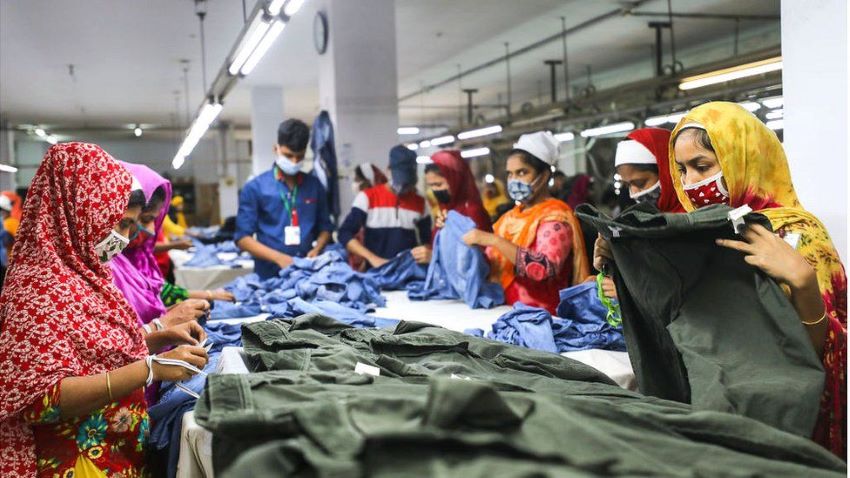
The just concluded Garmentech fair in Chittagong, irrespective of its small scale, was able to draw a decent crowd, which included decision makers and heads of garment factories. The fair held from August 29 to 31, 2019 hosted around 50 exhibitors and catered to the needs of the garment industry with products such as sewing machines, finishing equipment, CAD, boilers, servo motors and ERP.
Shirt automation pioneer Maica showed its automatic buttonhole indexer MA04. The machine, with its patented suction system, precisely ensures the buttonhole linearity and sews the front plackets of shirts of different widths. Japanese finishing company Naomoto was present with its basic irons, tables and steam generators. Naomoto has developed irons that reduce electricity consumption based on how customers use it.
As manufacturers are bracing up to eliminate productivity woes and cost challenges due to mismanagement in supply chain, they are receiving substantial support from ERP providers. One such company which participated, Skylark Soft, has created a cloud-based software to track real-time garment production from cutting to finishing. This is a fully Bangladesh company with a desire to fill in the information gap and improve data accuracy for the readymade garment sector. Its software has been adopted by some of the biggest garment manufacturers in the country.
Bangladesh fears impact of global recession
A global recession can hit Bangladesh’s export income and remittances, two life lines of the country’s economy. Recession can hurt Bangladesh’s export diversification as nearly 16 per cent of the country’s exports consist of non-readymade garment products. If there is a recession many companies in the Middle East would be out of business in which a good number of Bangladesh workers are employed. These workers can lose their jobs, having an adverse impact on the country’s remittances.
The recent slowdown in the US economy, dismal German economic performances, lowest ever industrial production growth in China in recent times, and a contraction in the economies of Argentina, South Africa and Iran are warning signs of a possible global economic meltdown.
Though Bangladesh is getting some benefits from the US-China trade war, economic diversification can help Bangladesh avoid the impact of a possible economic recession. However such diversification needs investments. Value addition is one way out and being sustainable is another. The country has to take initiatives to capture more low-end apparel manufacturing relocation from China. Bangladesh exports low-end garment products. Apparel exports contribute 84 per cent to the country’s total export earnings. Bangladesh has already witnessed double-digit growth during the July-May period of the current fiscal year.
Lack of knowledge hampers growth of plus-size market
"Miniscule in size as of now, plus size start-ups are searching for venture capitalists who can change the dynamics of their business by providing them adequate funds. However, Nadia Boujarwah, Cofounder of the plus-size personal styling service Dia&Co, notes investors usually try to match their current opportunities with previous successes which works against the startups as they still have to prove their capabilities. Also, the fact that only 10 per cent of decision makers in the segment are women compounds matters further."
 Miniscule in size as of now, plus size start-ups are searching for venture capitalists who can change the dynamics of their business by providing them adequate funds. However, Nadia Boujarwah, Cofounder of the plus-size personal styling service Dia&Co, notes investors usually try to match their current opportunities with previous successes which works against the startups as they still have to prove their capabilities. Also, the fact that only 10 per cent of decision makers in the segment are women compounds matters further. Of these, none are plus size. In order to raise funds therefore, the segment needs to hire a plus-size person who can understand and empathise with the problems faced by plus size shoppers.
Investors seek proofs of success
Boujarwah points out, though the market always presents huge opportunities, investors seek proofs for their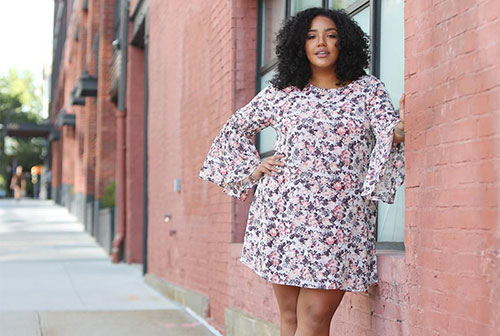 success. To prove them, Boujarwah and co-founder Lydia Gilbert invested their own money in to their firms. After exhausting their funds, they approached friends and family. It was only in December 2015 that their company could secure a $3 million in seed funding from Rebecca Kaden, a partner at the venture capital firm Union Square Ventures. This brought their company’s entire capital to date to $95 million.
Involving fans as business partners
On the other hand, Haber Jones had already built a community through her plus-size fashion blog The Pear Shape by the time she started pitching Part & Parcel to potential investors. She launched a successful campaign for a pair of wide-calf leather riding boots that came in four widths; and was an executive at Poshmark, leading growth and expansion. Despite her fashion bona fides, though, Jones was looking for investment partner who would understand her vision for the company.
Jobes initiated the "plus to plus" model, a sort of souped-up referral program that allows fans of the brand to sign up as "partners" and earn a 20 per cent to 30 per cent commission by evangelizing the products within their networks—the impetus for which was the rampant workplace discrimination that plus-size women still face. The brand also offers dimension sizing which provides an option to add extra room in the bust or biceps for a more tailored fit. The entire concept added up to something unique.
Brands need to expand their size range
Also spear heading the plus-size revolution are Waldman and Polina Veksler, founder and co-founder of Universal Standard who are trying to eliminate the difference between the "plus" and "straight sizes" To achieve this, the founders bootstrapped the company from their savings at first, which gave them a valuable degree of freedom. The company’s first round of investment—$1.5 million led by Red Sea Ventures—gave it a short runway from which to start ramping up the business, after which they got to work raising their Series A.
The second round of investment compromising $7 million, which closed in February 2018, was led by Imaginary, the venture capital firm founded by Net-a-Porter founder Natalie Massenet and investor Nick Brown, and joined by Red Sea Ventures, Gwyneth Paltrow, MatchesFashion's Tom and Ruth Chapman, Toms' Blake Mycoskie, SoulCycle's Elizabeth Cutler, and Sweetgreen's Jonathan Neman and Nicolas Jammet.
However, Waldman believes the investors still underestimate the potential of the plus-size market. According to her the biggest barrier is the lack of knowledge and understanding on the investment side. To combat this, established brands need to keep expanding their size ranges to prove that the market is there to meet the supply.
The circular fashion movement to shape core value system in future
"Around 60 per cent of Indian textile industry, projected to grow $223 billion by next few years, is cotton-based. Cotton cultivation consumes around 25 per cent of the world’s pesticides which is fast becoming a major cause of concern for the industry. Textile is the one of the biggest contributors of both dry and wet waste in the industry. Wet processing of textiles generates an enormous quantity of waste sludge and chemically polluted waters. Rising awareness about the challenges is compelling global and Indian brands and manufacturers to adopt the circular fashion movement."
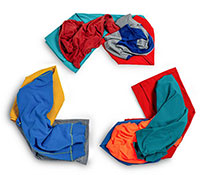 Around 60 per cent of Indian textile industry, projected to grow $223 billion by next few years, is cotton-based. Cotton cultivation consumes around 25 per cent of the world’s pesticides which is fast becoming a major cause of concern for the industry. Textile is the one of the biggest contributors of both dry and wet waste in the industry. Wet processing of textiles generates an enormous quantity of waste sludge and chemically polluted waters. Rising awareness about the challenges is compelling global and Indian brands and manufacturers to adopt the circular fashion movement.
Leading players are building a global circular fashion industry which not only eliminates substances that cause concern but also increases the durability of clothes, encourages recycling and uses available resources efficiently. This has been achieved through the introduction of many industry-led initiatives such as the Sustainable Apparel Coalition, a group of leading brands, retailers, manufacturers, non-governmental organisations, academic experts, and government organisations who developed the Higg Index.
New technologies, practices for fashion circularity
Local environmental challenges along with the global adoption of the principles of have brought Indian leaders on the brink of circular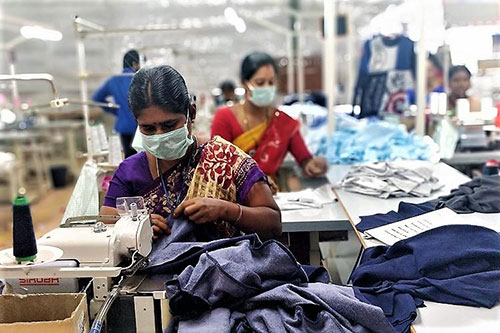 innovation. Organisations are experimenting and innovating towards the circular textile economy goals. New emerging start ups are inspiring the introduction of new technologies and business practices. For instance, Mumbai-based Boheco is reducing and replacing the use of cotton in textiles with hemp fiber. Similarly Chennai-based Trustrace is using blockchain technology to improve transparency and traceability in the supply chain. Two other start-ups Lionise and Kiabza are experimenting with new retail models of rental and second-hand clothing respectively.
Startups and stakeholders complement each other
Partnerships between stakeholders and startups are becoming common as corporations require large-scale organisational innovation to make an impact, while startups are agile and can respond to challenges with individual or small scale innovation.
Collaborations between the startups and corporations are becoming popular for the impact they have on the circularity agenda of these brands. Enablers are now identifying and driving ‘unlikely alliances’ between the two. The circularity movement is thus influencing the textile industry in a big way and is likely to shape its entire core value system in the next few years.