FW
Global textile waste increases by 811 per cent
Textile waste has increased by a massive 811 per cent from 1960 to 2015, says Retail Dive. The majority of this waste, approximately 66 per cent, is being dumped in landfills. Plastics show the largest increase in waste since 1960, a colossal 8,746 per cent. Rubber and leather, common materials used in footwear and clothing, have also shown a significant increase at 361 per cent.
Across the globe consumers now purchase more than 80 billion pieces of new clothing each year, with an increasing amount ending up in landfills. Companies want to be seen as being environmentally responsible. It’s about reducing waste during textile production and reusing or recycling waste to produce other products. Rugs and outdoor fabrics, for instance, are increasingly being made with recycled materials instead of new plastics. Fashion design students are experimenting using milkweed and flax to create luxurious fur from 100 per cent plant material. Another student design team has come up with the idea for a spandex-type elastic fabric using a protein found in oysters. An exhibit of textile innovations in the US included a dress made by a Japanese design team that features naturally glowing silk, made from silkworms injected with a green fluorescent protein derived from jellyfish.
Marcella Wartenbergh is new CEO of Pepe Jeans
Wartenbergh is replacing Carlos Ortega, founder and shareholder of the Pepe Jeans Group. Most recently, she was chief merchandising officer at Calvin Klein, a role she took up just four months ago. But she spent many years at PVH, the American group behind global brands including Tommy Hilfiger, Arrow, Van Heusen, Izod, Speedo and Calvin Klein. Before being promoted to chief merchandising officer, Wartenbergh held many roles at the retail group, including group president of global licensing and strategic initiatives at Calvin Klein. She cut her teeth in the merchandising division of Tommy Hilfiger in the Netherlands in 1999.
Pepe Jeans owns the Pepe Jeans London, Hackett and Façonnable brands and distributes Tommy Hilfiger and Calvin Klein in Spain. The group is majority owned by L Capital Asia, a private equity unit backed by LVMH, and M1, a subsidiary of Lebanese investment firm M1 Group. Pepe Jeans has 355 stores, including 219 Pepe Jeans locations, 105 Hackett shops, 29 Tommy Hilfiger outlets, two Norton stores and 16 Façonnable sites. The company is looking at closing a number of Façonnable stores as part of a wider restructure to turn around its finances.
October apparel event in Cambodia
Textile and Apparel South East Asia Summit 2019 will be held in Cambodia, October 28 to 29, 2019. Ten to 50 exhibitors are also expected to display their products and services at the event. This will be one of the biggest and most important gatherings of stakeholders of Southeast Asia’s garment sector. The summit aims to provide an opportunity to industry stakeholders to grow the textile and apparel business and ensure growth in Southeast Asia. It will showcase latest opportunities and trends as well as good practice sharing to accelerate the growth and development of the industry. Industry leaders and experts from all over the world will speak at the event. Major topics to be discussed are: the influence of the Regional Comprehensive Economic Partnership and the Comprehensive and Progressive Agreement for Trans-Pacific Partnership on the region’s textile and apparel industry; apparel procurement; different trends in the region’s labor markets; and the latest policy on investment in the industry.
Southeast Asia is among the leaders and plays an important role in global textile and apparel industry. The region has a strong comparative advantage for manufacturers, including market access, low labor costs, investment incentives, and a strong industrial base. In the region, Vietnam, Cambodia, and Myanmar have the fastest-growing textile and apparel industry.
Lyocell attracts worldwide attention
As a green regenerated cellulose fiber, Lyocell has attracted worldwide attention. With increasingly stringent environmental protection policies and awareness of social responsibility in enterprises and consumption, Lyocell is worthy of vigorous promotion and application.
The promotion of regenerated cellulose fibers is a concrete action for the industry to practice green development and promote sustainable development of the textile industry. It will significantly improve production technology and equipment level of new solvent-based cellulose fibers, and will also serve the structural adjustment of the textile industry. Transformation and upgrading of the regenerated cellulose fibers industry and the green manufacturing of textile fiber raw materials have made positive contributions.
With the continuous breakthrough of various basic research, equipment and process technologies in the green cellulose fiber industry and the advancement of industrialization, the industrial application of new solvent-based regenerated cellulose fibers will usher in a broad space for development. Of the 70 million tons of chemical fibers in the world, the total amount of regenerated cellulose fibers is less than five million tons, of which traditional viscose accounts for the majority. Major projects for the conversion of new and old kinetic energy include advanced basic textile new materials, key emerging strategic fiber new materials and bio-based chemical fibers.
Munich Fabric Start exhibits focus on sustainable fabrics, trims
A the just concluded Munich Fabric Start exhibitors focused a lot on sustainable fabrics, trims. GOTS-certified organic cotton fabrics printed with opulent bird and botanical prints, color saturated fabrics derived from cork and high shine metallic fabrics made with recycled polyester are among the statement-making fabrics were on display. Cotton alternatives like modal, Curpo and Tencel elevate fabrics with a drapey and soft hand feel. Linen and Tencel blends offered soft yet sturdy option, while thick pile organic cotton fabrics mimick the feeling of velvet and shearling.
Set to a color palette with names like zero emissions, white, naked truth neutrals and clean ocean blue, a dynamic range of hues can be achieved through vegetable-based dyes, waterless foam dyes and fabrics tinted with natural elements. Turkish denim mill Orta has showcased laser-friendly jeans coated with clay. Sustainable trims provide the finishing touch. Patches and labels made with recycled leather, compressed leather waste and recycled vegetable tanned leather are ideal for sustainable denim stories. Fabric labels made with organic cotton or recycled polyester serve ready-to-wear. Oeko-Tex-approved silicone labels deliver a sporty option.
German fashion sales down one per cent
Fashion sales in Germany fell 1.9 per cent in July 2019, compared to the previous month. Germany is the biggest fashion market in Europe but the country is expected to enter a recession in the third quarter of the year. Fashion sales in the United Kingdom, the second biggest European fashion market, have been on the rise for two consecutive months. Retail in the country was up 2.9 per cent in July. However, the rise was more moderate than in June, when the rise was 3.2 per cent. But like the German economy, the British economy is shrinking. During the second quarter of 2019, the GNP of the country dropped 0.2 per cent, due in part to the fear of a possible exit from the European Union without a deal. France is where fashion sales are showing the worst performance. For April, sales in the sector shrunk 6.7 per cent, being the biggest drop in the last seven months. France is the third biggest fashion market in the continent.
Fashion consumption in Europe has slowed down. Apparel, footwear and accessories market have weakened in the past few months and at the same time the ghost of recession is again haunting Europe.
Bangladesh exports to US up three per cent
Bangladesh garment shipments to the US increased three per cent this year compared to last year. Indeed, the US-China trade war has helped a lot. Also, automation in production of garments and distribution too helped. Garment businesses feel they cannot go far with traditional marketing and production in factories and they should be more technology dependent. Some Bangladesh exporters are already in business with Amazon.
Though Bangladesh is benefitting from the trade disputes, the biggest gainer is Vietnam, which received more work orders. The biggest challenges for Bangladesh are fast adoption of automation and exploration of marketing avenues alongside meeting shortages of skilled manpower. Bangladesh’s apparel manufacturers are facing tough competition in export destinations due to a devaluation in the currencies of all emerging countries. The country’s readymade garment sector has already lost its competitive edge in global markets due to a rise in production costs. A lot of money has been spent in improving safety standards to ensure a safe environment for workers. Also manufacturers have to implement the new wage structure from December. Last year shipments to the US, Bangladesh’s largest export destination, actually decreased two per cent.
Yarn Expo Autumn ’19: 30 per cent increase in exhibitors in Fancy Yarn Zone
Exhibitors in the Fancy Yarn Zone of the Yarn Expo Autumn 2019 will increase by 30 per cent from previous year and feature 118 exhibitors. The expo will also launch a new display area, Fancy Yarn Vision, within the zone. Fancy Yarn Vision will be open throughout the three days of the fair, from September 25-27, 2019 and feature advanced technologies and products from Chinese and overseas exhibitors. The zone has been gathering momentum in recent editions, as the fair is recognised for its all-encompassing range of yarn and fibre products, from natural to synthetic.
Debut of Fancy Yarn Vision display area (booth No. A02), supports growing demand for fancy yarn. With irregularities introduced during spinning, fancy yarn products add value in the form of color, texture and function, making it suitable for creating stand-out fashion and other finished textile products. The display area will offer exhibitors a platform to display their latest collections to a wider audience, while interested buyers can then streamline their sourcing trip by heading directly to individual booths.
The increase in fancy yarn exhibitors further reflects the fair’s commitment to meeting a variety of sourcing needs. Innovative yarns are a key way for industry players to spin and weave their way into the market for high performance. Sourcing options for innovative fancy yarn are now better than ever, due to increased growth in fancy yarn trade between Europe and Asia, which has opened up a vast new market that encourages competitive innovation. As Asia’s leading yarn and fibre trading platform, Yarn Expo has become a key event for exhibitors to reveal their latest technology. More functional innovation can be found from highlighted Korean exhibitors:
Yarn Expo is organised by Messe Frankfurt (HK) Ltd and the Sub-Council of Textile Industry, CCPIT. Yarn Expo Autumn 2019 will be held in Hall 8.2 at the National Exhibition and Convention Center (Shanghai), concurrently with the 25th Autumn Edition of Intertextile Shanghai Apparel Fabrics, as well as CHIC and PH Value.
SIMA awards top 10 performing group of mills
"At the 13th CEO Conference held on September 09, 2019 at The Residency Towers, Coimbatore, top 10 performing group of mills were awarded with the SIMA Technofacts Award for the year 2018-19. The awards were given away by the Chief Guest, CK Ranganathan, Founder Chairman, Cavinkare"
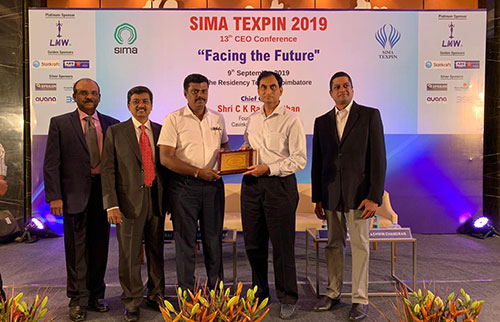
At the 13th CEO Conference held on September 09, 2019 at The Residency Towers, Coimbatore, top 10 performing group of mills were awarded with the SIMA Technofacts Award for the year 2018-19. The awards were given away by the Chief Guest, CK Ranganathan, Founder Chairman, Cavinkare
GHCL Unit II and I were ranked on the first and second position. The Unit II of the Sri Jayajothi & Co were ranked on the third, ninth and fourteenth position. The fourth and seventh ranks were occupied by the M Unit of the Precot Meridian while its C Unit bagged the fifth rank. The sixth rank was bagged by Premiere Cotton Textiles, the eighth by Sambandham Spinning Mills, the tenth rank by Jagannath Textile Company, eleventh by Loyal Textiles, twelfth by Premier Spinning & Weaving Mills; thirteenth by the Unit II of Jay Textiles and fifteenth by Shri TP Textiles.
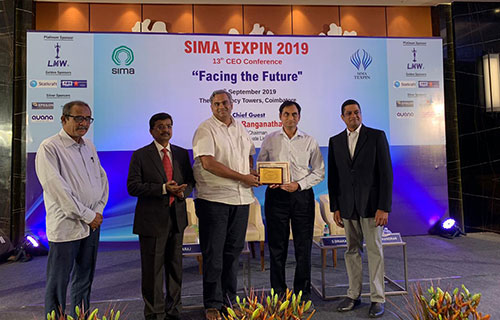
The awards were given away by CK Ranganathan, Founder Chairman, Cavinkare accompanied by P Nataraj, Chairman, SIMA; Ashwin Chandran, Vice-Chairman, SIMA and S Dinakaran, Jury Chairman, Technofacts Awards.
Italian Converter launches E.C.O. KOSMOS, a new range of green materials
Italian Converter has launched E.C.O. Kosmos, a new range of green materials. E.C.O. stands for Ecologic, Conversion, Optimisation, three unique concepts and values that embody Italian Converter DNA: sustainability, transformative process and quality improvement. For over 25 years, Italian Converter has been creating high-quality materials for some of the leading fashion and accessories brands.
The collection offers complete and balanced range sustainable materials - from natural to eco high tech onesthat are transformed, enriched and valued in 9 high-tech cuttingedge innovations thanks to the Italian Converter expertise. The natural line starts from bases of cotton bonded with Amni Soul Eco®, an enhanced •polyamide 6.6 that degrades within 5 years instead of decades, as other conventional ones do. The stretch innovations start from bases in GRS-certified Newlife™, a cutting-edge premium •Recycled polyester created using a High-Tech Conversion Model.
Through a mechanical process, used plastic bottles are turned into top-quality polymer and yarn which is 100 per cent traceable and 100 per cent Made in Italy. The whole process takes place within a 100 sq. km area in Piedmont in Northern Italy. Toupe and brik red E.C.O. Graffiti (100 per cent linen) on E.C.O. Aurora (cotton and Amni Soul Eco®) All the references make use only of water-based resins and Standard 100 by OEKO-TEX® certified dying. The result is resistant and transpiring solutions which come with bold and high-performing features, with a soft touch or even with a silky, yet strong, and enveloping feel. The designs range from rustic to contemporary and nod to jacquard, ‘authentic look’ and ‘drill’ hints. E.C.O. Kosmos reflects design, innovation and responsible values, as well as 100% Italian Converter know-how.