FW
Chris Roberts to be Mulberry’s new chairman
High end fashion label Mulberry has announced that Chris Roberts will replace Chairman Godfrey Davis who will soon step down from the group.
Roberts will assume the post at the end of September to lead abusiness whose revenues rose 23 per cent year on year to reach £152.4 million.
He was appointed to the board of Mulberry in June this year as non-executive director and is currently managing director of Como Holdings, the luxury hotel group owned by Malaysian husband and wife team and billionaire industry titans OngBengSeng and ChristinaOng, who also own Chalice a 56.2 per cent shareholder in Mulberry.
Mulberry said Davis would remain associated with the firm as life president in a non-board role to continue to allow the group to “benefit from his extensive experience”.
The Mulberry board said it intends to appoint an additional independent non-executive director and name a senior independent director in the near future.
C&A Textiles’ dyeing unit resumes experimental production
After a five-year hiatus, the dyeing unit of C&A Textiles, a listed company, resumed experimental production even though production in the garment unit of the company remains suspended.
As per an Apparel Resources report, the dyeing unit will resume full production after the trial run and will produce around 25 tonnes of cloth daily.
The trial production of C&A Textiles was inaugurated by Professor ShibliRubayat-Ul-Islam, Chairman (Senior Secretary), Bangladesh Securities and Exchange Commission (BSEC).
Listed on the capital market in 2015, C&A Textiles had raised Taka 45 crore from investors through initial public offerings, but had to halt production in 2017 due to loan fraud, less than a year after it was listed in the capital market.
The company had earlier cleared its longstanding dues thanks to Alif Group, which came forward to save the textile mill by investing Taka 50 crore as a share money deposit, after acquisition of C&A Textiles.
Sustainable supply chains will boost Sub-Saharan Africa’s cotton exports
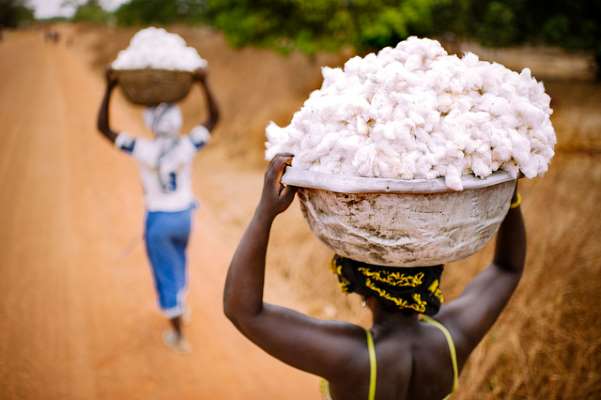
Accounting for 16 per cent of global exports, cotton remains an important export for Sub-Saharan Africa. Cotton production in the region has grown in recent years due to increased area under cultivation and improved yield, indicates the Organization for Economic Co-operation and Development (OECD) and the Food and Agriculture Organization’s (FAO). FAO’s market developments and mid-term projections for world cotton markets for 2022 to 2031 shows, area under cotton cultivation has increased due to a rise in cotton prices. Yet, cotton consumption across spinning mills in the Sub-Saharan Africa region remains limited as most produce is exported.
Export growth to boost market share
In the coming decade, exports from the region are projected to grow at around 1.7 per cent per annum with the region’s market share increasing by more than 1 per cent point to nearly 18 per cent compared to the base period. Textile and apparel exports from other countries like Ethiopia are also rising as processing capacities across the region are being enhanced. Driven by favorable economic conditions, expansion is boosting FDIs in the sector. This could also result in more mills of cotton in the long run and impact net export status.
In 2022, rising consumption and prices will continue to boost cotton prices in international markets. However, global demand may remain under pressure owing to the rising popularity of synthetic fibers, notably polyester.
Rising energy prices to impact cotton demand
FAO states, economic growth and urbanization will continue to impact per capita demand for cotton textiles in developing and emerging economies. Factors other than economic conditions in the developing world may impact global cotton consumption, production, and trade projections. Rising energy prices and the Russia-Ukraine war may impact demand in short term. The industry’s growth may also be affected by emergence of new COVID-19 variants and subsequent movement restrictions.
Adopt sustainable supply chains
FAO adds, raising of interest rates to contain inflation is likely to alter the cost of borrowing, hence investment plans in the sector. Growth in the sector could also be affected by providing of raw material to producers through textile recycling. To boost cotton demand, the industry needs to adopt sustainability standards in supply chains. They need to introduce measures to deal with effects of climate change including droughts and other adverse weather conditions.
adidas ready to appoint new CEO as business leaps ahead

The Supervisory Board at adidas AG is ready to appoint a new CEO in 2023, as current CEO Kasper Rorsted relinquishes his position to a new successor during the year.
Strengthened brand’s market position
In partnership with the Supervisory Board and Management Board, Rorsted will play a vital role in ensuring a smooth transition of this process. During his tenure at adidas AG from 2016, Rorsted repositioned adidas AG as one of the most trustworthy brands in the sportswear and accelerated its digital transformation. He helped the company grow online sales by almost five times, notes Thomas Rabe, Chairman.
During Rorsted’s tenure Adidas doubled sales in the world’s largest market, North America. It also gained formidable advantage in sustainability besides increasing diversity, equity and inclusion throughout the company. The share of women engaged in top leadership positions also increased sharply.
Making a successful restart
Having successfully divested TaylorMade, CCM Hockey and Reebok, adidas AG is now focusing on its core brand adidas. Marked by several economic obstacles in the last three years due to the pandemic and geopolitical tensions, the brand is set to initiate CEO transition to help the company make a successful restart.
An iconic sportswear brand, adidas has achieved great heights in its space. The brand’s business remained significantly disrupted in the past few years due to some external factors. Kasper Rorsted states, “adidas is an iconic sports brand. As a company, we have achieved great progress in strategic areas of our business. I am proud of our achievements as a team. The past years have been marked by several external factors that disrupted our business significantly. It required huge efforts to master these challenges. This is why enabling a restart in 2023 is the right thing to do - both for the company and me personally.”
At the moment adidas business is growing almost 85 per cent and it aims to accelerate this growth across all markets and continue to operate without major disruptions in future.
India’s retail sector on a roll with 31 new malls being developed

Being on hold for two years, the retail sector in India is bouncing back with strong ROIs, says a new report by Anarock. Around 31 new malls will come up by 2023-end, inviting massive footfalls and generating jobs. The study states, shopping malls will house around 76 per cent more retail spaces this year as compared to the previous year. Around 15 new malls are scheduled to open by the end of this year, while 16 others would be operational by the end of 2023. This would create a huge opportunity for developers and investors besides boosting employment in various regions.
Malls emerge new investment destinations
The upcoming malls are scheduled to open in 12 Tier I, II and III cities including Chennai, Bengaluru, Ahmedabad, Hyderabad, Mumbai, Pune, Baroda, Badaun, Indore, Nagpur and Udaipur. As per Amit Jain, Director, Mahagun Group, malls have emerged the ideal investment destinations. Rising consumer demands are boosting footfalls, creating a new demand for commercial spaces. This is benefitting CRE to a great level, adds Jain.
Ajendra Singh, VP-Sales & Marketing, Spectrum Metro, notes, commercial real estate is witnessing immense development in Tier I cities. Favorable returns are attracting retailers to invest in such projects, he adds. The prominent positioning of these projects also plays an important role in attracting developers to plan more such developments, Singh observes.
Research show, new malls being constructed on approximately 10.15 million sq. ft. area in Tier I, II and III cities are likely be to operational by 2022-end. Of the 31 malls expected to open this year, four malls will be located in Chennai, covering approximately 2.55 million sq. ft. area.
Dushyant Singh, Director, Orion One 32 opines, the strong positioning of commercial real estate post COVID, is likely to boost jobs on a massive scale. The moving of developers to Tier II and III cities with high-scale projects will boost the region’s economy thereby creating new employment opportunities, affirms Renu Singh, President - Sales & Marketing, Spaze Group.
VTG 2022 to attract over 200 brands from 14 countries
To be held from September 21-24 at the Saigon Exhibition and Convention Centre (SECC) in Ho Chi Minh City, the 20th Vietnam Int'l Textile & Garment Industry Exhibition (VTG 2022) will attract over 200 brands from 14 countries across the world.
The event is held in both in-person and virtual forms by Yorkers Trade and Marketing Service Co. Ltd., in coordination with a number of domestic and foreign trade promotion units.
According to Judy Wang, President, Yorkers Trade and Marketing Service, the event will provide an ideal platform for Vietnamese textile and garment manufacturers to gain access to advanced technologies and the latest market information, and connect with leading enterprises globally.
The exhibition will also include a series of seminars during which speakers will share expertise related to the field.
Statistics from the Vietnam Textile & Apparel Association (VITAS) show, Vietnam’s textile and garment exports grew by 17.7 per cent Y-o-Y to $22.3 billion from January-June.
Value of textile and apparel imports by the US increases 28.1% in June
The value of textile and apparel imports by the US increased by 28.1 per cent Y-o-Y to $11.45 billion in June this year. The volume of these imports surged by 18.2 per cent Y-o-Y to 10.65 billion sq m. The value of US apparel imports rose by 40.3 per cent Y-o-Y during the month to $8.64 billion while the volume of these imports rose by 18.9 per cent Y-o-Y to 2.76 billion sq m.
The volume of US’ textile and apparel imports from China declined by 11 per cent Y-o-Y to 3.25 billion sq m in June 2022. The value of these imports surged by 15.8 per cent Y-o-Y to $2.95billion. The value of US’ apparel imports from China in rose by 32.9 per cent Y-o-Y to $1.98 billion while the imports volume surged by 12.5 per cent Y-o-Y to 1.04 billion sq m. Compared with 2019, the total imports value from China decreased by 11.5 per cent, and the reduce rate saw a seasonal decrease.
Vietnam’s cotton imports drop 25% in July’22
In July 2022, Vietnam’s cotton imports dropped by 25 per cent Y-o-Y to 104,900 tons but increased by 12 per cent M-o-M. The US was the main source of Vietnam's cotton imports, accounting for 54 per cent to 56,448 tons. Imports from Australia and Brazil reached 26,026 tons and 7,390 tons, accounting for 25 per cent and 7 per cent respectively.
Vietnamese yarn imports surged by 0.29 per cent Y-o-Y but declined by 0.04 per cent M-o-M in July. Vietnam imported 91,300tons of yarns, up 0.3 per cent Y-o-Y during the month. By country, its yarn imports mostly originated from China, China Taiwan and South Korea. Of the total, 55,692tons of yarns were from China, 13,527tons were from China Taiwan, and 7,004tons were from South Korea, accounting for 61 per cent, 15 per cent and 6 per cent respectively. Vietnam’s yarn exports dropped by 37 per cent Y-o-Y and 16 per cent M-o-M, respectively.
Vietnamese fabrics imports decreased 6.7 per cent Y-o-Y and 11.9 per cent month-on-month. Vietnamese textiles and apparel exports surged by 18 per cent Y-o-Y and 2.7 per cent M-o-M.
Sri Lanka’s apparel exports grow 22.64% in July: JAAF
Provisional data from the Joint Apparel Association Forum (JAAF) shows, Sri Lanka’s apparel exports grew by 22.64 per cent to $522.14 million in July this year. Cumulative exports between January and July increased by 20.4 per cent to $ 3.3 billion from the corresponding period of last year and $ 3.07 billion in pre-COVID 2019.
In July, Sri Lanka’s apparel exports to the US grew by 17 per cent Y-o-Y to $ 213.6 million. Exports to the EU grew by 32.3 per cent to $154.29 million and to the UK by 29.3 per cent to $ 75 million.
In the first seven months of 2022, exports to the US grew by 27 per cent to $ 1.4 billion, to the EU by 14.5 per cent to $ 963 million and to the UK by 18 per cent to $ 455.4 million. Exports to other markets grew by 16.6 per cent to $ 484.50 million.
Despite resilient performance so far in 2022, industry sources fear prospects for the remainder of the year will remain challenging. This is due to rising inflation in the EU and the US and existing inventory in the latter. Energy crisis ahead of the upcoming winter is also a factor that points to depressed market sentiments.
North Carolina educational institutes team up with Honduras University for new textile workforce
North Carolina educational institutions are collaborating with a key Honduran University to educate and train thousands of students for the next generation textile workforce to meet a rising tide of nearshoring and onshoring in Honduras, Central America and the United States.
The groundbreaking initiative will launch a series of educational workforce development programs, ranging from training and certificate programs to undergraduate and graduate degrees, in textile-related areas of study.
The partnership comes at a defining moment for the US, Honduras and Central America, which are seeing historical levels of investment in textile and apparel production stemming from a global supply chain crisis that has driven a significant shift in sourcing out of Asia to the U.S. and the region. Nearly $1 billion of historic textile and apparel investment is anticipated in the US and Central America this year alone. And this partnership also creates an educational pathway to economic opportunity in Honduras and the region that not only creates a skilled and resilient workforce but can also help to address the root causes of irregular migration.