FW
Vietnam’s export earnings from textile-garments to surge to $45 billion
Vietnam’s export earnings from the textile and garment industry are expected to increase to $45 billion, compared to $40.4 billion, as per an Vietnam Plus report.
Truong Van Cam, Vice Chairman, Vietnam Textile and Apparel Association (VITAS), says, the industry has been growing at the rate of 26 per cent annually since the last five years. Vietnam is currently the world’s third largest exporter in this regard.
Textile and garment products exports from the country hold a global market share of 5.2 per cent, with the biggest importers being the US, the Republic of Korea, Japan, and Europe.
Cam held that to sustain the growth trend, the State should quickly disburse the financial aid package for enterprises and reform the mindset in attracting investment to textile and garment material production.
Meanwhile, businesses should adopt green manufacturing practices, including reducing and recycling waste, to meet the growing preference for environmentally friendly products, he added.
PVH Europe to sponsor Kingpins Shows MSP initiative
PVH Europe has been signed on by Kingpins Shows as a sponsor of its Most Sustainable Product (MSP) initiative with plans for PVH to produce a collection of garments featuring select MSP fabrics and washes.
As per the Spin Off report, PVH will produce the garments in its Amsterdam atelier using fabrics and processes selected by Miguel Sanchez, Textile Engineer and Kingpins Technology Leader and Piero Turk, Denim Designer and Industry Consultant. The garments will be washed by Italian finishing machinery maker Tonello. The Most Sustainable Garment collection will be showcased at Kingpins Shows in Amsterdam and New York.
The MSP initiative was launched by Kingpins to showcase new sustainable innovations, developments and practices from exhibitors at Kingpins shows.
Prior to Kingpins shows in Amsterdam and New York, Sanchez reviews sustainable products and processes from Kingpins exhibitors and then meets with companies at the shows to scout additional sustainable innovations.
Kingpins publishes a list of MSP development on its website, Kingpinsshow.com, as a resource for designers and brands looking for the latest sustainable developments to help them make informed choices about their production and their products.
Inditex, Carbios participate in the Whitecycle initiatve
Spanish clothing giant Inditex, French biological recycling specialist Carbios, and French group Michelin are participating in the initiative titled Whiltecycle, a consortium of 16 European entities, both public and private.
Announced on August 9, the new gathering of businesses aims primarily to achieve the objectives set out by the European Union for 2030 concerning CO² emissions. The consortium predicts that, by the end of the decade, adopting circular solutions will make it possible to recycle over 2 million tons of PET (complex waste containing textiles) per year and to reduce local CO² emissions by two million tons.
The consortium has an overall global budget of €9.6 million and funding for Europe totaling close to €7.1 million. The business Michelin will be in charge of coordinating its operations and the group’s partners are based in five countries: France, Spain, Germany, Norway, and Turkey.
The consortium has highlighted four areas of innovation comprising the development of sorting technology for complex waste streams, pre-treatments and enzyme-based processes to sustainably decompose materials, the repolymerisation of recycled monomers into like new plastic, and the production and quality verification of new products made from recycled plastic.
Exports orders to Texprocil crosses Rs 470 crore
Exports orders to the Cotton Textile Export Promotion Council of India, popularly known as Texprocilmay have crossed Rs470 crore ($59 million) at the three-day reverse buyer-seller meet held recently in Mumbai.
Having over 50 stalls of Indian suppliers displaying yarns, fabrics and home textiles, the show also featured international buyers from over twenty countries invited by Texprocil visited the event.
ManojPatodia, Chairman, Texprocil said the exhibitors and visitors had made on-site bookings to the tune of $6.4 million (Rs51 crore), while orders worth $59 million (Rs470 crore) are in the negotiation phase.
Given the current global market dynamics for cotton textiles, the orders reflect encouraging business prospects in the coming months, he added.
The China Plus One strategy of most international buyers has helped textile companies in India bag good orders at the event.
During the show, region-wise B2B meetings were held. Also, Indian sellers had the opportunity to meet all the overseas buyers during these pre-scheduled B2B sessions, said Texprocil.
8th edition of GartexTexprocess to be held from May11-13, 2023
After delivering two strong back-to-back editions this year, GartexTexprocess India aims to unite the industry once more by providing exemplary business opportunities through its eighth edition which will be held from May 11 – 13, 2023 at JioWorld Convention Centre, Mumbai.
Backed by strong support from the Ministry of Textiles and chief industry associations, GartexTexprocess India came to a resounding conclusion with a footfall of 11,258 visitors in its seventh edition at PragatiMaidan, New Delhi. The trade fair also proved instrumental in promoting India’s domestic capabilities in denim and fabric production.
The trade fair also attracted international visitors from 21 countries including France, Indonesia, Portugal, Romania, Singapore, UAE, the UK and the USA, owing to an extensive display of over 1,000 products and machinery from 207 exhibitors.
Incorporated with Denim Show, Fabrics & Trims Show and Screen Print India, the trade fair received immense support from the Ministry of Textiles and trade bodies such as The Confederation of Indian Textile Industry (CITI), Retailers Association of India (RAI) and the Apparel Export Promotion Council (AEPC).
Moreover, the trade fair’s organisers MEX Exhibitions and Messe Frankfurt India also joined hands with industry bodies like Denim Manufacturers Association (DMA) and Fabexa / the nodal arm of Maskati Cloth Mahajan to bring India’s top denim and fabric manufacturers to showcase their production capabilities.
RoSCTL threatens Rajasthan garment industry competitiveness
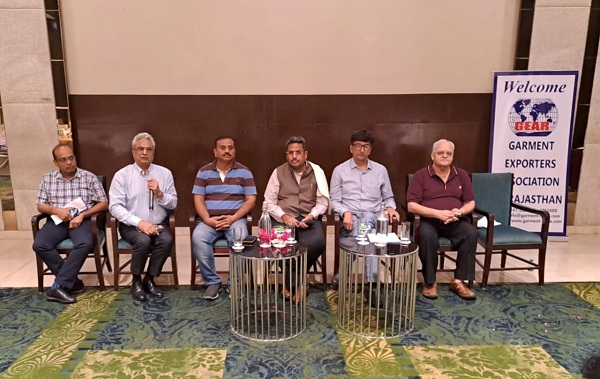
With the state’s garment manufacturing sector worth Rs 2,500 crore, Rajasthan is the largest manufacturer of garments and textiles. Jaipur, its capital has become the hub of garment manufacturing in India with over two lakh machines to produce 20 lakh garments daily. With a turnover of Rs 5 crore, the garment manufacturing sector in Rajashtan employs 5 lakh people in Jaipur alone. Of the current $44 billion exports by India, garment and textile exports account for $16 billion. The industry also employs around 4.5 crore workers and its value is expected to reach over $ 209 billion by 2029.
RoSCTL leads to loss of 15% profit margins
However, the garment sector in the state remains troubled by a 15 per cent loss in profit margins due to Rebate of State and Central Taxes and Levies (RoSCTL) reports MENAFN. The scheme is likely to result in a decline in the state’s export competitiveness. Launched with an aim to make India’s textile industry competitive, RoSCTL also aims to boost exports. However, changes made in the scheme in September 2021 have led to eroding of export margins for domestic textile exporters.
Resume cash reimbursement instead of scrips
Vimal Shah, President, Garment Exporters Association of Rajasthan (GEAR) urges the government to resume cash reimbursement instead of tradeable scrips, as these scrips are trading at 20 per cent discount. Sold by exporters to importers, the scrips are leading to substantial cash transfer from exporters to importers.
Vijay Jindal, Member, Export Promotion, AEPC & President, GEMA explains, exporters can sell scrips to importers and importers, in turn, pay import duty with these scrips as an alternative to cash import duty payments. The discount on scrips has also increased 3 per cent to about 20 per cent. This is benefitting importers, who are taking undue advantage at the cost of exporters.
Scrips discounting hurts sector’s competitiveness
The scheme aims to make India’s textile sector competitive against other low-cost producing countries such as Bangladesh and Vietnam. It conforms to the government’s intention to reimburse exports but is unable to achieve this due to discounting scrips.
Currently, the discounting on scrips benefits only importers, thus defeating the purpose and intent of the RoSCTL Scheme. To maintain the industry’s competitiveness, the government needs to make certain amendment to the structure of the RoSCTL scheme, else, demand may once again shift to low-cost countries.
Drop in cotton production, order cancellations impact Bangladesh RMG exports

One of the largest RMG producers in the world, Bangladesh is feeling the heat of draughts in major cotton producing countries like China, Europe, North America, Brazil and Africa. As per a Bloomberg report, cotton production in the US is set to fall 28 per cent, while Brazil is likely to see a drop of 27 per cent, production in India is also lower by considerable percentage. If cotton production in these countries indeed declines, it will have a severe impact on the RMG industry in Bangladesh, warns Monsoor Ahmed, Additional Director and CEO (In-Charge), Bangladesh Textile Mills Association (BTMA).
The association imports 10 to 11 per cent cotton from the US and 4 to 5 per cent from Brazil. It also imports yarn and fabrics from China. A decline in cotton production in these countries would therefore, have a negative impact on Bangladesh’s RMG production, he adds. Himel Khan, Director, Mithela Textile also predicts, the textile sector in Bangladesh may be deeply impacted by falling cotton production in the US, Brazil and other countries.
Walmart’s order cancellation to step up RMG losses in Bangladesh
Meanwhile, order cancellations by Bangladesh’s largest apparel importer, Walmart may also cause huge losses to the RMG sector, says Shahidullah Azim, Acting President, Bangladesh Garment Manufacturers and Exporters Association (BGMEA). Walmart cancelled orders by 30 per cent and is deferring shipments of certain orders, he adds. Mohiuddin Rubel, Director, BGMEA anticipates, this would prove to be a big blow for the industry as already production costs have increased due to various reasons. As the situation worsens, exporters can no longer do anything except keep a keen eye on developments.
Inflation leads to 30% order drop
European Union’s statistical office, Eurostat, pegs the inflation rate in the Eurozone in July 2022 at around 8.9 per cent. It is likely to be higher at 9.8 per cent in EU and 10.1 per cent in the UK. Together, the EU and the UK account for over 60 per cent in the last fiscal year. The surge in inflation in the US to 8.5 per cent in July 2022 is resulting in a fall of purchase orders from these by 30 to 35 per cent, reflects Statista data. Drop in orders is leading to closing of many big factories in Bangladesh, adds Azim. In August, Bangladesh’s export earnings declined around $500 million due to fewer orders, delay in delivery and forced discounts.
Hike in fuel prices impact production costs
Production costs in Bangladesh have grown around 15 per cent due to a rise in fuel price and a 20 per cent rise in logistics costs for the manufacturing sector, explains Shovon Islam, Managing Director, Sparrow Group. A hike of 62 per cent in yarn price, 500 per cent in freight cost and 60 per cent in chemical cost have also impacted the Bangladesh apparel production sector, observes Rubel. Rubel points out for the past few months other factors that have hindered growth are: drought in cotton-producing countries, cancellation of orders, global inflation, Russia-Ukraine war, power shortage among others.
Reliance to invest Rs 75,000 crore for petrochemical capacity expansion
Reliance Industries plans to invest Rs 75,000 crore in the next five years to expand petrochemical capacity.
The investments, notably, will be utilized to set up a PTA plant, and expand polyester capacity. Reliance will build one of the world’s largest single-train PTA plant of 3 MMTPA capacity at Dahej. It will also invest in a 1 MMTPA PET plant at Dahej.”
Both PTA and PET will be targeted for completion by 2026.
Reliance will also reinvest in Polyester Filament Yarn (PFY) and Polyester Staple Fibre (PSF). Polyester expansion with capacity of over 1 MMTPA will be completed in phases by 2026
AJIO, integrated omni channel platform of the company, is one of the most loved fashion destinations, with 80 per cent of purchases from repeat customers. AJIO Business, Reliance’s new commerce initiative, works with merchant partners across 3,500 towns, giving them access to a collection of over 8,000 regional and national brands and a wide portfolio of our own brands.
ErmenegildoZegna Group posts 20.8 % growth in H12022
The ErmenegildoZegna Group reported 20.8 per cent growth in H12022 boosted by A strong performance in the US, Western Europe and the United Arab Emirates.
In the six months ended June 30, the company’s revenues grew to € 729 million compared with €603.3 million in the same period last year. This was achieved despite the ongoing macroeconomic and geopolitical instability, and the impact of COVID-19 related measures in the Greater China region.
In the second quarter of 2022, sales rose 16 percent to €351.4 million.
Revenues of the Zegna brand increased 19 percent to €553 million from €466 million last year, a result of the repositioning of the brand. Shoes and luxury leisurewear continued to perform strongly, while tailoring and Made to Measure have rebounded.
Thom Browne sales climbed 30 percent, reaching €185.8 million compared with €142.5 million last year, boosted by growth across all lines, and particularly womenswear, and to the rollout of e-commerce through Tmall in the Greater China region, which was launched in the second half of 2021.
Revenues in the Greater China region declined by 14 per cent €to 247.2 million in the first half of 2022 compared with the same period last year, dented by the temporary store closures and lower customer traffic due to restrictions in major cities across the region.
Revenues in the rest of the world increased by 51 per cent to €481.8 million in the first half, up 53 percent. The second quarter showed a 59 percent rise, up from 48 percent in the first quarter of the year.
On cusp of big growth, India’s textile & apparel industry needs more policy support
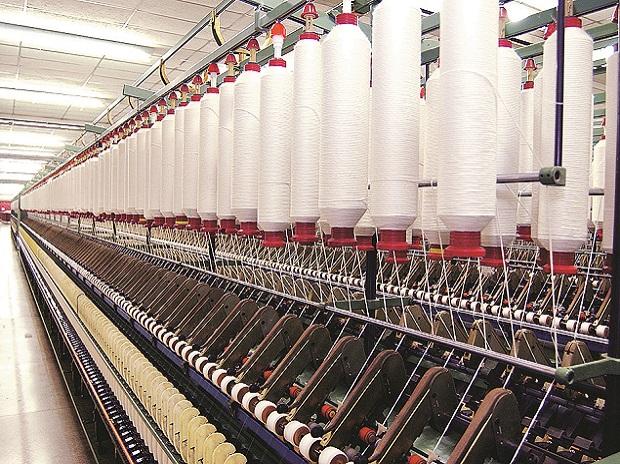
Having suffered considerable decline during the pandemic, the Indian textile industry is on a road to recovery. Contributing almost 7 per cent to India’s GDP in 2019, the industry is expected to grow at a CAGR of 10 per cent from 2019 to 2026 to reach $190 billion by 2026 and further to $209 billion by 2029.
The industry has been attracting significant investments for the last few years. From April 2000 to December 2020, foreign direct investment into the sector was $3.75 billion. The ICIL also invested $2.6 million in the sector in May 2021. Besides, the government authorized 100 per cent automation in the sector. Investments are being attracted through two new programs: Scheme for Capital Building (SCBTS), Production-linked Incentive (PLI). Together, these two schemes are helping the industry improve output and exports. By 2025, investments in the sector are likely to reach $120 billion and exports S$ 300 billion.
Positive future outlook
Known for the use of a wide variety of natural and synthetic fibers and yarns, the textile industry in India is technologically advanced and capital-intensive. Growing trade mechanization has created huge opportunities. Reaching a value of $121 billion, the Indian textile sector is projected to be the second most attractive market by 2025. India’s robust GDP growth is increasing the spending power among consumers, boosting demand for textile and apparel products. One of the most diverse textile industries across the globe, it offers hand-woven textiles on one end and capital-intensive mills on the other. This increases the range of possibilities.
Growth obstacles
Despite numerous investment opportunities and bright future prospects, the India’s textile industry also faces many challenges. Frequent policy changes both at the state and national level create several obstacles in the sector’s growth. The industry also suffers due to GST on its products that make them costly.
Another challenge faced by the industry is lack of access to latest technologies and machines. It is also unable to fulfill global export market criteria and faces obstacles like child labor, competition from neighboring low-cost clothing making countries and personal safety regulations.
Reforms the need of hour
To overcome these challenges, India’s textile sector needs to increase its competitiveness by modifying certain practices and implementing new ones. It also needs to emphasize on technological upgradation and capacity expansion. Government clearance for effluent treatment facilities to elevate the commercial market in its entirety is also advocated.
Supporting small and large-scale players can help the industry reach new heights. In addition, the sector needs to educate workers to suit changing needs of contemporary market besides decreasing taxes on government-subsidized exports. Sufficient gas supply would also help the textile industry continue operations unhindered. Besides, the government needs to create capital subsidies, provide a single point of contact for resolving industry issues a set price for yarn on an annual basis.
The rise in disposable income has boosted demand for India’s textile products both locally and internationally. The future is also brightened with rapid expansion of the retail sector, government subsidies and investments.