


FW
South African apparel workers recieve COVID-19 relief funds
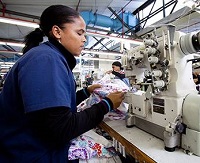 Workers in the South Africa clothing manufacturing industry have become the first in country to receive an industry-wide COVID-19 Unemployment Insurance Fund (UIF) relief pay-out
This follows on the ground-breaking collective agreement which was concluded under the auspices of the clothing industry bargaining council, on 23 March 2020, and which was promulgated as law by the Minister of Employment & Labour on 26 March 2020.
The provisions of that unique collective agreement caters for clothing industry employees to be paid their full wages, made up of a combination of voluntary employer contributions and worker UIF monies, for a 6-week lockdown period.
The agreement was concluded between the COSATU-affiliated Southern African Clothing & Textile Workers’ Union (SACTWU), the Apparel & Textile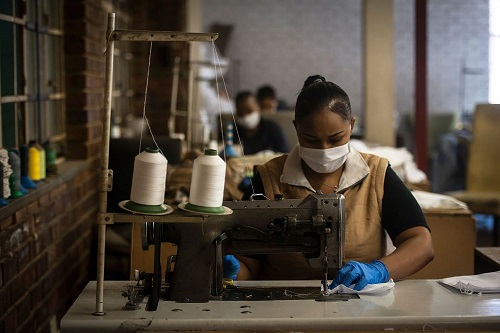 Association of South Africa (ATASA), and the South African Apparel Association (SAAA).
On Friday 17 April 2020, the bargaining council received its first tranche of worker UIF funds, which was to compensate workers for loss of wages for the first full day of the lockdown, 27 March 2020, and which was the last day of that pay-week in the clothing industry.
On the same day that the funds were received, these worker UIF monies were seamlessly transmitted from the bargaining council’s special dedicated COVID-19 bank account to the wage-bank accounts of 367 companies employing 38 751 employees.
While there are still very serious delays in the receipt of COVID-19 UIF monies due to clothing and textile workers, our bargaining council is pleased that this innovative payment transmission system which we had designed in conjunction with the UIF, has concretely proven to be efficient and effective. It is now our hope that the outstanding worker UIF funds still due to clothing and textile workers will now be speedily processed and transmitted to the bargaining council for transfer to workers.
The signatory parties of our COVID-19 Lockdown Collective agreement remain committed to work closely with the UIF, to help resolve the remaining practical difficulties which we are still confronted with.
“Discount retailers and value-oriented brands stand to win”
Usha Periasamy, Director, Brands & Operations, Classic Polo
 “Consumer spending is dramatically curtailed during a recession. Consumers have adopted short-term behaviour during the pandemic that in many cases will become permanent, as a lesson learned from such unprecedented occurrences. Not only do consumers become more financially conservative but also credit may become less available and a large cohort may go into default on their debt, dramatically limiting purchasing power. Consumers will wake up from the pandemic in a new economic reality, changing their commercial behaviours in extreme ways.
In this climate, discount retailers and value-oriented brands stand to win. This will also boost the trend toward value-oriented store brands. Spending will aggregate on need-based categories, with discretionary categories declining. Classic Polo is a value for money brand and therefore, presumes to stay stable with remodelling of strategies along with the advantage of in-house manufacturing. Future is cloudy and ambiguous for all brands and Classic Polo is no exception. How quick we understand consumer sentiment and resign the marketing blueprint with various permutation combinations will decide the business outcome.”
What is the current situation of India’s garment industry?
The COVID-19 pandemic forced retail down shutters, prompting an atypical disruption of economy. Retailers and brands will face numerous short-term challenges related to cash flow, supply chain, labour force, health and safety, consumer demand and marketing. Post pandemic a very different world would emerge. In order to ensure a future where businesses not only survive but also move ahead, it is critical to predict what a post-pandemic world has in store for us, and then we will begin to remodel to match the new reality.
How would be the consumer spending be affected?
Consumer spending is dramatically curtailed during a recession. Consumers have adopted short-term behaviour during the pandemic that in many cases will become permanent, as a lesson learned from such unprecedented occurrences. Not only do consumers become more financially conservative but also credit may become less available and a large cohort may go into default on their debt, dramatically limiting purchasing power. Consumers will wake up from the pandemic in a new economic reality, changing their commercial behaviours in extreme ways.
In this climate, discount retailers and value-oriented brands stand to win. This will also boost the trend toward value-oriented store brands. Spending will aggregate on need-based categories, with discretionary categories declining. Classic Polo is a value for money brand and therefore, presumes to stay stable with remodelling of strategies along with the advantage of in-house manufacturing. Future is cloudy and ambiguous for all brands and Classic Polo is no exception. How quick we understand consumer sentiment and resign the marketing blueprint with various permutation combinations will decide the business outcome.
China has played a pivotal role in the garment industry but after this, can we look at India as the next sourcing hub?
China being the major and main source for all industries, the slowdown will surely have an impact on overall business in a negative way. Significant qualities of our woven fabrics come from China and naturally if goods do not arrive on time, readymade garments industry is affected. If the crisis in China is prolonged, the impact would be severe. It is not easy to shift sourcing destination overnight. But buyers will have to look for alternative sources. Are the buyers ready to pay more is a million dollar question? So, it is not that easy. But yes, companies will look beyond China to survive in the long run. Need to wait and watch.
How is Classic Polo overcoming this challenge?
Those that sell high-demand pandemic necessities online are/will aggressively hire to meet demand they are increasing employee pay and boosting their supply chains. These retailers could well emerge with growth on a consistent scale.
How do you foresee this fiscal year performing?
The net result for retail may be that a few retailers emerge stronger and many specialty stores and independents no longer exist. Even well-positioned retailers may find they have to permanently close under-performing stores and make drastic cost cutting efforts to bolster their balance sheets. It’s easy to imagine India having 20-30 per cent less retail space by the end of the pandemic.
Has the government done enough to take care of the garment industry during this challenging time?
Apparel industry bodies are approaching government with various pleas and suggestions to support and combat the situation, which are yet to formalise. Common support on extension of tax payment and other deferments are being extended, while how much this will support businessmen and industry to overcome the pandemic’s residual effect is inexplicable. A significant consolidation of retailers will fundamentally result in emergence of new competitive landscape and partner ecosystem, this is a puzzle to solve.
AAFA collaborates with 65 industry gruups
 American Apparel & Footwear Association (AAFA) recently collaborated wtith 65 industry groups in a call to governments and international financial institutions to enact coordinated efforts to address the economic crisis caused by the COVID-19 pandemic. Representing the textile, apparel, footwear, travel goods, and fashion industry, the groups represent companies, workers, and consumers in each and every part of the global supply chain.
As companies have closed retail locations in response to social distancing needs, revenue used to employ millions of workers around the globe has dried up. This lost revenue has had knock-on effects through the global supply chain. To respond to this economic crisis, the groups ask that governments and international financial institutions:
- Enact temporary stimulus measures to ensure liquidity; - Undertake temporary duty deferral and tariff relief to support liquidity and cash flow, and keep workers employed; and - Refrain from imposing new trade restrictions and not impede production or delivery of PPE, its intermediate products, or raw materials.
In the statement, the organizations recognise that many of these items were addressed in a G-20 statement released in March, but add that, “words mean a lot, but the actions will determine how fast and how well we can emerge from this crisis.”
“Companies are desperate for cash to pay their workers and suppliers, while at the same time access to revenue is down due to closed stores,” said Steve Lamar, president and CEO of the American Apparel & Footwear Association. “This is why we need governments – both the U.S. and globally – to work together with international financial institutions to make sure financial resources are available to keep supply chains solvent and workers employed. If this is not done quickly and thoughtfully, we risk burning a hole in the global supply chain. It is essential that leaders act now to support these networks that employ millions around the world.”
Wrangler(R) to announce new water conservation goal
Wrangler®, the global icon in jeanswear and casual apparel, plans to announce a new, more ambitious water conservation goal later this year. The brand recently saved over 7 billion liters of water in its production of denim products. The savings surpasses the denim brand’s 2020 global year-end goal to save 5.5 billion liters and as a result,
Wrangler manufacturing achieved the water savings by increasing both water efficiency and water recycling in the denim finishing process since 2008. The brand’s manufacturing facility in Torreon, Mexico regularly recycles up to 85 per cent of the water through sequential batch reactors, micro-filtration and reverse osmosis. At the brand’s other manufacturing campuses, efficiencies such as merging or removing finishing steps and enhanced enzyme technologies were able to reduce water use without compromising quality.
In addition to conserving water, the brand has high water quality standards to ensure the water returning to the local communities is cleaner than when it was taken for use. All owned and operated facilities and Wrangler suppliers are required to adhere to these strict standards.
Fast Retailing launches program to pay suppliers
Uniqlo owner Fast Retailing has launched robust program in place to ensure suppliers get the money they’re owed. The brand is committed to payment for completed orders and orders where production has commenced, with no change to payment schedules in place prior to Covid-19 disruptions”.
It will use fabrics or materials already purchased by partners to fulfill orders or will provide compensation should they later become unnecessary. It also plans to consult each of its production partners, in accordance with ‘Responsible Procurement Policy’, to understand the current financial health of the partner, and to offer support if needed.
The company has engaged with BetterWork, a joint program between the International Labor Organization (ILO) and the World Bank Group's International Finance Corporation (IFC). It has provided factories with guidelines to strengthen their sanitisation measures and to help them understand their obligations to employees in case of factory closure.
Tirupur knitters exploit the $2-billion PPE opportunity
The Economic Times reports South India’s cotton knitted garments capital, Tirupur, is leveraging the $2 billion business opportunity to make PPE equipment. About 200 units in this in Tamil Nadu town are currently making (PPE, mostly to serve needs within India. Industry body Tirupur Exporters Association has been pushing local manufacturers to improvise on products to meet global standards.
An incubation centre for textiles and apparels in the city is also trying to develop a reusable, biodegradable, antibacterial facemask. This will be cotton, three-layered mask which will be developed with the outermost layer being water repellent and anti-viral, the middle layer filtering the virus and the innermost layer will be finished in a way that provides comfort to the mask wearer.
Meanwhile the magnitude of the coronavirus outbreak in the US and Europe and its impact on the economies have left these exporters worried, as those are their biggest markets.
The garment cluster manufactures textiles worth Rs 60,000 crore per year for exports and domestic markets. The knitwear industry here has provided jobs to about 8 lakh people (800,000), half of whom are migrants. Local executives said they were managing their units with just about three lakh people now, as the rest have gone home when the lockdown was clamped.
Pepe Jeans, Tom Ford & Max Mara ranked as least transparent fashion brands
An index published recently by Fashion Revolution, Max Mara Pepe Jeans and Tom Ford are among the least transparent fashion brands when it comes to providing information about their supply chains, that found little progress in the industry. The annual index by Fashion Revolution advocacy group ranked 250 of the world's biggest brands according to how much information they disclose about their social and environmental policies, practices and outcomes.
H&M, C&A, Adidas, Reebok and Esprit topped the index while Max Mara, Pepe Jeans and Tom Ford –among at least 10 brands that scored zero points. On average, the brands measured in the index scored 23 per cent - up two percentage points from last year - judged on 220 indicators including working conditions, living wages, forced labour, supplier disclosure and buying practices.
COVID 19: Brands collaborate with ILO to support manufacturers
ILO says a group of employers’ organizations, unions and major brands in the garment industry have collaborated with them to support manufacturers affected by the coronavirus outbreak. Under this agreement, brands and retailers commit to paying manufacturers for finished goods and goods in production. They will also commit to maintaining open lines of communication with supply chain partners about the status of business operations and future planning.
Brands and retailers who have signed up to the call to action include Adidas C&A, H&M, Inditex, M&S, Primark, Under Armour and PVH. The group called on governments and financial institutions to accelerate access to credit and income support.
ILO further revealed that an international working group will be set up within the next two weeks to elaborate the steps to deliver on the commitments.
Retailers to reopen stores by June: Walter Leech
Walter Loeb, former retail analyst and now consultant, expects most stores to reopen in May or June but in staggered waves. Fashion brand Mango has already started reopening its stores. The Spanish retailer plans to open 16 additional Dutch shops on top of 42 in Germany. Another 27 stores will reopen in the Czech Republic, Latvia, Georgia, Cyprus and Ukraine.
Most retailers are readying their back-to-school and fall assortments, or at least those orders that either have been reduced or not fully canceled. According to Loeb, retailers that plan to open stores locations later in the summer, either late August or early September, will need to stock merchandise better suited for fall and early winter.
Southern India Spinners’ Association seeks relief from Tamil Nadu government
N Murugesan, President, Southern India Spinners’ Association (SISPA) says his association has requested the state government to provide immediate remedial measures, including sanctioning six equal installments for payment of electricity bills for March 2020, irrespective of the consumers (LT, LTCT and HT) without levying belated payment surcharge (BPSC)/any other additional surcharges or otherwise it may be deducted from the additional current consumption deposit (ACCD).
The association also requested the state government to advice TANGEDCO to collect minimum electricity charges for the recorded (actual) demand and not for the sanctioned demand during the lockdown period. SISPA also requested the government to adopt the same procedure for at least six months to overcome the financial crisis after the lockdown period. Murugesan revealed the 40 days nationwide lockdown, closing of borders between districts and states has affected the highly labour, capital- intensive textile spinning sector and has affected the revenue of the entire textile value chain. Hence, the association is seeking support at this critical moment to safeguard the industries and the millions of the workers in the nation.











