


FW
INDA’s World of Wipes and RISE 2020 Conferences transit to virtual format
INDA is transitioning two conference events scheduled for August and September to an all-virtual format for 2020 in deference to corporate travel policies and individual concerns about travel.
Registration is open for the virtual World of Wipes International Conference, aligned with the WIPES Academy training course, and the RISE (Research, Innovation & Science for Engineered Fabrics) Conference.
Virtual WOW offers 30 speaker presentations focused on breakthrough wipe technologies, buyer demographics, sustainability, industrial and flushable wipes, substrates, preservatives, single use plastics, and strategy-setting market intelligence. Presentations will also address industry changes prompted by COVID-19. All speaker presentations will be recorded and available near real-time and on-demand for 12 months.
Participants will connect with senior-level wipes professionals through audio and visual presentations on relevant technical and educational content with business engagement opportunities through virtual tabletop displays, web pages, video, live chat, and calendar appointments.
Virtual WOW event schedule:
• Virtual WIPES Academy – August 25-26
• Virtual WOW Conference Presentations – August 25-27
• 2020 World of Wipes Innovation Award Presentations – August 26
• Virtual WOW Tabletop Displays – August 26-27
• 2020 World of Wipes Innovation Award Announcement – August 27
Developed for technology scouts and product developers, the 10th edition of the Research, Innovation & Science for Engineered Fabrics Conference presents “What’s Next” in sustainability developments. Virtual RISE offers 23 speaker presentations focused on new developments in polymers, fibers, additives, and fabrics, from sourcing and disposal to reuse amid the trends that are driving nonwoven advances.
Virtual RISE event schedule:
• Virtual RISE Conference Presentations – Sept. 29-30
• RISE 2020 Innovation Award Presentations – Sept. 29
• RISE 2020 Innovation Award Announcement – Sept. 30
Hybridizing on-site solutions, virtual reality help designers offer unique fashion experience
 Even as fashion houses like Dior, Burberry and Fendi plan new shows to showcase future collections, a sense of uncertainty looms over people attending these shows. As Milan-based psychologist and psychotherapist Laura Manigrasso says, these shows might evoke three types of responses from consumers. They may either rush out to attend irrespective of the regulation; or chuck them completely and stay safe at home; or may adopt a mixed route of returning to normal life by following the rules.
Wider access and creativity
And as Paola Cillo, Associate Professor and Vice Director, Department of Management and Technology, Bocconi University says, the situation offers brands and designers an immense opportunity to be inclusive. Fashion has always been synonymous with creativity, change and innovation. Hence, designers will have to hybridize on-site solutions with augmented and virtual reality to offer unique fashion experiences.
Lack of physical spaces and imitations encourage designers to make the experiences more desirable and doable. It also makes these shows and luxury events accessible to mass number of fans. The use of digital tools also makes people less suspicious of the authenticity of these garments. The industry can be more creative and make their visuals more sophisticated, adds Emanuela Mora, Professor-Sociology of Communication, Università Cattolica del Sacro Cuore and Creative Director, ModaCult, However, to achieve this, it needs to maintain that energy and effervescence typical of live shows. Another benefit of these virtual shows is that by reducing their trips and costs, brands can stage even more events, less crowded and in strategic places.
Being responsible
According to civil lawyer Laura Cereda, people are adapting to the new normal. They are less afraid of the virus and are getting used to the protective measures, such as getting body temperature taken. Employers are also rushing in to protect their employees. The lockdown has made people more careful. They have realized that if they fall sick they also risk making others sick
Make in India fuels revival of leather and chemical industries
 The ‘Make in India’ sentiment is pervading across all Indian industries particularly leather and chemical industries which are pleading with the government to impose anti-dumping duty on import of Chinese footwear and chemicals like Sodium Sulphide and basic Chrome Sulphate.
Both these industries have been urging the government to increase import duties on these products by almost 35 per cent. Particularly, chemical manufacturers who are facing the wrath of cheap Chinese imports. Ramesh Juneja, Regional Chairman, Council of Leather Exports says, cheap import of Chinese chemicals for footwear treatment is fast eroding local manufacturers. Hence, the government needs to impose an anti-dumping duty on these imports.
Initiatives to battle Chinese imports
Leather and chemical manufacturers and suppliers in the country have decided to boycott Chinese commodities. They are also urging the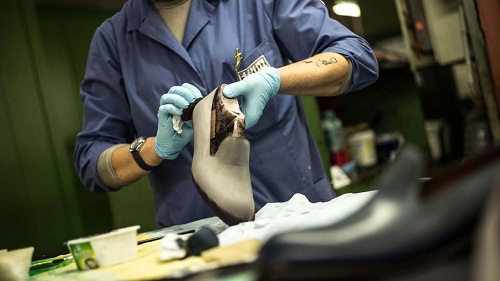 government to levy more taxes and duties on Chinese leather imports. These manufacturers are also attracting new investments in the sector. Oricon Enterprises has formed a joint venture agreement with Tecnocap, an Italy-based company for manufacturing lug caps. In 2019, Berger Paints India acquired a 95 per cent stake in STP, while Bharat Earth Movers (BML) manufactured the first coach in Mumbai under Make in India.
Though credible, these initiatives may not be sufficient to revive Indian leather and chemical manufacturing as India has very low manufacturing capacity. Also, cheap imports and failure to adapt to new technologies such as e-commerce, hampers growth.
Fashion struggles to survive
Closely linked with the leather and chemical industries, the Indian fashion industry is also suffering from low priced China imports. COVID-19 has forced many fashion companies to cancel orders. These businesses are unlikely to survive the pandemic due to massive drop in consumer demand for fashion especially in physical stores.
To tide over the crisis, many fashion brands have accustomed themselves to online sale channels. However, they are currently focusing on primary products such as masks, gloves and sanitzers. E-commerce labels like Myntra and Flipkart are offering huge discounts to attract consumers. However, the industry need to be revived urgently as there is a lot of unmet demand in the country.
The 127th Canton Fair promotes international trade development
The recently concluded 127th China Import and Export Fair (Canton Fair) promoted the development of international trade amid the COVID-19 pandemic. The event attracted over 25,000 exhibitors leveraged a wide array of display options, including graphics, video and 3D, to showcase their wares, in tandem with the presentation of a number of global debuts and smart products. Buyers from around the world, after visiting the exhibition hall, started conversations with sellers on the spot about potential orders or booked appointments to initiate a negotiation.
The live stream showroom launched at the fair provided exhibitors with additional opportunities to engage in enhanced interactive experiences with business partners. Exhibitors applied customized live stream solutions to present and highlight their competitiveness, for example, creating a virtual reality showroom or displaying a factory's automated production line. Exhibitors had the option of scheduling their live stream based on the client's time zone, allowing for the optimization of the experience no matter whether the client originated from the Americas, Europe, Asia Pacific, the Middle East or Africa.
Size-inclusive brands gain in popularity
The fashion search engine Stylight has been following inclusive brands that have gained in popularity in recent months. A case in point is Savage x Fenty by Rihanna, which has become well-established in just three years.
With the Savage x Fenty brand, singer Rihanna aims to offer affordably priced quality lingerie to all women, irrespective of their ages and sizes. According to the recent figures reportced by Stylight, the venture is a runaway success. The search engine noted a huge jump in the number of clicks for the brand, which were up by 1,126 per cent in May 2020 when compared to the previous month. Not only has Rihanna organized grandiose shows with women of all backgrounds, and of all ages, shapes and sizes, but she has also revolutionized the lingerie market.
Less well-known to the general public, the green size-inclusive brand Felina, which appears to be rapidly gaining in popularity, is also one to watch. The number of clicks on products by the label was up by 986 per cent in May 2020 when compared to the same month a year earlier.
Similar increases have been reported for swimwear brands offering a wide choice of sizes, which are also enjoying support from a fast-growing community. This is notably the case with the Reina Olga brand and Frankies Bikinis .
More recently, activewear brands have also branched out into the inclusive market with products for all shapes and sizes, and not just the athletically built. For example, the Prana label has seen an 8,179% percent increase in clicks on its products in May when compared to the same period a year earlier.
Informa Cancels September trade shows
Informa Markets has cancelled its September apparel and footwear trade shows in New York City. This includes Coterie, Fame, Moda and Sole Commerce as well as previously rescheduled Project and Children’s Club. The trade shows were to be held under one roof at the Jacob Javits Center Sept. 22-24.
Though New York City is inching toward Phase 3 of its reopening, the former U.S. epicenter of the coronavirus pandemic remains a challenging location for large-scale events. The decision to cancel, Informa stated, came down to continued uncertainty around travel and border restrictions as well as health and safety concerns.
Instead, show organizers will focus their efforts on providing an opportunity for “business continuity” through a newly launched digital trade event beginning Sept. 1 that will run through Nov. 1.
The month-long digital event will come together through a partnership with wholesale e-commerce platform NuOrder. The online show will allow buyers to shop brands’ collections via e-catalogs, digital line sheets and virtual showroom technology as well as review creative editorials and content.
Esprit to lay off 1,200 employees
As a part of its ongoing restricting program, apparel chain Esprit plans to lay off 1,200 employees globally, including 100 in its Hong Kong office and 800 store employees in Germany. Job cuts follow the closure of 56 stores across Asia, outside Mainland China. The company plans to close 50 more stores in Germany, which accounted for 17.2 per cent of the group’s total revenue in the year to June 30. It has received court approval to open insolvency proceedings for its German subsidiaries allowing it to continue with the self-administration process under which it will streamline its business in Europe.
Another part of the company’s restructuring plan includes renegotiating contracts with service providers to obtain more favorable terms. These initiatives will lead to savings of around $116 million for the company, but the one-off costs of the restructuring will add up to about $64.5 million in the June 2021 year. Esprit’s management team is currently working to create a consistent customer experience across all touch points by improving its production quality and sustainability credentials and focusing on full-price sales.
Primark’s sales recover quicker than expected
Primark’s sales have recovered quicker than expected since stores reopened from lockdowns. The retailer has reopened 367 stores while eight stores still remain shut. The retailer also opened five new stores in this quarter and plans to open another five during the rest of the year, including two in the US. Its parent company AB Foods expects Primark’s profit to slump by about two-thirds this year because of the shutdowns. The UK conglomerate said the discount chain should generate adjusted operating profit of as much as £350 million ($437 million) in the current fiscal year, compared with £913 million last year.
As Primark does not sell via e-commerce, its revenues fell 75 per cent in the fiscal third quarter. The chain also suffered a cash outflow of £800 million. Sales at its other divisions, including sugar, agriculture, grocery, and food ingredients, offset some of the impact on its fashion business.
Bangladesh’s export earnings decline by 18.45 per cent: BGMEA
BGMEA reveals the Coronavirus pandemic has led to a significant decline in the country’s earnings from its apparel exports. According to the data, earnings declined 18.45 per cent year-on-year to $27.83 billion in the outgoing fiscal year. This is $6.3 billion less than fiscal 2018-19 and falls $10.37 billion short of the target set for fiscal 2019-20. The target for the immediate past fiscal year was $38.20 billion. Bangladesh exported $34.13 billion-worth apparel in fiscal 2018-19.
In June, the earnings were $2.12 billion which is 11.43 per cent lower than a year earlier but up 72.4 per cent from the previous month. The sector experienced a historic low in shipments in April this year. Earnings from the garments sector reached only $0.37 billion, the lowest receipt since the sector started taking shape four decades ago.
The receipts from apparel, which typically makes up 84 per cent of national exports, was lower mainly because of two reasons fuelled by the pandemic coronavirus. Primarily, thousands of retail stores were shut in the Western world and secondly, factories were shut in Bangladesh due to the pandemic.
Clean Clothes Campaign launches new website for authentic data
The Clean Clothes Campaign (CCC), the garment industry’s largest alliance of labor unions and non-governmental organizations, has launched a new website, called “The Fashion Checker” to provide garment workers, activists and consumers access to real data from supply chains of the worlds’ biggest fashion brands including Primark, Bestseller and Topshop.
CCC will use data on the website to put pressure on brands and policymakers to implement living wages for all workers in the garment industry by Dec 31 2022. A recent survey conducted by the alliance found that 93 per cent brands failed to provide evidence of paying a living wage to any of their suppliers while 63 per cent could not disclose names or addresses of suppliers or only partially comply with the transparency pledge.
According to the CCC, brands have continued to ruthlessly seek lower prices for goods, forcing suppliers to operate on narrow profit margins and squeezing the wages of workers who are already living on the poverty line. Muriel Treibich, from the CCC said for decades, brands and retailers have built profits through a low-wage, labour- intensive model. Lack of transparency in the garment industry has enabled them to distance themselves from workers and evade their responsibility to address low wages and exploitation in supply chains.











