


FW
Luxury becomes more artistic as brands focus on slow fashion
 Conforming to the old saying, everything happens for the better, the COVID-19 pandemic has sparked an interest amongst luxury consumers for products focusing on greater craftsmanship, points out Kayla Marci, Market Analyst, Edited. Brands offering conscious and ethical products are gaining more popularity for the value they offer compared to traditional luxury brands, says a Womens Wear Daily (WWD) report.
Growing emphasis on quality
The industry is moving towards slow fashion movement that emphasizes on quality and durability of the product. It aims to minimize waste of all kinds and maximize social impact. The movement advises brands to put a brake on production that does not conform to demand.
One of the leaders of slow fashion movement is brand Agua by designer Agua Bendita. Founded in 2018, the luxury ready-to-wear brand plans to slow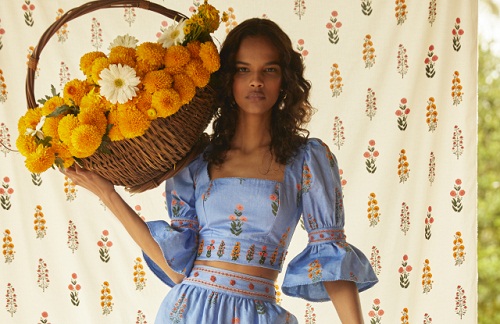 down its fashion cycle and launch only two collections every year. The brand plans to work at a more organic pace to reduce its impact on the environment. Its aim is to have more time to boost creativity.
A new beginning
As per Lyst’s 2020 Conscious Fashion Report , over the last 12 months slow fashion has generated more than 90 million social impressions which suggests the beginning of a shift in consumers’ shopping behaviors. For example, Sika, a brand founded by Ghanaian designer Phyllis Taylor which makes handmade and made to order garments in Ghana. Taylor started by producing a handful of garments at a time before ordering more accordingly. She later moved to an online-only model and only made garments on order. This helped achieve zero waste besides giving her space to customize garments as per demand.
The uptick in Sika’s orders prompted the brand to alert customers about the delay in payments. However, customers are willing to wait for their orders. The brand has gained 35,000 followers on Instagram which proves, though slow fashion may take time to work, artisan luxury brands will lead this change.
COVID-19 can drive inventory-efficiency among brands
 Growing economic uncertainty with ongoing pandemic has made apparel makers skeptical about unsold inventory. And to avoid future losses, they now prefer to make clothes only on pre-paid orders, says a Business of Fashion report. For example, Stòffa, a Manhattan-based producer of classic luxury menswear, which now makes garments only after they are paid for. This helps generate around 90 per cent of its revenue besides eliminating the risk of holding unsold inventory.
To build its business, Stoffa had to first establish a good relationship with Italian manufacturers and suppliers. Then, it had to build a client base through own network and trunk shows across cities. Finally, it had to hire and train sales people to help fit clients for garments in a convincing and authoritative way. As 90 per cent of products are made-to-measure, consumers are willing to wait for their orders to complete. However, this has slowed the company’s pace of annual growth. While in some years, it has grown by upto 70 per cent; in others, it has recorded just 25 to 30 per cent annual growth.
Pandemic worsens inventory issues
One of the biggest problems the fashion industry faces today is that excess inventory that costs the US around $50 billion a year, comments Haley Smith Recer, Retail Consultant. Pandemic-induced lockdowns and a recession in 2020 have left retailers with much more inventory than usual. However, it’s not just the unsold inventory that’s the problem, the costs associated with inventory is also an issue.
In a trend-driven sector like fashion, it is impossible to align supply with demand as the brand has to place bets on a product almost nine months before it hits the market. In the past, it was considered a good thing for a brand to have some excess inventory at the end of each season. However as the pressure for revenue grew over time, brands resorted to markdowns to drive volume.
Production softwares like PlatformE were introduced to smoothen logistical issues of made-to-order brands. The platform currently has 17 brands including Pyer Moss and Tucker. It allows designers to develop new products without betting their own cash on the end result.
Greater collaboration on components
Stanley Szeto, Executive Chairman, Lever Style points out, one of the biggest challenges in getting brands to convert to a lower-inventory model are the restrictions on fabrics. Viewing factories as partners can help brands negotiate better rates on materials. John Thorbeck, Chairman, Chainge Capital advises brands to collaborate and cooperate on the components required for finished goods to create flexibility, which in turn creates value to be shared among partners.
Katie Demo, Chief Executive, Brass’ factory in China has adapted to brand’s need for inventory. It plans to sell a certain number of units each year. For this, they first determine inventory requirement at the beginning of the year. The brand pays more per piece than ordered everything in advance, but it’s worthwhile if more garments are sold at full price.
Shan Reddy, Financial Consultants, advises brands to rethink the base of their production. This can help local manufacturers turn things around quickly. Indeed the pandemic offers brands an opportunity to rejigger operations.
Messe Frankfurt to hold Hemtextil Expo concurrently with Techtextil
Messe Frankfurt has decided to run the Heimtextil expo concurrently with Techtextil and Texprocess. Originally scheduled from January. 04-07, the show will now be held from May 04-07. It will take place alongside Techtextil and Texprocess in Frankfurt.
Joining Heimtextil with the two other textile fairs will present visitors with the entire textile value chain at the same time on the Frankfurt exhibition grounds.
For the first time, Messe Frankfurt will make its Nextrade digital marketplace available to customers of Heimtextil, Christmasworld and Creativeworld to extend their physical trade fair participation and allow orders to be placed all year round.
The digital B2B marketplace for the Home & Living sector matches supply and demand. Ambiente, Tendence and Nordstil have been using the portal and its ordering and data management services since 2019.
In another shift, the Ambiente, Christmasworld and Paperworld shows will be making a once-only appearance as a joint event in Frankfurt am Main from April 17-20 as the International Consumer Goods Show – Special Edition. The physical event will be actively supplemented with digital offerings as part of Consumer Goods Digital Days, which will also be home to the purely digital Creativeworld, an event that is taking a one year hiatus as a physical meeting place in 2021.
Intertextile Shanghai Apparel Fabrics to welcome over 3.000 exhibitors
To be held from September 23-25, 2020, in Shanghai, Intertextile Shanghai Apparel Fabrics – Autumn Edition will welcome 3,400 exhibitors from 20 countries and regions. Along with pavilions and dedicated product zones, the inaugural Hybrid Showcase will allow exhibitors who cannot attend the fair, to showcase their products in a designated display area.
Along with the international pavilions, the eight exhibition halls spanning over 200,000 square meters will also include a number of product zones and group pavilions. The comprehensive product zones includes Accessories Vision, Beyond Denim, Premium Wool Zone, Verve for Design, All About Sustainability and Functional Lab. A wide range of innovative exhibitors will feature in this year’s Group Pavilions which includes Button & Garment Accessories Industry Chamber (Hong Kong), DuPont Trading (China), Ecocert (China), Hyosung group (Korea), Lycra (USA), KTC (Korea), Lenzing Fibers (Hong Kong), and Oeko-Tex Pavilion (Switzerland).
ITM 2021 to be held from June 22-26, 2021
The ITM 2021 Exhibition will be held between June 22-26 2021 in Istanbul. The exhibition will enable textile machinery manufacturers to also be known internationally ITM 2021 Exhibition to be held between 22 and 26 June 2021.
The Turkish textile industry has increased its textile exports unlike many countries during the pandemic. The Turkish companies, which engaged in the production of high-quality masks and protective textiles in hygienic conditions, by using the advantages of early delivery due to Turkey’s geographical position have become an alternative compared to the companies in China. They have also become important for European countries, which have turned their route to nearby producers for supply.
Turkey’s most important export product in the January–June 2020 period was technical textiles. This product group, which constitutes 27.2 percent of total textile exports, achieved an increase of 43.9 percent compared to the same period of last year and reached the level of $1.1 billion. The export of technical textile products in June was calculated as $318 million with an increase of 202 percent.
IFAI, Messe Stuttgart to co-organize IFAI Expo with Sun Shading Expo North America
Industrial Fabrics Association International (IFAI) and Messe Stuttgart, organizers of R+T in Stuttgart, Germany; R+T Turkey in Istanbul, Turkey; R+T Asia in Shanghai, China and R+T South America in Sao Paulo, Brazil, plan to co-organize IFAI Expo with Messe Stuttgart’s new US show named Sun Shading Expo North America beginning in Nashville, November 02–04, 2021.
These two events will bring together the textiles industry’s leading companies, latest innovations in equipment and textiles and valuable education, highlighting ways textile companies can provide high quality solutions for commercial businesses and consumers. Co-locating shows will provide unprecedented value in the opportunity to connect with customers, suppliers, end-product manufacturers and industry counterparts.
This co-location will open opportunities for attendees to increase their business in textiles used for both internal and external textiles applications. IFAI Expo features specialty, advanced and industrial textile solutions with the largest contingency of attendees and exhibitors representing exterior sun protection.
Messe Stuttgart’s Sun Shading Expo will deliver a show and education focused on the internal sun protection marketplace, in part, as they do through their R+T Trade Shows in Germany, China and Turkey. R+T produces the leading world trade fair for roller shutters, doors/gates and sun protection systems.
The Ohzone Inc to hold interactive fashion show at New Era Virtual Fashion Week
US-based fashion technology provider The Ohzone Inc, plans an interactive fashion show as the closing event of New Era Virtual Fashion Week on September 27, 2020. Featuring 10 exclusive designs, this virtual fashion show will use 3D technology developed by The Ohzone, Inc. This will support the interactive capabilities of show and enable attendees to virtually hop onto the runway to stop a fashion model, rotate him/her to inspect different angles of the worn garment.
Attendees will also be able to zoom in the garment to closely examine its design details like colors, fabric textures and patterns. The OHZONE Inc will produce 3Dreal versions of runway looks of international fashion designers along with animation in order to offer attendees the opportunity to shop live on their own terms.
Award-winning Fashion Community Week, San Francisco will host its first-ever digital fashion week from September 24-27. The fashion week will also have a global fashion conference to discuss the future of fashion.
Zalando launches range of pre-owned clothing
To take charge of the Europe’s fragmented resale market, e-commerce retailer Zalando has launched a range of pre-owned clothing,. The retailer collected, curated, quality assured and photographed this collection and is now selling it in Germany and Spain. It also plans to launch the collection in four more countries next month.
The Berlin-headquartered retailer hopes the multi-brand consignment will appeal to customers. The move offers the retailer new lines of revenue as the resale market is expected to more than double in five years to $51 billion by 2023, predicts GlobalData. Prior to this, Zalando experimented with secondhand retail both offline and online for two years. The company operated a pop-up bricks-and-mortar resale store in Berlin last autumn and has been selling womenswear via a separate app called Zalando Wardrobe since 2018.
Zalando’s new range has been carefully curated to appeal to its 34 million strong customer base. It currently sells 20,000 items on the site. The company plans to collect inventory directly from its consumer base. Customers will be able to sell 20 items at a time to Zalando, receiving credit on the site or making a donation to charity in return for their contribution for anything the retailer decides to buy.
Sri Lanka’s Finance Ministry permits BOI approved manufacturers to engage in local sales
Acceding to the request of Sri Lanka’s Joint Apparel Association Forum (JAF), the Finance Ministry has permitted apparel manufacturers approved by the Board of investment (BOI) to engage in local sales or to undertake sub-contracts from retailers or suppliers for three months starting from September 10 subject to conditions.
The apparel manufacturers approved by the Board of Investment can undertake sub-contracts to the domestic retailers to manufacture apparel products using duty paid fabric (raw material), supplied by domestic retailers/suppliers. This will be subject to payment of relevant taxes on income generated from such contracts as per provisions of the BOI agreements and the Inland Revenue Act.
JAAF had made this proposal with the objective of utilizing the excess capacity available at these BOI-approved factories and to generate an extra income for them during these trying times. According to the federation, if the industry calls for an extension of the blanket period, it was ready to shepherd fresh discussions with the Government and other relevant authorities.
Paris Fashion Week to hold 19 live shows
French fashion’s governing body, Fédération de la Haute Couture et de la Mode has revealed that 19 fashion houses will stage actual physical shows at the upcoming Paris Fashion Week. Some fashion brands to hold live catwalk shows this season are: Christian Dior, Chanel, Louis Vuitton, Issey Miyake, Hermès and Rick Owens.
In all, 84 fashion houses will participate in the Paris Fashion Week to be staged between September 28 and October 6. The season will feature spring-summer 2021 women’s ready-to-wear collections. Around 20 fashion houses will organize physical presentations while another 45 brands will produce digital displays. The brands that will stage live shows include Coperni, Victoria/Tomas, Kenzo, Gauchère, Acne, Balmain, Chloé, Isabel Marant, Yohji Yamamoto, Ami, Gabriela Hearst and Xuly Bet.











