FW
Ring spinning for smooth functioning of machinery
"Uster Sentinel enables practical optimisation for managers and shop floor personnel Uster, Switzerland, 10th December 2019: Even in the best ring spinning mills, there is always room for improvements, among a complex range of options management and operatives need to consider for optimised productivity and profit"
 Uster Sentinel enables practical optimisation for managers and shop floor personnel Uster, Switzerland, 10th December 2019: Even in the best ring spinning mills, there is always room for improvements, among a complex range of options management and operatives need to consider for optimised productivity and profit. Uster Sentinel provides a fact-based overview of spinning machine performance, pinpointing real opportunities for excellence in the use of technology, components, and manpower.
Wide-ranging benefits in ring spinning
“We invested in Uster Sentinel ring spinning optimization system with the goal to improve profits but we are delighted that staff also likes the installations,” says Vrajesh Kikani, Managing Director, Kikani Exports. The mill reports a positive impact on profitability resulting from successful optimization of a number of factors, such as waste, ring traveler lifetime, machine speed and energy consumption etc. The production focuses on 100 percent cotton combed compact yarns, in the count range Ne 20 to Ne 40, for weaving and knitting end-uses.
Uster Sentinel also monitors the productivity of all spindles, feeding back all the required links and information to help yarn producers make optimisation decisions at ring spinning based on reliable data.
Among potential problems for all spinners is inconsistent yarn quality characterized by low twist, caused by loose fibers blocking travelers especially excessively worn ones. Only Uster Sentinel can identify spindles malfunctioning in this way, since the issue does not cause end- breaks but still produces yarns which are too weak for high-speed warping and weaving machines. 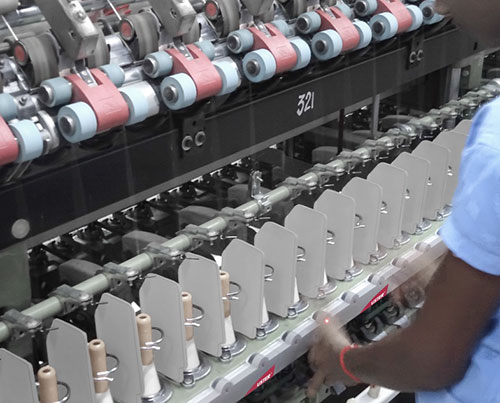
The unique Off-Standard feature of Uster Sentinel safeguards against ‘hidden ‘quality risks such as this.
Fact-based feel-good advantages
Reports give status information at five-minute intervals, including end-breaks and piecing during that period. “Information about piecing speeds helps me to identify each operator’s skill level so that I can optimize the operation schedules and processes. Only by assigning manpower carefully it is possible to maintain ideal working conditions,” says M. Kannan, General Manager. Uster Sentinel handles complete personnel management, including shift planning and staff assignment for all machines in the system integrated with monitoring of critical ring spinning parameters.
This makes personnel management in ring spinning fact-based and less time-consuming. Reliable detection of slip, rogue and idle spindles is what makes Uster Sentinel popular among shop floor staff. LEDs indicate spindles showing an issue or positions where an end-break occurs, directing personnel quickly to fix the problem. Incidents are also shown on the machine display, providing an overview of spindles where attention is needed.
Bobbin build-up report gives practical support
End-break levels are a key indicator of ring spinning performance and Uster Sentinel recognizes this by providing an intuitive bobbin build-up report for every parameter influencing end-breaks. Spinners can then initiate improvements relative to their own mill, taking account of ambient conditions and energy consumption, as well as machine speed, wear of mechanical parts and personnel.
Comprehensive analysis of the speed curve and its impact on quality throughout cop build-up is a key element of the enhanced way of optimizing ring spinning performance. Cop build-up quality is the new dimension of optimization, enabling managers to select the correct machine settings for higher production yields, while keeping quality at the desired levels. Furthermore, it is now possible to compare ring spinning performance between different machines.
VDMA awards six engineers
In November, the chairman of the Walter Reiners-Stiftung (Foundation) of the VDMA Textile Machinery Association, Peter D. Dornier presented awards to six successful young engineers in Dresden.
The award ceremony took place as part of the Aachen-Dresden-Denkendorf International Textile Conference.
The focuses of the award-winning works of the young engineers reflect the strengths of German textile machinery which is particularly strong in areas of high-quality applications and products
JaninaElser, TU Chemnitz, Abdelrahman Elbayoumi, ITA Aachen and Hendrik Pötzsch, ITM Dresden, were honored with creativity awards for the cleverest bachelor or project work. The prizes are endowed with 3,000 euros each.
Elser bachelor thesis dealt with the prototypical development of circular knitted knee bandages. The subject of Mr. Elbayoumi bachelor thesis is a feedback control system for an over-braiding process. Mr. Pötzsch project work deals with the production of carbon fibres using solvent wet spinning technology.
Tim Kaluza, ITM Dresden and Julia Eckert, ITA Aachen, were awarded two promotion prizes in the category diploma/master thesis with prize money of 3,500 euros each. Mr. Kaluza's diploma thesis deals with the automated production of mesh-free multiracial fabrics.
Saurer Twisting Solutions to present process automation and cost reduction solutions at Domotex
Saurer Twisting Solutions will present solutions for process automation and product cost reduction at Domotex. The world largest trade fair for floor coverings, will be held in Hanover from January 10-13, 2020.
Automation of the material transport systems offers significant customer benefits as they are individually adapted to look after the needs of our clients and enable an optimum material flow throughout the entire twisting mill.
The form of a lifter in combination with rail transport system FlexFlow or the automated guided vehicle PackDrive, the modern automation solutions offered by Saurer are the next step into the future.
Easier and faster with new machine generation the new generation of Saurercarpet yarn machine, and Carpet Cabler Carpet Twister 1.10,offers an optimum of possibilities for reliably and confidently mastering even the mostunusual requirements of a lively market.
Central adjustments of almost all production parameters, an intuitive user interface and thenewly designed take-up area significantly reduce the machine changeover times. Moderndrive technology and innovative yarn sensor technology for monitoring the yarn qualitygenerate significant added value for our customers.
Process control with Saurer Mill Management System Sensesthe digital system bundles and analyses production, quality and performance data acrossall divisions. Even machines from third-party manufacturers can be managed. Plandeviations, quality fluctuations or irregularities are thus detected in real time, enabling millmanagers to react quickly.
They can also use the sum of the data to analyse processes comprehensively in order to find opportunities for optimisation.
Intertextile Shanghai Apparel Fabrics 2020 to help tap new opportunities in the sector
"The next Spring Edition will be held from March 11-13, 2020 at the National Exhibition and Convention Centre (NECC) in Shanghai. To be organised by Messe Frankfurt (HK) alongwith Sub-Council of Textile Industry, CCPIT; and the China Textile Information Centre, the expo will enable worldwide textile suppliers and buyers to once again anticipate new potential and opportunities at the industry’s most prominent sourcing platform"
 Unfazed by economic uncertainties and trade concerns, the spring 2019 edition of Intertextile Shanghai Apparel Fabrics welcomed a record-breaking 94,661 visitors from over 110 countries and regions in 2019. The fair presented itself as an exceptional spring / summer apparel sourcing platform for buyers from China and worldwide with 3,273 exhibitors from 23 countries and regions. While the Chinese exhibitors showed off the country’s strong capability in apparel exports as an international manufacturing hub, a 12 per cent increase in overseas exhibitors also illustrated the attractiveness of China’s large domestic purchasing power.
Exhibitors promote new products; increase brand exposure
The steady growth of visitor numbers, especially international visitors, provided a greater chance for suppliers to meet more potential buyers, such as garment manufacturers, designers and retailers from Korea, Japan, India, the US, Russia, Italy and Spain. Besides understanding about the Chinese market, 90 per cent of overseas exhibitors promoted their new, high quality products besides increasing their brand exposure at the event
The next Spring Edition will be held from March 11-13, 2020 at the National Exhibition and Convention Centre (NECC) in Shanghai. To be organised by Messe Frankfurt (HK) alongwith Sub-Council of Textile Industry, CCPIT; and the China Textile Information Centre, the expo will enable worldwide textile suppliers and buyers to once again anticipate new potential and opportunities at the industry’s most prominent sourcing platform.
Fringe events to help promote brands, attract clients 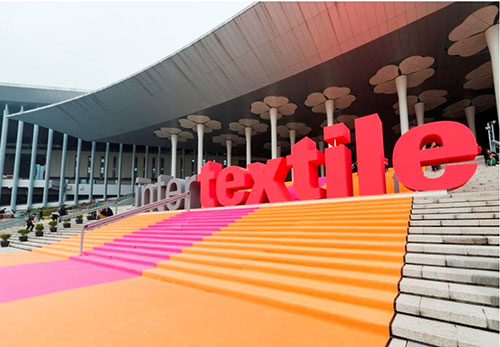
Occupying seven halls at the NECC, the event will showcase the industry’s latest domestic and international trends at specialised product zones and pavilions. This will be complemented by the Intertextile Directions Trend Forum and the Fabrics China Trend Forums that will focus on international and domestic forecasts respectively, and a series of seminars and panel discussions presented by industry experts from China and overseas. These fringe programme events will help exhibitors to promote their brand and attract potential clients to their booths as well. The highly appreciated business matching programme will facilitate the sourcing progress with more convenience and better suit buyers’ needs.
The expo will include the following zones:
• Country & region pavilions / zones: France, Germany, Hong Kong, Italy (Milano Unica), Japan, Korea, Pakistan, Taiwan and more
• Group pavilions: Korea Textile Centre and Birla
• Accessories Vision: a comprehensive range of garment and fashion accessories
• All About Sustainability: products, services and solutions that meet global demand for sustainability
• Beyond Denim: This zone will showcase denim solutions with cutting-edge technologies for a wide range of products from fabrics to accessories
• Digital Printing Zone: This will include fabric printing technology that covers machinery, inks and transfer paper to chemical auxiliaries and apparel fabrics
• Functional Lab: The functional Lab will display innovative fabrics for athleisure, sportswear, protective apparel and more
• Premium Wool Zone: High-end wool and luxury wool cashmere fabrics from France, Italy, the UK and more for menswear, womenswear and suiting
• SalonEurope: This will be a platform for the best of European brands to satisfy the Asian market
• Verve for Design: This will offer inspirational and original textile pattern designs by designers and studios from Australia, Denmark, France, Italy, Japan, Korea, Turkey, the UK, the USA and more
A textile platform of unrivalled scale and variety
Participants at Intertextile Apparel will also benefit from the four concurrent fairs: the Spring Edition of Intertextile Shanghai Home Textiles, Yarn Expo Spring, CHIC and PH Value. Combined together, these fairs will create a textile platform of unrivalled scale and variety to offer new opportunities and business connections to exhibitors and buyers at one convenient location.
China looks overseas to mitigate trade war effects on apparel, textile sector
"China first proposed the Belt & Road initiative in 2013. The initiative became one of its three major national development strategies in 2014. In July 2019, the Chinese government signed co-operation agreements with 136 countries along the route, which runs through three continents. During the initiative’s first five years, the total trade volume between China and countries along the Belt & Road route exceeded $6 trillion"
 China’s textiles industry was one of the first markets to open up globally. The country textile exports increased 3.5 per cent in 2018, accounting for around 37.6 per cent of the world’s total apparels. Although its purchasing power slowed slightly, the Chinese textiles industry still experienced high demand in the domestic market. China offers a safety net to its industry due to its huge population. Domestic apparel sales, which grew 8 per cent in 2018, continued to grow in 2019, though not as fast as previous years.
However, investments in the industry slowed as US-China trade war frictions knocked confidence. The country’s investments in fixed assets, which grew 5 per cent in 2018, also slowed in the first half of 2019. Investments focused on technology and innovation, resulting in increased productivity. The country is now entering a new era in textile manufacturing and design with a focus on technology and innovation, cultural and local talent and sustainability.
Overseas investments crosses $6billion mark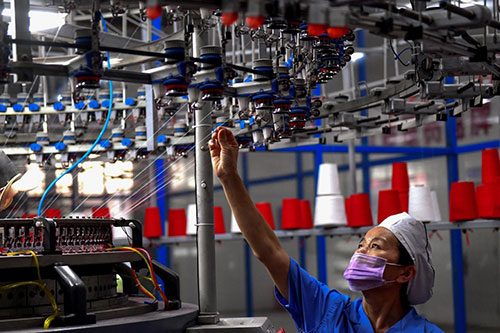
China first proposed the Belt & Road initiative in 2013. The initiative became one of its three major national development strategies in 2014. In July 2019, the Chinese government signed co-operation agreements with 136 countries along the route, which runs through three continents. During the initiative’s first five years, the total trade volume between China and countries along the Belt & Road route exceeded $6 trillion. The textiles industry makes up a large part of this trade.
By 2018, Chinese textiles industry reportedly invested $6.5 billion in countries along the Belt & Road route. The textile industry in the country has made further investments overseas, upstream and downstream.
Opportunities for other countries to step in
With 18 per cent of China’s textile exports going to the US, the country forms its largest export market for textiles. China is also the largest exporter of apparels and textiles to the US, accounting for 38 per cent of the nation’s total imports.
However, ongoing tensions, tariffs and uncertainties have opened up opportunities for other countries to step in. Indonesia, which recently experienced a decrease in purchasing power, has opened its market to Chinese investment as the country plans to develop local e-commerce industry and start-ups.
Asia Pacific Rayon cleans viscose rayon making
Asia Pacific Rayon is committed to clean production of viscose rayon fiber. The company constantly strives to operate in the top quartile of viscose rayon manufacturing, in terms of reduced greenhouse gas emissions, improved carbon disulphide recovery, and wastewater management in line with industry-leading practices.
Based in Indonesia Asia Pacific Rayon is the first fully integrated viscose rayon producer in Asia from plantation to viscose fiber and has a production capacity of 2,40,000 tons per annum. Almost half of the output is used in the domestic market, while the rest is exported to countries like Turkey, Pakistan, Bangladesh, Vietnam, Germany and Italy. Being fully integrated from plantation to viscose-rayon bale, the company has minimal risk of supply disruption and is also protected against the volatility of commodity prices.
Asia Pacific Rayon has invested in a pilot-scale yarn and fabric manufacturing operation, which is expected to start-up in the first quarter of 2020. It will possess all three spinning technologies of ring, open-end and MVS to produce yarn for both knitting and woven applications, with a capacity of 7,600 tons per year. The aim is to help build a vibrant and sustainable textile industry where raw materials are responsibly grown, using the latest technologies to maximize efficiencies and to supply world-class products for customers all over the world.
Neonyt to focus on sustainable fashion brands
Neonyt, the global hub for fashion, sustainability and innovation, will gather green fashion labels in the German capital during January 14-16, 2020. The event will bring together decision-makers and stakeholders of the fashion and textile industry, remaining committed to interpreting sustainability not only as a fashion trend, but as a complete innovation process.
For retail buyers, Neonyt is the one-stop solution for scouting out cool, contemporary collections and future trends. The event has established a catalogue of criteria for exhibitors and built up a contemporary portfolio of exhibitors. The success and growth history of Neonyt, with its formats like the Fashionsustain conference, influencer format Prepeek and the Fashion Show, helps it to appeal to the different communities and their various stakeholders in a very targeted way.
The event will hold panel discussions on fashion and “Air” – the theme for 2020 - at the multidisciplinary conference Fashionsustain. Allison Dring, co-founder of Made of Air, will deliver a keynote speech on how carbon dioxide can be used as a raw material. And the panel discussion “SDGs x Fashion – The UN’s Fashion Industry Charter for Climate Action” will be shedding light on the global repercussions of climate change on the textile industry and vice versa. During the conference, Christopher Veit, managing director of the Veit Group, will look at things from the perspective of the mechanical engineering industry.
Techtextil show in Mumbai sees strong participation
Techtextil was held in Mumbai, November 20 to 22, 2019. This event on technical textiles saw a strong participation of 192 exhibitors from major countries across the world. Visitors from Canada, Dubai, Germany, Italy, Turkey, UAE, UK and USA gave the show a global feature. The fair marked a 17 per cent increase in exhibition space, growing by 25 per cent in international exhibitors compared to the previous edition.
Smart textile machineries, recycled fibers, industrial fabrics, fire retardants, industry wearables, and other sustainable solutions were among some of the key highlights on the show floor. Among the areas discussed were recent technical advancements, all-round growth, sustainability, and reusability of materials in technical textiles, including inventive means and methods, such as the use of lighter, stronger, and better renewable composites including technologically refined machineries in the manufacture of technical textiles.
A lot of quality visitors showed up and conveyed their interest in the innovative technologies exhibited. Overall, the conference also received a tremendous response from the prominent delegates. As always, Techtextil India succeeded in bringing all stakeholders together through this platform. A survey and analysis of the problems and challenges facing the growth of technical textiles in India and the various subsidy schemes launched for the promotion of technical textiles were a major highlight at the show.
Chinese luxe customers becoming more experimental
The luxury market in China is becoming younger, more diffuse. Customers are trying out far more brands than before rather than fixating on a handful and are more interested in things like sustainability and even secondhand luxury.
LVMH has its eyes firmly set on deepening its accessible jewelry portfolio and capturing a greater share of the Chinese middle class as well as US-based Chinese students and US-bound Chinese tourists. Although 2019 marked a decline in Chinese travelers headed for the US and a slower pace of Chinese student enrolments, there are signs that both could recover in 2020. Similarly, the mid-market jewelry segment in China remains ripe for continued growth. This opens up LVMH to tap more of the Chinese middle class, which also favors the group’s higher-end offerings. LVMH can’t expect younger Chinese customers to be as enthusiastic about heritage Louis Vuitton collections as their parents. To stay on top, the brand has to make smart additions to its portfolio.
Italian apparel brand Moncler’s high-priced puffer jackets are a regular sight in Beijing or Shanghai. With nearly 50 stores in Greater China, Moncler already has a strong stance in the country and is a popular purchase for Chinese tourists from Los Angeles to Milan.
Nike sells Hurley to Bluestar Alliance
With this acquisition from Nike, Bluestar aims to fuel Hurley’s sales in categories like skateboarding and snowboarding, as well as continue to grow the women’s business, which will be fueled by connecting fashion and function. Hurley also expects several of its sponsored athletes to qualify and compete in the 2020 Summer Olympics in Japan, where surfing will be an Olympic sport for the first time.
Bluestar Alliance, founded in 2006, owns, manages, and markets a portfolio of consumer brands, including Hurley, Bebe, Tahari and Kensie, among others. Bluestar's retail footprint includes over 250 stores as well as distributors all across the world. Since its inception, the company has acquired select brands with retail sales expected to exceed three billion dollars in 2019.
Hurley is a surfing brand, which Nike bought in 2002. As well as a wide range of women’s board shorts, customers at Hurley can also find backpacks, wetsuits, hats, bikinis and jackets. Nike, the world’s largest footwear maker, now sells more of its products directly to customers through online platforms rather than through wholesalers. Nike has also launched pop-up stores that cater to loyal fans of the brand in several big US cities in an effort to build a strong relationship with its customers and gain market share.