FW
Hyosung A/W ’22 Textile Trends: Sustainability and performance to dominate
 Year 2022 is expected to bring along many new apparel trends. These will help brands and retailers offer innovative products to customers. Hyosung’s newly established Fashion Design Center highlights new Autumn/Winter 2022-23 textile trends that are likely to dominate collections of intimate and swimwear brands in the latter part of 2022.
Big City Wanderers
As per a Knitting Industry report, the first trend is:‘Big City Wanderers’. The trend will incorporate refined apparels for all seasons and categories. Apparels will be versatile and adaptable to make customers look smarter. The trend will also include trans-seasonal basic apparels whose demand has increased due to the ongoing lifestyle shifts. Other apparels gaining importance are those having classic textures such as rib, waffle, or crepe jerseys. Knitted with functional yarns, these apparels have evolved into must-have essentials due to their versatility.
Multi-functional apparels
Multi-functional apparels are gaining importance as consumers expect their clothes to have multiple uses. They prefer clothes made with functional fabrics and adapt to changing environment.
High performance essentials
With the launch of high functional fabrics and a growing need of basic items, there is demand for high-performance essentials amongst consumers. They are looking for core items that adapt to changing temperature and incorporate various cooling and warming techniques. They also expect apparels to be comfortable and offer more stretch. They expect clothes to withstand all environmental changes, be lighter, durable and protect them from harsh climatic changes.
Softer fabrics
The emerging trend is of apparels made from soft sensuous fabrics. These fabrics offer physical and emotional comfort and sooth anxious consumers with their smooth textures. They make them feel comfortable and secure with their smooth textures. They include pile fabric, a winter essential that will be upgraded with soft-touch and eco-friendly fabrics and decorative textiles.
Sustainability and performance
Sustainability, versatility, and performance along with interesting textures will be the key textile drivers for next autumn/winter, says Lewis Hong, Team Manager Hyosung Fashion Design Center. The company offers a broad range of options across elastane, nylon and polyester portfolio available to meet these forecasted textile trends.
The range of GRS-certified, 100 per cent recycled creora regen spandex, Mipan regen nylon and regen polyester incorporate performance properties. Its creora regen fresh is sustainable and comes with anti-odor properties. The Mipan regen aqua-X nylon and regen Askin polyester offers a cooling performance.
A comprehensive fiber manufacturer, Hyosung offers world-class products. Its creora elastane is the world’s largest elastane brand and supplies the broadest range of stretch fiber offerings. The sustainable fiber solutions provided by Mipan nylon and specialty polyester are a perfect answer to today’s textile needs.
Focus on price and compliance issues to sustain Bangladesh RMG development
It’s almost the end of 2021. Yet; Bangladesh RMG manufacturers are still trapped in the uncertainties of the COVID-19 pandemic. With new variants emerging every day, the pandemic continues to create chaos in the main apparel markets: Europe and the US. New lockdowns in some countries are threatening the amount and types of clothing being purchased from manufacturers. Some RMG manufacturers are stepping into the New Year with a sense of dread that the progress they achieved in the second half of 2021 might again get derailed due to new COVID-variants.
Open discussions on price issues
Manufacturers need to keep a close eye on the pandemic development in the main markets, says a Daily Star report. They need to follow local news outlets in the EU, US and beyond. Manufacturers also need to have open transparent discussion with customers on issues related to price rise. They need to consider whether a cultural shift is required in terms of what end consumers pay for clothing.
The third issue that manufacturers need to pay attention is: regulations. They need to conform to certain standards and regulations regarding the environment and social issues. Though this may increase regulatory costs for suppliers, they must accept the new regulatory environment to survive.
More domestic and international collaborations
Manufacturers also need to pay attention to two more issues that may become increasingly important over the years. They need to emphasize on more collaborations with industry leaders in textile recycling, traceability, inward investment and the promotion of the brand Bangladesh. These will help them come to terms with the new dynamics of sustainability, innovation and technology that are shaping the current Bangladesh garment industry. Moreover there is a need to focus on international collaborations to take the industry forward.
Unfair purchasing practices are also threatening to derail industry growth. The industry needs to collaborate with buyers and sellers to resolve issues and discuss an equitable way of doing business. This can also help manufacturers make adversarial business relations around prices and purchases a thing of the past.
With customers back to stores, apparel sourcing sees an uptick
The buying season for spring/summer 2022 has been good for most retailers and brands across the world and in India, suggests and Apparel Resource report. While comfort is still a dominant requirement, fashion is making a comeback with a return to bold going-out clothes in bright colors, sparkly sequins, dramatic trains and edging fringes. Silhouettes range from short shirts and low waist to baggy and oversized styles. Another key trend being followed is clothes inspired by the late ’90s and early 2000s. The first category to make its presence felt, post the heavy dose of athleisure wear, is denim. The same is true for buyers working in the international market and exporters working in the category are overbooked.
Being restricted to home for almost two years, a lot of social gatherings including weddings are now happening and orders for the same are also visible. There has been a significant uptake in occasion wear and bridal wear, besides work wear. For example, Orange Sourcing with US and European client base has seen good uptake in occasionwear and bridalwear, besides workwear. As per Rakesh Saigal, CEO, dressing gown imports by the US valued at $284.93 million in the first half of 2021 rose 7.30 per cent higher than what it was in first half of 2019.
The women’s wear segment in particular has seen a huge surge in demand. Bangladesh still takes away the lion’s share due to price competitiveness and good quality especially on bottoms. India’s strength lies in fashion for women’s wear. Though a lot of focus is now shifting to manmade fabrics, the demand for cotton products has continued to grow.
Bangladesh fixes knitwear units wastage rates, manufacturers not happy
Bangladesh has set the maximum wastage rates for knitwear factories. These will be 27 per cent for basic items, 30 per cent for specialized items and four per cent for sweaters and socks. This is important for knitwear manufacturers because if production wastage rate of an export-oriented readymade garment manufacturer, who enjoys a duty-free facility for raw material imports, is less than the prescribed rate, they sell the excess raw materials in the open market.
This eventually damages the business of local companies that produce raw materials. However, the knitwear industry is not happy with the new rates. As Mohammad Hatem, Executive President of the Bangladesh Knitwear Manufacturers and Exporters Association (BKMEA) points out the rate is not acceptable. He says it will hamper exports growth and they want at least 35 per cent wastage rate. He also said the new wastage rate is by no means reasonable and will not solve problems rather accelerate them.
On the other hand, if the actual wastage rate is higher than the rate set, duty, supplementary duty and VAT is imposed on the extra wastages. Apart from the basic items, separate categories have been created for the first time and the wastage rate is set at four per cent for sweaters, socks and similar item productions, and 30 per cent for special items including rompers, gowns, and hoodies.
Earlier, the maximum wastage rate was revised from 16 per cent to 27 per cent for the production of basic knit items — T-shirts, polo shirts, trousers, shorts, skirts, pajamas.
US junior wear imports up 32 per cent from January to October
During the first 10 months of 2021, import of children’s wear into the US grew 32 per cent. Sourcing of children’s clothing is back on track this year after COVID woes. As per OTEXA figures, China is still the largest children’s wear exporter to the US even as the country has been facing serious backlash over unethical business practices of late. China’s exports to the US from January 2021 to October 2021 grew by 41 per cent. Vietnam’s exports of children’s clothing to the US in this period grew by 32 per cent while shipments from India grew by 48 per cent. Bangladesh increased children’s wear shipments to the US by 22 per cent. China, Vietnam and India collectively contributed 55 per cent to the overall US children’s wear import value in January 2021 to October 2021 compared to 52 per cent in the same period of the previous year.
Meanwhile US imports of denim increased 28 per cent in October 2021 compared to a year earlier. Imports from Mexico grew 43 per cent. Shipments from countries of the Central American Free Trade Agreement rose 29 per cent, led by a 30 per cent from Nicaragua and a 22 per cent gain from Guatemala.
India: Gokaldas Q2 revenue up 30 per cent
For the second quarter Gokaldas Exports’ revenue grew 30 per cent. Earnings before interest, tax, depreciation and amortization (EBITDA) jumped 63 per cent. Margins improved 250 basis points to 12 per cent from nine per cent in the year ago period. Net profit was up three-fold.
A strong order book, increased focus on augmenting capacity (up by around 30 per cent) while containing costs has helped deliver this growth. With a strong order book, the company has ensured a rapid expansion of its production capacity. It managed the production value chain well by increasing manpower availability, improving productivity and on-time shipments. The management continues to focus strengthening the order book position for the coming quarters as well.
Credit metrics and liquidity position witnessed a healthy improvement, primarily on the back of the equity infusion made in October 2021. A portion of the funds have been utilized towards reducing debt levels, with the surplus to be used to meet incremental working capital and capacity expansion requirements. Reduction in net debt levels, coupled with the growth in operating profits, is expected to result in key credit metrics including net debt to operating profits and PBDITA to interest and finance charges to be at around 1 times and 4.5 times, respectively, in fiscal2022.
Garment worker unions in Sri Lanka sign agreement with JAAF

Garment worker unions in Sri Lanka have signed a ground-breaking agreement with employer association Joint Apparel Association Forum (JAAF) in which both parties reached an understanding about how to address vital workplace issues for garment workers, especially during the pandemic.
This historic agreement lays out and confirms joint support for fundamental steps towards improving working conditions during the Covid-19 pandemic and importantly towards respect for freedom of association in Sri Lanka’s garment industry.
A joint statement of the Sri Lankan signatory unions, Free Trade Zones & General Service Emplees Union, National Union of Seafarers Sri Lanka & National Union of Migrant Workers Sri Lanka, and Sri Lanka NidahasSewakaSangamaya said: “This is the first time an industrial sector is represented in a bi-partite agreement with worker representatives. This is also the first time both employer and employee representatives have agreed on workplace health management through bi-partite health committees.”
InekeZeldenrust, International Coordinator at Clean Clothes Campaign, said: “This agreement goes some way towards redressing the power imbalance between workers and employers. It gives joint support for the Bipartite Health Committees, and a Bipartite Dispute Resolution Mechanism, all of which have been key asks of the Sri Lankan trade unions to factory owners during the pandemic.”
Sustainability, localization can help Bangladesh achieve $50 bn apparel export target: BGMEA
In the last five decades, Bangladesh has become one of the fastest growing economies of the world. Its per capita income has reached $2,554, one of the highest in South Asia. Poverty rate declined to 20.5 per cent, both ways trade increased to $82 billion during the same time. Foreign exchange reserves have reached 45 billion.
Largest formal women employer
This success story has largely been woven by the ready-made garment (RMG) industry in the country, says Faruque Hassan, President, BGEMA. With 3,500 active clothing factories, the industry generates 81 per cent of Bangladesh’s export revenue. It is the world's second largest garment supplier, with its products going to 167 countries.
The RMG industry is also the largest formal employer for women in Bangladesh. The industry employs around 60 per cent of women, mostly within the age group of 18-30 years. This contributes to women’s empowerment and poverty reduction besides bringing about many positive changes like a drop in early marriage and early motherhood, increase in female literacy rates, etc.
Great strides in safety and sustainability
The industry itself has gone through a massive transformation since its inception. Its technology features, workplace safety, product quality and range, and environmental sustainability-- all have improved significantly. The sector has made great strides in safety and sustainability. Entrepreneurs have engaged with the government, ILO, local and international labour federations and brands through the initiatives titled 'Accord, 'Alliance' and 'National Action Plan'. Bangladesh made a joint declaration with ILO, EU, USA and Canada called the Sustainability Compact in 2013 to make it more sustainable.
World’s highest number of green factories
All factories in Bangladesh are compelled to go through a robust remediation program and install all the required safety equipment as per the standards. The country has the highest number of green garment factories in the world. US Green Building Council (USGBC) certified a total of 152 Bangladeshi factories as LEED (Leadership in Energy and Environmental Design), among them 44 are LEED platinum-rated and 94 are LEED gold-rated units. These factories are moving from semi-automatic to more automatic mode using sophisticated machines, technologies and software to prepare the industry for next phase of growth.
Bangladesh has also formed the RMG Sustainability Council (RSC) involving equal number of representatives from industry bodies, brands and unions in its governance.to build local capacity, It has entered into collaborative arrangement with a number of development partners and the government to train workers and mid-management officials on occupational safety and health and on social dialogue.
Explore the MMF sector
Bangladesh now aims to carve a niche in high-end garment products market. It aims to harness the potential of man-made fibre (MMF) market. Localization of MMF will enable it to explore the potential in active-wear, athleisure, suits and high-end formal-wear, outerwear, lingerie etc. To achieve the next phase of business sustainability, Bangladesh needs to make continuous efforts to cope up with the global fashion trends and realign its business strategies accordingly. It must strive to remodel its business from labor intensive to a value-added one through innovation, modern manufacturing, diversification, technology upgrading, up-skilling and re-skilling of our workforce.
Focus on human resources
To achieve its desired economic development, Bangladesh also needs to focus on its human resources. It needs to adopt a People Centric Approach while devising its strategies and policies.
The RMG industry will play a pivotal role in Bangladesh’s economic development. To achieve its target of $50 billion worth of exports, the government and the industry must continue to work together.
DenimFWD’s Urban Factory to make current textile production model more sustainable
 A company encouraging the return of the textile production to the United States, the Denim Forward Inc (DenimFWD) has opened the world’s first ‘Urban Factory.’ As per a Textile World report, the plant is located in the City of Industry, Calif. And employs revolutionary technologies to transform the current textile production model into an on-demand, completely sustainable digital and automated model. Through this model DenimFWD aims to bring back 15 to 25 per cent of manufacturing production to the US.
The model allows 100 per cent sustainable on-demand production close to the consumer. It digitizes the entire production process besides improving saving time and speeding up time-to-markeet, says Carlos Arias, CEO, DenimFWD. The model will allow consumers to decide buy a product that will be finished and delivered to him the same, he adds. It will also reduce the number of garments ending up in landfills or being incinerated.
Eliminates 100 per cent pollution from jeans
A complete transformation of the denim operating model, Urban Factory is being developed by DenimFWD in partnership with Jeanologia, world leaders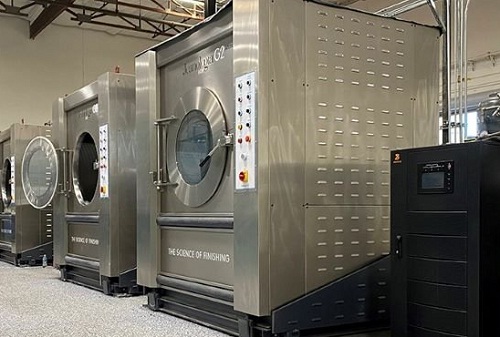 in sustainable and efficient technology development as expert technology partners. Enrique Silla, CEO, Jeanologia says, the new production model will help eliminate 100 per cent discharge and pollution from jeans in the world. It will mark the beginning of a new era in completely sustainable and digital production.
With minimum delivery times, DenimFWD’s Urban Factory produces up to 5,000 jeans and 4,000 T-shirts a day. Its operating model is sustainable and integrates Jeanologia hardware and software for advanced digital production. It offers five benefits to the industry, eco-friendliness, agility, scalability, digital and cost-effectiveness to designers, producers, and consumers.
Reduces operational costs and environmental impact
Through this model, DenimFWD offers the industry products that are in demand rather than those produced. This reduces the industry’s operational costs and environmental impact, guaranteeing zero discharge.
The model uses the following Jeanologia technologies: laser, G2 Ozone, e-Flow, SmartBox, ColorBox, EIM (software for measuring environmental impact) and H2Zero (the first water treatment and recycling system that produces zero discharge without extra costs). It has the first active Handman in the US and allows automated production through robots, making it more agile, clean and scalable. The eDesigner technology makes digital designing easier, faster, and more dynamic for designers.
Xinjiang bill may end up harming American interests warn China’s textile associations
 A group of textile industry and trade associations in China have condemned the US’ ‘Xinjiang bill’ saying, it endangers the security of the global textile industry. The bill was signed by the US President Joe Biden this month as a part of the US initiative to curb forced labor. It aims to curb US funding amongst ethnic minorities in the Xinjiang Uyghur Autonomous Region.
The law instructs the US Customs and Border Protection (CBP) under Section 3 of the Act to adopt a rebuttable presumption that goods mined, produced, or manufactured in the Xinjiang Uyghur Autonomous Region (XUAR) or by certain entities are prohibited from being imported into the US.
Moreover, the bill instructs the government to guide importers on best practices/due diligence and on the type of evidence to demonstrate that goods are not made with forced labor. It also directs the government to develop a comprehensive enforcement strategy and a diplomatic strategy. However, the bill has been opposed by all leading Chinese textile industry and trade associations.
Suppresses domestic industry and violates WTO rules
The China Cotton Association says, the bill suppresses China's cotton textile industry in the name of human rights while the China National Textile and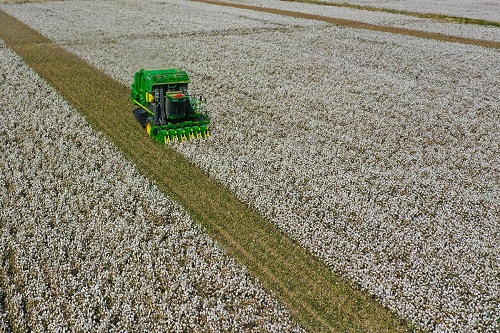 Apparel Council and 12 industry associations accuse it of setting a dangerous precedent to international economic and trade by presumption of guilt with regards to forced labor covering all Xinjiang products. It says, Xinjiang cotton is globally recognized as a high-quality natural raw material for fiber, and is vital to the sound and sustainable development of the Chinese and global textile industry. The US suppression of Xinjiang cotton and related products is bound to severely endanger the security of the global textile supply chain. The China Chamber of Commerce for Import and Export of Textiles (CCCT) accuses the US of completely violating market principles and WTO rules. The bill severely harms the interests of both, the Chinese and the American textile and apparel companies and consumers and also
An important part of the global textile supply chain, Xinjiang cotton amounted to 5.13 million tons in 2021. It accounted for about 20 per cent of global cotton output, adds CCCT. However, since 2020, the US government has issued import bans on Xinjiang cotton restricting the import of cotton-related products from the region. This has damaged the reputation of the China’s cotton textile industry across the world.
A move doomed to fail
Through its crackdown, the US aims to curtail the development of new industries in Xinjiang, thus slowing its economic growth. However, such a move is doomed to fail, says Huo Jianguo, Vice Chairman, China Society for World Trade Organization Studies. The US imports of textiles and apparels from China grew 23.9 per cent year-on-year to $25.79 billion in the first ten months of 2021. This was a growth of 58.9 percentage points from the same period last year, accounting for 27.6 percent of the US' total textile and apparel imports during the same period, according to industry data.
Bill to aggravate US’ economic predicament
Thus, the suppression of imports from China by the US' will not only harm millions of cotton farmers and textile workers in Xinjiang, but also the interests of American textile and apparel consumers, retailers, distributors and importers, adds CCCT. The restrictions will end up harming American interest and aggravate its economic predicament, adds Jianguo.