FW
Pitti Immagine announces schedule for upcoming physical events
Pitti Immagine has announced the dates and venues for upcoming summer trade shows’ physical editions. As per reports by the Spin Off, Pitti Filati will be held from June 28-30 at Stazione Leopolda, in Florence. Trade shows Pitti Immagine Uomo and Pitti Immagine Bibo will take place between June 30 and July 2 at Fortezza da Basso, in Florence. Perfumes and fragrances show Fragranze will take place September 17 to 19 at Stazione Leopolda in Florence.
Pitti Immagine is working tirelessly to organize the show in order to recall the highest possible participation of exhibitors, buyers and press. It is coordinating with public authorities like municipality, region and ministries, and private entities such as carriers, airports, stations, hotels and shops among others, involved in the overall exhibition activity to monitor and manage each phase of the process, from travel to arrival in the city, from access to the exhibition venues to the route through the pavilions and the use of services.
The decision to hold Uomo and Bimbo in the same days at Fortezza Uomo and Bimbo, will benefit both events through its strong integration between the physical and digital formats, said Agostino Poletto, General Manager, Pitti Immagine.
Isko, Bluesign Technologies collaborate for new fabric range
Leading denim brand Isko has collaborated with Bluesign Technologies, the architects of a sustainable and responsible textile supply chain, to launch bluesign® approved fabrics. These fabrics are made from bluesign® approved chemicals and raw materials, and are manufactured with minimum impact on people and the environment. This enables brands to provide safe products to their consumers, verified as bluesign® product, which are sustainably produced without hazardous chemicals. This latest development is part of ISKO™’s central sustainability strategy, including a plan to certify additional bluesign® approved articles in Isko™’s collection.
Through this partnership and certification, Isko and bluesign® continue their vision of a textile and fashion industry with a future that focuses more attention on people and the environment, because only when both are considered can the industry truly make a positive, long-lasting impact. Isko has a long-standing commitment to ensure the integrity of its ingredients and the traceability of its fibers and materials. The brand aims to build for the needs of tomorrow with trust and verified impact at scale.
Johnstons of Elgin bags Queen’s Award for Enterprise
Scottish luxury textiles and knitwear manufacturer Johnstons of Elgin has been awarded this year’s Queen’s Awards for Enterprise, reports The Northern Scots. As per Knitting Industry, the company has bagged this award in the Sustainable Development category.
This is the fourth award bagged by Johnstons of Elgin. Its previous achievements include the Queen’s Award for Export Achievement in 1978, 1994 and 2002. The company’s approach to working with natural, renewable, and biodegradable fibers and its commitment to limiting environmental impact, animal welfare and its people, have earned it many accolades in the past. Simon Cotton, CEO, says, Johnstons of Elgin strives to cover every aspect of its product’s life and truly values every thread. In its 224-year history, the company has launched many animal welfare initiatives, grassland preservation, fair work, reduced manufacturing waste, etc.
Intimately to extend garments’ size range
Emma Bulter, Founder and CEO, Intimately plans to extend the size range of her brand’s undergarments. As per Sourcing Journal, her new range of six bra and underwear styles is scheduled to drop later this spring, Butler also plans to launch her second more robust range of bras using a newly developed patent-pending closure technology.
She also plans to raise her first round of funding from venture capital groups and angel investors in the e-commerce and technology space, which she will use to fund the line’s expansion. Butler aims to offer a more inclusive size range than any adaptive intimates brand on the market, as well as an array of nude shades to suit a variety of skin tones.
She has also designed a capsule collection of apparel items including shirts, pants and jackets, which she hopes to release once the brand finds an adept supplier. The global adaptive apparel market is slated to be worth $400 billion by 2024, according to research from Coherent Market Insights.
India’s yarn prices to drop from May 1
Industry leaders expect a drop in prices of Indian cotton yarn from May 1 with a growth in inventory levels. As per Textile Today, yarn prices have been falling for last 15 days by Rs 10 a kg due to low caused by the second COVID-19 wave. India’s rising COVID cases have forced many spinning mills’ workers to again migrate to their villages, interruption cotton production. The country’s yarn inventory levels have built up, says Atul Ganatra, President, Cotton Association of India.
In addition, lockdowns by many states have dampened demand for cotton yarn in the country. As many states in India have imposed curfew/lockdown, there has been a drop in the demand for cotton yarn. K Selvaraju, Secretary-General, Southern India Mills Association (SIMA), informs, warp yarn prices have dropped by Rs 30 per kg as there is surplus. Demand for weft yarn demand has also declined due to the closure of mills in Maharashtra. Spinning mills were put under tremendous pressure to bring down yarn prices despite their overheads rising due to a slew of factors, adds Selvaraju.
GHCL posts Rs 104 crore profit in Q4
India-based leading chemical and textile company GHCL has posted Rs 104 crore profit in its fourth quarter of the current fiscal. Revenues have grown 12 per cent to Rs 821 crore compared to the revenue of Rs 734 crore in the same period previous fiscal. Revenues of the company’s inorganics chemicals division have grown to Rs 531 crore while those its home textiles business have increased to Rs 290 crore.
Favourable recovery trends across key end user industries combined with operational excellence steered momentum for the year and resulted in 73 per cent growth in profit before tax in Q4 FY 21. Plant utilization levels returned back to pre-COVID levels supported by a positive demand scenario, says RS Jalan, Managing Director.
Given the current visibility and a promising demand landscape, the company foresees better times that will help it realize its growth aspirations while focusing on shareholder value creation, he adds.
Hyosung launches new water-resistant fiber
World’s largest spandex brand Hyosung has launched a new fiber to protect fabrics from water damage. As per Texbrasil, known as Creora® highclo, the fiber has been jointly launched by Abit (The Brazilian Textile and Apparel Industry Association) and Apex-Brasil (Brazilian Trade and Investment Promotion Agency). It is designed for beachwear and fitness products that usually have a shorter life span due to exposure to water and chlorine, sunscreens and tanning oil.
The fiber improves the durability of the swimwear fabric and provides a more lasting fit for the pieces, as it guarantees compression and modeling of the articles made and conservation of the shape. It can also be used to make sportswear. Another feature of the thread is its stretch. It can be stretched up to 500 per cent of its original shape, providing comfort and softness in the fabrics produced in its composition. Its fiber is unbreakable and supports upto 135 degrees of polymers in the dyeing process.
Hyosung is a world-class manufacturer of fibers and products, which has 10 industrial plants located in South Korea, China, Turkey, Vietnam, Brazil, and India. In Brazil, it has been present since 2011, when it installed the industrial plant located in the city of Araquari, in Santa Catarina, with a land of 250 thousand square meters and a built area of 40 thousand square meters.
Eurojersey’s Sensitive Fabrics launches new activewear collection
Sensitive® Fabrics by Eurojersey has launched ‘React’ a new AW 2022 activewear collection that enhances key aspects of the athletes’ performance and talent to ensure maximum results. Its energizing fittings and materials ensure the ultimate workout and competitive experience for athletes. The fabrics combine an incomparable performance with flexibility and protection. They sculpt the silhouette and adequately support the muscle tissue, while providing lightness and calibrated compression.
With their ultra-flat surface and elevated elastic memory, Sensitive® Fabrics provide the perfect solution for sports garments requiring the most innovative treatments to make them weather-proof in all conditions. Some innovations in this collection include Sensitive® Fabrics bonded with special wind-proof coatings and bicoloured solutions in which Sensitive® Fabrics are bonded with fleece and water-repellent membranes with waterproof properties.
Increasing demand from the West boosts India’s fashion exports
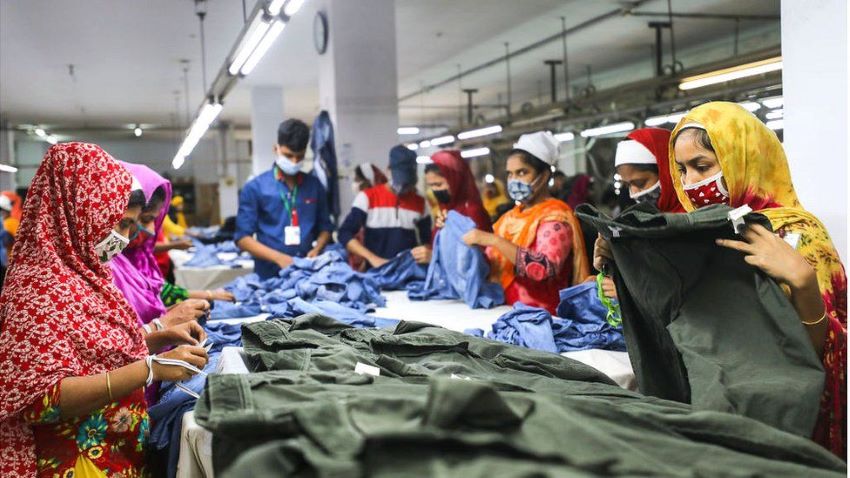
Increasing demand from UK and US is leading to a surge in exports of fashion and lifestyle products from India, says Sanjay Jain, CEO, PDS Multinational Fashions, a supplier to brands including Zara, Walmart, Mango and Superdry. He expects pent-up demand and increase in online sales to further drive exports. Exports are doing well despite problems related to migration of workers, adds Rahul Mehta, Chief Mentor, CMAI. However, order volume, is nowhere close to the pre-pandemic level as brands want to mitigate risk, he adds. Brands expect the ongoing vaccination to drive shoppers back to stores who until now relied on -commerce for most of their sales.
Worth $1.9 trillion in 2019, the global textile and apparel market is projected to reach $3.3 trillion in 2030. The market is likely to be dominated by Europe and the US who contribute about 30 per cent to the total apparel market.
Australian wool supply to grow for 5 years: ANZ
Latest ANZ Agri Commodity Report says, overall supply of Australian wool onto the market is forecast to grow for at least the next five years. This report builds on the ABARE predictions from earlier in the year, saying wool's fortunes had bottomed out and were rebounding.
Madeleine Swan, Associate Director- Agrobusiness Research, ANZ, says the reason for optimism was based on demand in the Nhemisphere which will drive the Australian wool industry in 2021. While short to medium term wool demand will be dependent on global economic conditions, the overall supply of Australian wool onto the market is forecast to grow for at least next five years, Swan adds.
She expects demand for Australian wool to climb by a marginal 1.7 per cent in 2020/21 to 288 thousand tonne, despite a five per cent fall in the number of sheep shorn
Wool production is expected to rise by 20 per cent by 2025/26 which could lead to a build-up of stockpiles again, she added