FW
Despite recession fears, global luxury market grows 21%, outlook bright: Bain

The global luxury market has grown 21 per cent from 2021, says a recent report by Bain & Co. and Altagamma. Despite worsening economic conditions, high inflation and rising costs of living, coupled with ongoing Covid restrictions, some 95 per cent luxury brands have clocked in positive growth in 2022.
Chinese consumers will represent 40 per cent of all luxury consumers by 2030. But as China remains challenged due to Covid restrictions, other parts of the world have begun to shine. The US luxury market is still leading in size while Europe has managed to surpass pre-pandemic levels thanks to an uptick in local demand and overseas shoppers. Newer luxury markets have emerged, too, including Southeast Asia, although it lacks the infrastructure to facilitate expansion locally. In South Asia, India is a country to keep tabs on, with a luxury market forecasted to swell 3.5 times today’s size by 2030.
Gen Y, Gen Z key growth drivers
Gen Y and Gen Z accounted for the entire growth of the global luxury market in 2022. In coming years, Gen Z and Gen Alpha spending will grow three times faster than other generations until 2030, when they will make up a whopping one-third of the market.The impact for brands of these young consumers entering the market will be substantial. Brands will be asked to adapt their value proposition, where purpose and expanded brand meaning have a central role in order to remain relevant.
Old loyalty programs are now being innovated with social incentive schemes. These flip traditional VIP schemes on their head, incentivizing brand engagement and advocacy pre-purchase rather than post-purchaser, attractive user experience with points, rewards for each interaction with a brand to be redeemed against exclusive content and discounts.
Brands perform using current dynamics
Not only does the current luxury industry have a larger consumer base than it did during the 2009 financial crisis, brands have done a better job at developing and balancing business across regions and generations.
Furthermore, brands have been able to nurture their top, ultra high net worth customers, traditionally less impacted by economic downturns. They constitute a safer bucket of sales for brands to rely on, especially during periods of economic pressure.
In the third quarter, Kering’s sales in Western Europe jumped 74 per cent year-on-year, while LVMH and Hermès posted double-digit growth thanks to strong performances in Europe and the US. Aditya Birla Fashion and Retail along with Galeries Lafayette will bring luxury department stores to New Delhi and Mumbai by 2025.
Top brands exhibit at Denim Premiere Vision Italy show
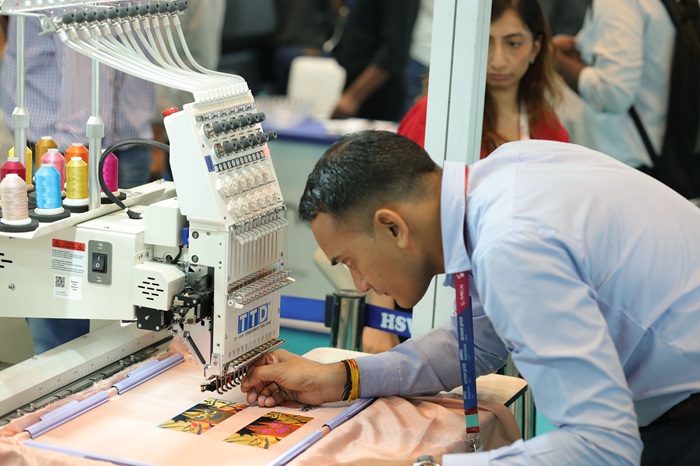
Denim Premiere Vision was held in Italy, November 23 and 24, 2022. The specialised trade show registered high attendance, from both Italian and international visitors, and saw the presence of high-level players from the denim and fashion segments.
Busy halls, a vast crowd of insiders, a rich program of talks involving top speakers, and a happy atmosphere characterised the event focused on presenting spring/summer 2024 novelties from the denim industry. The show hosted 67 exhibitors, 14 upcoming brands, and three trend areas and also hosted a series of highly inspiring installations and projects. The show worked well both for its content and as a container. Among the topics of discussion there were Made in Italy, the jeans creative process, sustainability, education, and more. It hosted prestigious industry speakers. Among the main trends, colored denim -- both with yarn-dyed fabrics and by using ready-for-dye- - remain a must for the upcoming season.
Mixing different fibers, while keeping great attention on environmental care, was a must for many manufacturers. Among the most interesting collections some of them presented new creative mixes of hemp with cotton, cotton and Tencel, viscose or recycled polyester. The show registered the attendance of creative teams from top pret-à-porter brands.
US garment imports up 34 per cent
America’s imports of garments between January 2022 to September 2022 increased by 34 per cent. However imports in September 2022 fell compared to imports in August 2022. Though the import value fell in September, it is still the second highest in 2022.
All major Asian apparel exporting countries have seen significant increases in their shipment to the US during January to September. China is still the largest supplier to the US though its share in the US market has shrunk to 22 per cent in 2022 compared to 2021.Vietnam, Bangladesh, India and Indonesia increased their shipments to the US by 34 per cent, 51 per cent, 53 per cent and 54 per cent respectively.
With just one quarter left in 2022, all eyes are on the festive season that is said to be a season when retailers will plan to sell all the piled-up inventories. US imports of garments from January 2022 to August 2022 increased by 37 per cent. Import values in August 2022 were 11 per cent higher than imports done in July 2022. Most big retailers in the US are holding back new inventories and are not placing fresh orders in their partner factories located worldwide.
Global retailers saddled with unsold clothing
Fashion retailers across the spectrum are sitting on piles of unsold clothing.
M&S has asked suppliers to postpone deliveries to its warehouses and has delayed confirming orders for next year. The retailer has resorted to discounting coats, jackets and boots by 20 per cent in a bid to clear excess stock as milder weather combined with shoppers cutting back has led to slow-moving winter clothing. Like other retailers, M&S is re-adjusting stock flow as supply chain disruption has eased.
An easing of supply chain disruption has also led to a pile up of products in warehouses. Lead times from east Asia have shortened which means retailers faced with clearing last year’s delayed stock are receiving new stock quicker than expected.
Asos’ unsold stock is up a third on the year before. Next has returned a very small amount of stock to its third party brands although its inventory was at planned levels. Tesco’s clothing suppliers are preparing for delays after the grocer wrote to them to remind them of its stock holding policies. When brands have unsold stock, they sell at a reduced price through sales. H&M also actively moves garments to stores or markets where it sees a greater demand or stores them for the next season. At a last resort, it considers external buyers of its overstock.
UK: Primark to open stores, while others shutting shops
Primark is investing in opening stores across the UK. This British fashion chain is betting on its rock-bottom prices luring customers as the country grapples with a cost-of-living crisis.
The plan contrasts with other retailers who have shut shops due to weak footfall and rising costs, while a shift to online shopping, accelerated by the pandemic, has also hampered store revenues. Exacerbating the pain from rising costs, footfall at UK retail destinations still remains 15 per cent lower on an average this year compared with pre-pandemic levels.
Even before the pandemic pushed more shoppers online, many high street retailers were struggling due to stiff competition from online-only brands leading to the collapse of household names like Debenhams.That saw Primark, which has shunned the extra cost of home delivery, launch a click and collect online service earlier this month. Although there was an uptick in UK retail sales in October 2022, driven by clothing, a bleak winter lies ahead and consumers are looking at how they can tackle the fallout from the cost-of-living crisis in their spending decisions.
There’s still little sign of early Christmas cheer for retailers. Online sales of textiles, clothing and footwear were down 8.4 per cent compared to a year ago and down 2.7 per cent compared to September, while department store sales online were down 6.8 per cent compared to a year ago and 1.7 per cent against the previous month.
Lethal chemicals found in Shein clothing: Greenpeace
Clothes sold by fast-fashion giant Shein contain hazardous chemicals. So says Greenpeace.
Shein is the largest online-only retailer in the world, producing between 35,000 and 1,00,000 new garments a day.But these cheap clothes were found to contain chemicals at levels that breach EU regulatory limits.These chemicals threaten the health of consumers and ecosystems.
Chemicals released into air and wastewater throughout the supply chain pose a threat to human and ecosystem health. They also prevent clothes from being properly recycled - contributing to the vast global fashion waste problem. So a new top or jumper may not cost much but the environmental costs are huge.
This ultra-cheap model not only contributes to planetary warming but harms workers down the supply chain.At its core, the linear business model of fast fashion is totally incompatible with a climate-friendly future – but the emergence of ultra fast fashion is further accelerating the climate and environmental catastrophe. The fashion industry is responsible for more than ten per cent of carbon emissions and consumes approximately 100 million tons of oil a year. Every second, a truckload of textiles ends up in landfill or is incinerated.But despite the urgent need to decarbonise, demand for cheap items isn’t slowing.
The average consumer throws away 60 per cent of new clothes in the same year they were bought.
Indian cotton exports fall
India’s cotton exports this year may fall short of estimates. Export enquiries are poor as Indian cotton is more expensive compared with world cotton prices.
The season started with very poor opening stock. Arrivals are not picking up as expected and domestic mills are gradually increasing capacity utilization. Cotton arrivals in November usually surpass 1.5 lakh bales a day. At present, it is at 1.3 lakh bales a day. In several areas, sowing and harvesting have been delayed. Further, farmers are waiting for prices to improve. Prices are down 35 per cent already. So farmers are not selling cotton. But there are no signs that prices would improve either.
Exports this season are expected to be about 30 lakh bales. Since October only 50,000 bales were exported compared to seven lakh bales last year. Another major reason for tepid demand for cotton is the slowdown across the textile supply chain globally. Almost 50 per cent of Indian cotton exports are to Bangladesh. But there is no demand from Bangladesh. A spinner in Bangladesh is able to get west African or US cotton at a relatively lower price. At this rate, Indian exports of raw cotton will probably only touch 25 lakh bales this season. It all depends on the global market for textiles.
India needs to align with buyer needs: TAG
To build a sustainable textile industry, India needs to invest in new products, build scale of operations, and improve competitiveness.
So say FICCI-Wazir Advisors in the annual conference TAG. The industry should also align with global buyer needs, value chain traceability and provide end to end services. Other measures include a focus on automation and digitalization to improve processes and efficiency levels, a focus on people and skill development, leveraging free trade agreements to tap new markets, developing capabilities and building capacities in synthetic textiles and technical textiles and adopting global best practices for manufacturing excellence.
Already the textile industry in India is shifting gears from linear to circular operations. Manufacturers are making concerted efforts to introduce sustainability by using innovative materials, safe dyes, reducing water and energy consumption, treating waste material and ensuring a greater focus on reducing, reusing and recycling, ensuring that both pre-consumer and post-consumer waste are controlled.
Zero Liquid Discharge, for instance, is a wastewater treatment process that removes all liquid discharge from a system. Apart from prioritising organic fabrics, the focus of the sector is all about conserving the natural environment. Other projects, like processing PET bottles to make recycled polyester fibers, are also underway. This has triggered the movement towards slow fashion that works on a‘fit-to-demand’ model, reducing surplus and investing in garments that have a long life.
India: Chennai plans textile city
A textile city is coming up in Chennai. Spread over 100 acres, it will house leading international brands from the textile industry.
Tamil Nadu tops third in the country in attracting foreign investments and exports in the textile sector and contributes 12 per cent of the total textile exports from India. Hubs will be established in Karur, Tirupur and Kancheepuram to promote textile exports. A textile park coming up in Virudhunagar district will be spread over 1,500 acres. Tamil Nadu wants to be a leader in technical textiles.
The state has withdrawn the market committee cess on cotton and has created a separate commissionerate for textiles. Incentives will be given for those who invest in the state in technical textiles. Annual cotton production in the state has increased to nine lakh bales and a scheme has been announced to increase the area under cotton. Several policy initiatives are being undertaken to address the needs of the textile industry. Tamil Nadu is attracting investment worth Rs 8024 crores, including a Rs 595 crore subsidy, under the Amended Technology Upgradation Fund Scheme. Further, the Centre has extended Rs 6 crores to Karur under the textile venture scheme. Under the Production Linked Scheme (PLI), six units are coming up in the state.
Crespo quits Inditex
Carlos Crespo is leaving Inditex. He was CEO between July 2019 and November 2021 and was chief operating officer and head of sustainable and digital transformation at Inditex.
At the same time, the company announced the end of Pablo Isla's 17-year tenure as chairman, during which he also held the position of CEO. In April 2022 Marta Ortega was named as the company's new chairwoman. Since Marta's arrival at the helm of the company, Inditex has accelerated its progressive transformation in order to affirm its steps forward in terms of sustainability as well as to elevate its positioning and improve brand perception. The organization of high-profile exhibitions has been accompanied by the launch of more premium collections as well as collaborations with leading names in fashion.
In terms of management, one of its first changes involved the communications team. In April, Jesús Echevarría was replaced as head of the department by Raúl Estradera, one of the Ortega family's most trusted advisors. Echevarría had held the position as chief communications officer since Isla's arrival in 2005.
In the first half of the current financial year, the Spanish group increased its profits by 41 per cent. In addition, turnover grew by 25 per cent.