


FW
Garment makers urge US and Bangladesh to sign cotton purchase agreement
Garment manufacturers recently urged the US and Bangladesh to sign cotton purchase agreement so that they could get duty privileges on export of apparel items to American markets and ship more products.
If the US agrees to the proposal, local millers will import cotton from the US under a special arrangement for Bangladeshi apparel manufacturers to make garment items from the yarn and fabrics for American customers. Under the agreement the US can allow the duty benefit on condition that all the garment items would be made from the yarn and fabrics using American cotton.
Two local spinning mills have already proposed that the government allow them to set up mills in the US to produce yarn there and make garment items in Bangladesh. But, the proposals were not approved.
Earlier, US cotton exporters also raised the issue and the BGMEA agreed to the proposal. Such trading arrangement in garment business had been incorporated in the now-scrapped Trans Pacific Partnership Agreement keeping Vietnam in mind.
H&M launches prints for children wear
H&M has unveiled a children’s wear print collection made in collaboration with a French artist Nathalie Lété.
The capsule comprises an assortment of colorful and poetic artworks by Lété, juxtaposed as prints over children’s clothing and accessories. The pieces in the recent collection include vibrant T-shirts, jackets, jeans, dresses, jumpsuits, shorts and swimsuits for toddlers and children. The motifs comprise animals and floral patterns starting from Lété’s acrylic paintings, where the designs are artfully arranged together to create an imaginative and fun story. This enfolds to a tropical jungle with chameleons and tigers, along with the artist’s signature depiction of flowers with cats, birds and rabbits.
Nathalie Lété is famed for her illustrations, textiles, ceramics and paintings. In her work, she creates a fantasy land for herself, a land that she wants to share with other people to make them dream. Through flowers, animals, birds, naivety and colors, she aims at creating a cocoon that brings happiness and harmony all around. The relationships between the different elements tell stories, stories that create a nice atmosphere.
The Swedish multinational fast fashion brand has been involved in such print-based collaborations in recent seasons. It collaborated with British heritage interiors brand GP&J Baker for a women’s line last summer, endorsing archive prints.
Fame showcases cool trends
Fame was held in the US, February 25 to 27, 2019.
Numerous extremely important products and solutions were exhibited. Several of these were about fashion, fashion accessories, footwear and fashion design. The show takes place twice a year.
Fun, fresh and full of cool trends, Fame is a one-stop shopping destination where retailers discover ready-to-wear young contemporary and trend-driven fashion for women.
The trade show offered an array of hemlines for bottoms, with a wide selection of finishes. Fame vendors targeted the younger contemporary market, focusing more on adding a bit of spark and glitter for a glammed update to the look.
Animal prints and camouflage were favored on Elan’s denim jackets. What did attract more attention were the embellished jean jackets with faux pearls or rhinestones. At Vocal, a denim vest looked more like a jean jacket with the sleeves ripped off and featuring petite studs in rows down the front panels. Buyers looking for bottoms paid particular interest to its black denim jeans with a tapered leg and rhinestones down the side. Another favorite was a jean with leg lacing.
Since juniors and young contemporary markets want on-trend denim looks, embellished offerings did the trick in ways that help them stand out from their older siblings.
Adidas takes Martin Shankland on board
Martin Shankland is on Adidas’ executive board. He will be responsible for global operations. He succeeds Gil Steyaert.
Martin Shankland joined Adidas in 1997. Since 2017, he has led Adidas’ emerging markets as managing director, setting up the organisation for sustainable success across the Middle East, Turkey, India and Africa. Prior to that, he was managing director Adidas Russia/CIS for 17 years. Under his leadership, Adidas Russia/CIS became a clear market leader through the development of an extensive own-retail network for both the Adidas and Reebok brands.
Steyaert had worked at Adidas since 1999 in local and regional roles with increasing responsibility, among others as managing director Western Europe from 2013 to 2017. Since 2017, he was executive board member responsible for global operations.
Adidas dominates fashion. It’s technically a sports brand and not a fashion brand. But that hardly matters when sports and style have become inseparable and street wear is blending with high fashion. The brand has opened an experiential new retail store in New York, debuted a sneaker made of synthetic spider silk and sold its first 3D printed shoes. Its classic styles, such as the Stan Smith, Sambas, and especially the Superstar, have helped drive the big swing toward casual shoes.
Winter Magic focuses on the US-China trade talks, rolls out new trends
"With the deadline for China and the US to conclude their tariff negotiations just around the corner, the air at the recent Winter Magic event was rife with speculations regarding the impact of tariffs on the fashion sector. As Julia K Hughes, President of the United States Fashion Industry Association (USFIA) noted the major fear now is a failure to agree to deal could result in tariffs on all Chinese imports including apparel, textiles and footwear. A recent USFIA study indicates, many companies plan to diversify their sourcing. Topping this list are companies in Vietnam, Indonesia, India and Bangladesh, with Ethiopia who have noted a 92 per cent increase in their orders from the US in the past 12 months."
 With the deadline for China and the US to conclude their tariff negotiations just around the corner, the air at the recent Winter Magic event was rife with speculations regarding the impact of tariffs on the fashion sector. As Julia K Hughes, President of the United States Fashion Industry Association (USFIA) noted the major fear now is a failure to agree to deal could result in tariffs on all Chinese imports including apparel, textiles and footwear.
A recent USFIA study indicates, many companies plan to diversify their sourcing. Topping this list are companies in Vietnam, Indonesia, India and Bangladesh, with Ethiopia who have noted a 92 per cent increase in their orders from the US in the past 12 months. To minimise the impact of these tariffs, these companies plan to re-engineer their products, reduce the value of goods and ship directly to consumers from their overseas manufacturing facilities.
The floorplan at this year's show featured fewer Chinese manufacturers than in previous years. This, however, provided an opportunity for a number of potential new sourcing destinations to shift centre stage.
Focus on sustainability and smart fabrics
Sustainability and higher-performance fabrics continued to be important topics at this year’s event. Denim exhibits focused on sustainable practices, such as the E-flow technology on offer from Jeanologia, a Valencia-based textile technology specialist, which delivers dye to fibres via nanoparticles, a process that uses 95 per cent less water and produces no waste.
Attendees could also familiarise themselves with the Styku Body Scanner, the latest high-tech offering from Tukatech, a California-based fashion-technology specialist. The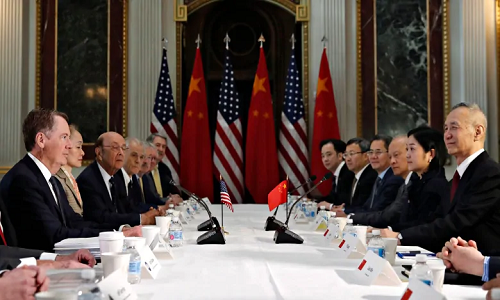 system creates an exact replica of the original model as a 3D avatar, after taking hundreds of measurements as part of a body scan.
Other advanced fashion manufacturing technologies on show included a fabric digital printer developed by Mutoh America, an Arizona-based printing group. There was also an automatic laser-cutter, which relied on the latest camera tech to maintain pinpoint accuracy.
Trendspotting for Spring/Summer 2020
This year, Fashion Snoops, a Los Angeles based trending consultancy identified future fashion trends at the event. The first trend Ethos was inspired by JOMO – the joy of missing out. Drawing on Scandinavian design with a dash of folk, this trend translates into bark, green and rust shades, sunset-scapes and basket stripes, all on such items as baggy pants with high waistlines, linen bomber jackets with short sleeves and heeled mule shoes. Materials used in this trend are plant-based, alongside Earth-friendly textures and crafty crochets.
Inspired by psychedelics, the second trend Dose resulted in bright, artificial colors such as "blazing dandelion", neon greens and purple pinks, while used a number of iridescent materials, high-tech PVC, trippy graphics and dreamy dyes. The key items here include see-through windbreakers, bra tops with a branded trim, sling-back sandals, etc.
Genesis, the next trend focused on fusing prehistoric life with new technologies. Here, consumers could envisage a keen adherent attending the unearthing of ancient burial sites especially if they're wearing brushed silk cargo pants, a campshirt with oversized pockets and a novelty purse, decked out with feathers Flash fused sci-no-fi tech with retro aesthetic and translates into disco metals, fierce feline prints and waxed denim. In terms of colors, chicory, cinnabar and chakra (a type of purple) and neutral "potter's clay" with pink undertones trended along with awe- a neon blend of lime and yellow.
Higher imports, resolution of US-China dispute to support cotton prices in 2019
"World cotton production declined in 2018 to an estimated 118.4 million bales due to lower acreage and yields. The US was not the only country plagued by weather and pest issues in 2018. As compared to 2017, India’s crop declined by 2.0 million bales. Australia harvested 43.4 per cent less acreage in 2018 due to severe drought conditions, resulting in a 2.2 million bale reduction as compared to 2017. Pakistan’s production also fell 950,000 bales. The 19.1 per cent increase in Brazil’s cotton acreage in 2018 did offset some of the production losses experienced in other countries. Brazil produced a record 11.0 million bales, an increase of 1.8 million bales over 2017."
 Year 2018 was full of uncertainty and volatility for the world cotton market. This uncertainty surrounding the ongoing trade tensions between the United States and China, is one of the most challenging issues facing the global cotton market today. Last month, the two countries concluded a round of talks aimed at resolving the dispute with further discussions planned for mid-February. President Trump had set March 1st for either resolving the trade issues or increasing tariffs applied to approximately $200 billion of imports from China. Based on the positive statements resulting from the recent negotiations, the NCC assumes that the additional tariffs being imposed by the two countries will be removed in advance of the 2019 marketing year. With exact timing unknown, the ultimate resolution is not assumed to have a significant impact on the balance sheet for the 2018 marketing year.
Production to increase in 2019
World cotton production declined in 2018 to an estimated 118.4 million bales due to lower acreage and yields. The US was not the only country plagued by weather and pest issues in 2018. As compared to 2017, India’s crop declined by 2.0 million bales. Australia harvested 43.4 per cent less acreage in 2018 due to severe drought conditions, resulting in a 2.2 million bale reduction as compared to 2017. Pakistan’s production also fell 950,000 bales. The 19.1 per cent increase in Brazil’s cotton acreage in 2018 did offset some of the production losses experienced in other countries. Brazil produced a record 11.0 million bales, an increase of 1.8 million bales over 2017. For 2019, production is expected to increase in most major cotton producing countries. World production is estimated at 125.5 million bales.
Consumption to reach 126.5 million bales
World cotton consumption is expected at 123.6 million bales in 2018 marketing year. Estimates have been revised downward due to the ongoing trade dispute as well as a slowdown in the Chinese and world economies. For 2019, consumption is expected to increase to 126.5 million bales.
Consumption to exceed production in 2019
Cotton consumption exceeded production by 5.1 million bales in the 2018 marketing year. Ending stocks declined to 75.5 million bales. Stocks outside of China increased to a record 46 million bales. The world production is estimated to increase by 7 million bales in 2019 to 125.5 million bales, which would be the highest level since the 2011 crop. World consumption is projected to increase to 126.5 million bales in 2019. Ending stocks are projected to decline to 74.2 million bales. Stocks outside of China are projected to increase to a record 46 million bales.
While the Council’s economic outlook does not attempt to project cotton prices, it is important to review some of the factors shaping the current price situation. Cotton prices maintained a weaker appearance since August 2018 due to the U.S.-China trade dispute as well as a slowdown in the world economy. Based on the underlying assumptions and resulting cotton balance sheet, the level of stocks outside China in the 2018 marketing year along with higher projected production in 2019 may contribute to a more bearish tone for cotton prices in the next year. However, the increase in world trade due to higher Chinese imports along with a resolution to the U.S.-China trade dispute could provide some price support.
Wrangler relaunches its core range
Wrangler is re-launching some of its core denims. These include six iconic products such as 124MJ jacket, which became the archetypal denim jacket, to the 27MW western shirt, created for cowboys but embraced by rock stars.
Wrangler will also reissue the authentic 11MWZ, its first jean and the original slim fit cowboy cut and re-imagine a women’s style. The collection is available on the Wrangler website.
Vietnam January exports to the US up 42 per cent
Vietnam’s exports to the US in January 2019 were up 42.1 per cent compared to the same period last year.
Exports of garments and textiles to the US increased 34.1 per cent. Other Vietnamese exports to the US include footwear, wood and timber products and mobile phones. Vietnam has also been able to export mangoes to the US after a decade of negotiations and the completion of all procedures required by one of the most choosy markets in the world. In addition the two countries do business in numerous other fields such as seafood, rice, coconut products, mechanical goods, manufacturing, chemicals, cosmetics, electric cables, electronic equipment, and semiconductors.
Two-way trade turnover between Vietnam and the US has increased nearly 120 times. At present, Vietnam is ranked 16th among the leading trade partners of the US.
The US made up 23.3 per cent of Vietnam’s total export turnover in January.
Trade relations between Vietnam and the US in 2019 are expected to see important changes because the US looks likely to recognise the market economy of Vietnam after July 1, 2019.
Therefore, bilateral ties will be laid on the important legal foundation of international commitments. So businesses in Vietnam are proactively developing markets and increasing their domestic production capacity.
Victoria's Secret to close 53 stores in North America
The US lingerie giant Victoria's Secret is closing 53 stores in North America this year, citing a "decline in performance," as a reason. Its parent company L Brands reported fourth-quarter earnings after market close. Same-store sales at the Victoria's Secret brand declined by 3 per cent during the quarter and overall in 2018.
The brand has increasingly been accused of losing relevance among shoppers as its oversexualized ads and racy runway shows have failed to resonate in the era of #MeToo.
The annual fashion show's ratings also took a hit. According to ABC, the network that ran the show, 3.3 million people tuned in to watch the fashion show when it aired on December 2, down from 5 million viewers in 2017 and 6.7 million in 2016, when it previously aired on CBS.
Meanwhile, more body-positive brands such as American Eagle's Aerie and ThirdLove have gained market share.
American Eagle reported a 32 per cent increase in same-store sales at Aerie in the third quarter. This marked its 16th consecutive quarter of double-digit positive growth.
Bangladesh turns to African cotton
Africa has become the largest source of cotton for Bangladesh. Last year, Bangladesh, the largest importer of cotton in the world, met 37.06 per cent of its requirements for cotton from East and West Africa. The CIS (Commonwealth of Independent States) countries supplied 11.35 per cent of Bangladesh’s cotton requirements, 11.14 per cent from the US, 4.65 per cent from Australia and 9.65 per cent from the rest of the world. India accounted for 26.12 per cent of Bangladesh’s cotton imports, down from more than 60 per cent two years ago.
Bangladesh’s cotton imports will continue to commensurate with expansion in spinning. Last year, Bangladesh imported 8.28 million bales of cotton. In dollar terms, the imports are worth three billion dollars. The country produced 1.65 lakh bales of cotton last fiscal year, which is less than three per cent of the country’s annual demand for ten million bales. The hope is to produce 2.5 lakh bales of cotton by 2021, which will meet nearly seven per cent of the local consumption. Cotton has helped farmers in Bangladesh cultivate land which used to previously stay fallow due to lack of irrigation facilities. Cotton imports are proving to be a major drain on foreign exchange reserves in Bangladesh.











