


FW
Incomes drive global denim market
Higher spending capacity and rise in disposable income are some of the important drivers of the global denim apparel market. Another driving factor is the fact that denim is a material of choice for a large number of consumers due to its comfort and style. The rise in population of young consumers who favor denim for its style quotient is propelling the denim apparel market. Manufacturing facilities set up by international brands in developing economies are expected to present lucrative opportunities for the denim apparel market.
Denim is a fabric made of cotton that is rough and thick in nature. Denim was initially designed for use in work clothes and slowly gained importance as a material used in other types of apparel. Today, denim is an important and fashionable item in every wardrobe.
One of the key trends in the market is experiments with new apparel styles using denim fabrics with lighter grams per square meter. Stretch denim is another new fabric chosen by consumers in their denim apparels. Additionally, manufacturers are experimenting with colors and distressed textures. Another trending factor in the denim apparel market is the rise in preference for recycling denim apparel. Some manufacturers are engaged in recycling campaigns where they take back used jeans from their customers.
First OutDoor by Ispo to debut in Munich
The first OutDoor by Ispo will take place from June 30, 2019 to July 3, 2019 in Munich. The fair will feature over 50 international exhibitors in nine halls with more than 96,000 sq. mt. of exhibition space in the Munich exhibition centre. In close cooperation with the industry, the Ispo team has tried to develop a modern, consumer-centred concept for the event. Their aim is to inspire as many people as possible worldwide, to break down inhibitions and to show the multitude of possibilities and varieties of "outdoor" that consumers have long been experiencing.
The focus of the fair continues to be classic outdoor activities such as climbing or hiking, however, it is also adding new segments such as mountain biking, trail running and water sports are being added. In addition, OutDoor by Ispo opens up sectors outside the outdoor industry such as environmental technologies or digital trade and technology solutions.
Another focus of the fair is on sustainability. The fair aims to reflect the pioneering role of the outdoor industry in terms of awareness of sustainability and social responsibility in the apparel sector. The trade fair has developed a holistic sustainability concept that is to be implemented as a fact-based sustainability guideline with concrete recommendations for emissions, water and waste management.
The new ticketing model at the fair is intended to motivate retailers to visit the trade fair: Retailers, wholesalers and distributors will receive their day ticket in the Early Bird tariff from 15 Euros until 20 May 2019. Other groups of trade visitors will start at a ticket price of 75 Euros.
H&M works on carbon neutral product line
Swedish fashion brand H&M has collaborated with Danish transport leader Maersk in a new carbon neutral ocean product. H&M, being the first customer of this pilot project, is exploring its transport options to reduce emissions released by the various transport methods it uses. The biofuel blend consists of wasted cooking oil which has been tested and endorsed in a trial driven in collaboration with the Dutch Sustainability Growth Coalition and Shell. It has been certified as a sustainable fuel by the International Sustainability and Carbon Certification and is showing positive results of reducing emissions caused by ocean shipping.
H&M aims at becoming climate positive by 2040 at enabling innovative solutions such as the carbon neutral ocean product for a greener commercial transport. H&M has been striving to become a sustainable fashion brand since more than a year now.
Luxury fashion brand Ralph Lauren plans to set science-based greenhouse gas reduction targets by 2020 and 100 per cent renewable energy targets by the end of this year. In May, PVH, the parent of Calvin Klein and Tommy Hilfiger, unveiled Forward Fashion, the evolution of its corporate responsibility strategy that aims at reducing its negative impacts to zero, focusing on eliminating carbon emissions by using more renewable energy sources and cutting waste to zero by avoiding landfill solutions.
Gap increases its green footprint by introducing waterless foam dyeing
Gap will produce denim using Dry Indigo, a waterless, indigo foam-dyeing technique. Utilising foam dye that adheres to yarn, the transformative Dry Indigo technique produces a denim fabric that is comparable in hand-feel, aesthetic, performance, and washability to traditionally dyed denim. The process can reduce water use by up to 99 per cent, while also using 89 per cent less chemicals reducing energy use by 65 per cent. The foam-dyeing technique occurs in a space of less than 65 feet – compared to the hundreds of feet that is typically necessary for a traditional dyeing machine – thereby significantly reducing energy needs.
Leveraging this revolutionary new dyeing process directly supports Gap’s manufacturing goal to conserve ten billion liters of water by the end of 2020. Gap has worked closely with supply chain partners to implement numerous water-saving initiatives. In 2016, Gap introduced a smart denim wash program that has enabled the company to save over 229 million liters of water when compared to conventional wash methods. The company has so far saved 5.7 billion liters of water. The brand plans to derive 100 per cent of its cotton from sustainable sources by 2025. Gap’s divisions Old Navy, Gap, and Banana Republic are launching denim with five per cent post-consumer mechanically-recycled cotton content.
Bangladesh apparel exports up 12 per cent this fiscal
Bangladesh’s apparel exports rose 12.82 per cent in the first eleven months of the current fiscal year. Earnings from woven products were up 13.13 per cent from the same period of the previous fiscal year. Earnings of the specialised textile sector saw a 33.79 per cent growth.
Since the three months from December to March are the peak season for apparel shipment, future prospects are even higher and brighter. The capacity of the country’s garment sector has also increased. On the back of value-added products, product diversification, policy support and capacity enhancement, Bangladesh’s readymade sector is maintaining a positive trend in export earnings. The cash incentive for selling in non-traditional markets has helped achieve a two-digit export growth rate. China, the world’s largest apparel supplier, has started importing products from Bangladesh and grants duty-free access to over 5,000 Bangladesh products. This has enhanced export growth of the apparel sector. The inspection by Accord and Alliance has helped remediate factories and prompted factory owners to emphasise workplace safety, which has eventually lifted the country’s image in the eyes of foreign buyers. Of the top ten green garment factories in the world, seven are located in Bangladesh. Eighty green garment factories currently in operation are completely LEED -certified and another 300 are in the process of getting the certification.
Fall in Indian cotton production likely
India’s cotton production in 2018-19 is estimated at 343 lakh bales, less than the previous year’s harvest of 348 lakh bales. Steadily falling global prices along with weak demand for cotton yarn may drag domestic prices lower in the months ahead. Output is seen taking a hit as high summer temperatures, delayed onset of monsoons and water shortage especially in key cotton growing states of Telangana, Andhra Pradesh, Karnataka and Maharashtra have affected cotton yield, which has driven prices higher. Domestic spinning mills are inclined to import and save costs. However, it is hard for small and medium enterprises to import, as they may not have the financial muscle to buy and store. On the other hand, weak garment exports have been weighing on the demand for yarn. So the trend of rising domestic cotton prices may reverse over the next few months. At present, imported cotton is nearly Rs 3,000 to Rs 4,000 cheaper than the domestic price.
Fall in global prices has tempered the rise in domestic cotton prices. In global markets, cotton prices have declined largely as the escalating US-China trade war has hit demand for the commodity. While the US is one of the largest exporters of the commodity, China is the largest consumer.
Intertextile’s Accessories Vision to feature over 600 exhibitors
Around 600 exhibitors will participate in Accessories Vision, the comprehensive accessory product zone at Intertextile Shanghai Apparel Fabrics, from September 25 to 27, 2019. This exhibition will feature new exhibitors from Cambodia and South Africa further diversifying the international exhibitor line-up, which also includes suppliers from Hong Kong, Italy, Japan, Taiwan and more, as well as leading Chinese companies.
Accessories Vision product zone offers visitors access to a wide variety of suppliers, both Chinese and international, who will showcase a huge range of high-quality products at competitive prices. The zone also includes options essential for smart branding, such as eco-friendly tags and labels. Alongwith big names like 3M, Avery Dennison, Ideal Fastener and Shimada Shoji, the exhibition will features new exhibitors include include Huashengda Zipper from Cambodia and Prime Fastener from South Africa.
Other highlighted exhibitors include Hong Kong Bright Zipper & Machinery, Monica Crystal Accessories, U.R.Label & Printing, Wai Hung Weaving Factory, 3M, Mitchell, Mainetti.
The fair will be held concurrently with Yarn Expo Autumn, CHIC and PH Value at the National Exhibition and Convention Center (Shanghai). Intertextile Shanghai Apparel Fabrics – Autumn Edition 2019 is co-organised by Messe Frankfurt (HK) Ltd; the Sub-Council of Textile Industry, CCPIT; and the China Textile Information Centre.
Asean gets closer to RCEP
Asean members have reached common ground on the Regional Comprehensive Economic Partnership. The mega trade deal, stuck in negotiations for the past seven years, has a total 20 chapters, seven of which have now been completed. In the context of increasing trade tensions and protectionism, promoting RCEP negotiations bear an important meaning as it strengthens rule-based multilateral economic connectivity and free trade throughout the Asia Pacific region. The challenge is that India and China, members of the trade bloc, have no free trade agreement to build upon, and have been holding up completion of some chapters to gain leverage in negotiations on other chapters. Hence, the remaining 13 chapters will be concluded together as they are interlinked with one another.
The Regional Comprehensive Economic Partnership is a free trade agreement between 10 member states of Asean –Brunei, Cambodia, Indonesia, Laos, Malaysia, Myanmar, the Philippines, Singapore, Thailand, Vietnam – and Australia, China, India, Japan, South Korea and New Zealand.
The 28th round of RCEP negotiations will be hosted by Vietnam in October. Thailand is this year’s Asean chair. RCEP will cover nearly half the global economy. In 2018, trade between the RCEP countries represented up to a third of global trade.
Savio offers innovative Industry 4.0 solutions at ITMA 2019
"Savio, the leading supplier of winding, twisting and rotor spinning machines, with manufacturing plants spanning over Italy, China, India and Czech Republic, is exhibiting innovative, highly automated, energy saving Industry 4.0 solutions in all displayed machines at ITMA 2019. These solutions include winding systems that are ideal for many different needs, supporting customers in the textile challenge and developing new applications to meet their requests."
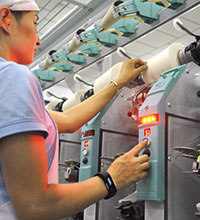 Savio, the leading supplier of winding, twisting and rotor spinning machines, with manufacturing plants spanning over Italy, China, India and Czech Republic, is exhibiting innovative, highly automated, energy saving Industry 4.0 solutions in all displayed machines at ITMA 2019. These solutions include winding systems that are ideal for many different needs, supporting customers in the textile challenge and developing new applications to meet their requests.
Savio’s Polar Evolution and EcoPulsarS winding machines can easily process special and challenging yarns, thanks to special splicing and tension control devices for ensuring perfect joints and perfect package shape, while always monitoring off-standard values.
Direct Link System offers bespoke solutions
This latest solution from Savio is the Multi Link that connects multiple ring spinning frames to one Savio winder,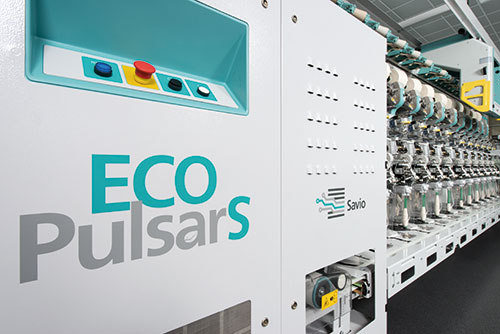 becoming a tailor-made circuit to link two or three RSFs to one winding machine. A special iPeg tray guarantees the circulation of RSF bobbing to/from winder. This solution optimises space, reduces energy-consumption and production costs. This automatic bobbin transport shortens servicing paths for the operators and allows an ergonomic material flow. The costs for production, space and energy are reduced, while keeping the quality consistent even with long and multi-connected machines.
Savio way for Industry 4.0
Industry 4.0 is the actual trend of automation and data exchange in manufacturing technologies. Connectivity, data management, remote machine set-up and operator real time interactivity: this is the Savio way for smart solutions for textile mills.
Nowadays, Savio is focusing on developing ‘smart’ components that transmit data online. The new possibilities offered by the connection of these machines translates into the different levels of Savio Industrial IoT, with the possibility of progressive sophistication (Basic, Business or Executive).
Three different levels of Savio Industrial IoT include different option levels, each corresponding to a different dose of Industry 4.0 applied to Savio textile winding machinery, from simple connectivity and machinery data downloading, to remote machine setup, to operator real-time interactivity. The leap in quality of textile machinery is evident in the new control systems, which allow for example employees to receive alarm signals directly to their wrist by smartwatch. When one of the winding machines present a problem, the anomaly signal is sent to the operator through a smartwatch, Savio Smart Bracelet, able to communicate also the type of intervention required, thus minimising the break downtimes of machine.
This data management system relieves mill operators of time- consuming routine work. Thanks to data analytics, a wealth of data are available, allowing to manage the different production phases in the best possible way and to monitor all significant parameters anytime and anywhere, making use of mobile devices. All these features enable Savio customers to control overall equipment effectiveness, increase workforce efficiency, and maximise quality and working time. Another direction of technological development concerns maintenance, with numerous systems already connected in real time with the assistance network, to minimise intervention times, also through remote actions via software without having to send technicians on site. Savio Winder 4.0 is also meant as communication between machine operator and service specialist in case of need.
Stäubli launches new-generation machines at ITMA
"At ITMA, Stäubli is exhibiting a wide range of machinery equipped with state-of-the-art high-end technologies and software solutions that offer new and expanded benefits to textile mills. Stäubli solutions can boost weaving or sock-knitting performance and overall mill efficiency, besides offering decisive functional advantages. The new generation machines on offer are:"
 At ITMA, Stäubli is exhibiting a wide range of machinery equipped with state-of-the-art high-end technologies and software solutions that offer new and expanded benefits to textile mills. Stäubli solutions can boost weaving or sock-knitting performance and overall mill efficiency, besides offering decisive functional advantages. The new generation machines on offer are:
SAFIR S60 automatic drawing-in system with ‘Active Warp Control’
The SAFIR series of drawing-in systems offers unique advantages thanks to AWC (Active Warp Control),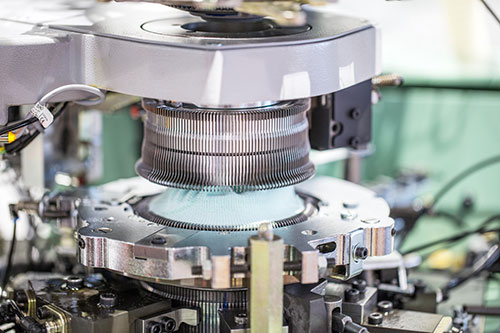 Stäubli’s exclusive yarn-repeat management system. The precision of this ingenious technology leads to more first-quality output, supports on-time delivery, and boosts the overall productivity of the weaving department. AWC is based on optical, non-contact recognition and measurement of yarn characteristics using two cameras.
New S1792 cam motion expands the broad range of frame-weaving solutions
Stäubli’s frame-weaving solutions are renowned for reliable high-speed weaving and adaptability to any kind of plain or patterned fabric and any kind of weaving machine. This versatility, in conjunction with robustness and high quality, has made the broad range of 1600/1700 series of cam motions and the S3000/S3200 series of electronic rotary dobbies well known as extremely reliable workhorses
LXXL Jacquard machine with NOEMI electronic system for luxury and technical fabrics
The LXXL machine boasts a large format (up to 25,600 hooks or 51,200 hooks in a tandem installation), for flat, terry, and velvet fabrics. It is dedicated to luxury and high-quality fabrics for clothing, upholstery silk weaving, bed linen, coverings, and technical applications.
Like the LX/LXL, the LXXL features lifting motion that ensures precise shedding geometry and absolutely vibration-free movement even at high speeds. The optimally coordinated kinematics of all moving parts within the machine and the directly mounted components such as the drives enable routine weaving of very heavy fabrics.
New-generation machine for selvedging
The N4L is Stäubli’s latest answer to the challenges of selvedge weaving, allowing the weaving of complicated patterns at the highest speeds using the most delicate and precious yarns for high-fashion fabrics. The machine is available in two formats: 80 or 128 hooks. It features robust construction and dust-proof design.
ALPHA 500 series of Schönherr carpet systems
The ALPHA 500 carpet weaving system adds immense flexibility to any carpet-weaving mill. It weaves the highest-quality applications and allows responding swiftly to rapidly changing market demands. Visitors may observe the high-performance operation up close, including the latest servo-controlled dobby of the UNIVAL 500 series and the unique servo cutting device that produces carpet surfaces of unequalled evenness.
Knitting solutions: D4S toe closing device shortens sock production
Stäubli’s D4S automatic toe closing device rapidly closes the sock on the knitting machine with a smooth seam, significantly shortens sock production, ensures top quality and uniformity of the product, and makes for very short idle times. The automatic sock pick-up and seaming operations are electronically controlled by the 2900SL controller, and this setup will boost the performance of any mill producing socks, woollen stockings, pantyhose, or medium-to-large diameter knitted goods used in various sectors.
Stäubli Robotics presents HelMo, the mobile robot system
HelMo is an autonomously driving and navigating vehicle developed especially for human-robot collaboration. At ITMA, HelMo will be at work replacing bobbins. Thanks to its modular design and robust drive technology, it can be used in virtually any industrial area, including, logistics, assembly, and quality control.
Stäubli has the core competencies in shedding (cam motions, dobbies, and Jacquard machines) and weaving preparation (drawing-in, leasing, and warp-tying machines.











