


FW
British Wool to sponsor 2019 Shearing & Handling World Championships
"British Wool will sponsor the England, Scotland and Wales teams at the 2019 Shearing & Wool Handling World Championships. The Championships, to be held in Le Dorat, France from July 01-07 July, 2019, will see the teams from England, Scotland and Wales face competitors from over 20 countries, up to 300 shearers and 5,000 sheep."
 British Wool will sponsor the England, Scotland and Wales teams at the 2019 Shearing & Wool Handling World Championships. The Championships, to be held in Le Dorat, France from July 01-07 July, 2019, will see the teams from England, Scotland and Wales face competitors from over 20 countries, up to 300 shearers and 5,000 sheep.
British Wool Chief Executive Officer, Joe Farren, said: “It’s an honor to support these incredibly skilled and committed individuals in their quest to be World Champions. It has been amazing to watch them progress through the British Wool training courses, mentored by a great team of proven and talented shearers and wool handlers, and grow as skilled tradespeople.
“In the UK, we are seeing a resurgence of interest from young people looking to improve their skills with the aim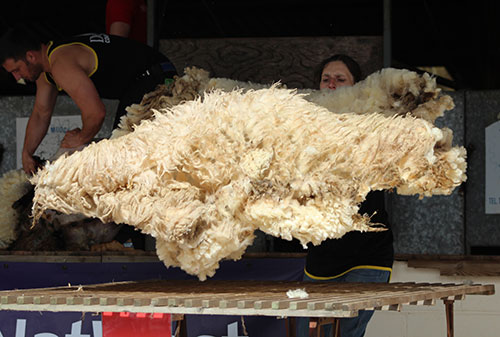 of improving the value of wool as well as recognising the global respect of the British Wool training courses for job opportunities.
“The teams heading to France have a lot of experience and support each other immensely. I am very proud of their achievements to date and they are a credit to our industry. Their dedication to the sheep sector gives me huge confidence in the future.
“At British Wool, we strongly believe in our remit to encourage young people who offer the sheep industry ambition and enthusiasm. This team proves we are achieving this objective and I believe the industry is stronger and will be more resilient for it.” Team Manager of the England Team, Andrew Barratt, feels the British Wool courses were “a foundation for their success”:
“All of the people on the team have been on British Wool shearing courses, and as one of the instructors for British Wool, I know they have had a good foundation to start their shearing career.The courses are fantastic and a platform for key knowledge transfer. It’s not just about going on one course, it’s about continuing to develop and learn something new each time.”
British Wool is based in Bradford and is owned by approximately 40,000 sheep farmers in the UK. It collects, grades, sells and promotes British Wool to the international wool textile industry for use in flooring, furnishings and apparel.
Archroma launches new liquid sulfur blue dye at ITMA 2019
"Archroma, a global leader in color and specialty chemicals towards sustainable solutions launched Diresul® Smartdenim Blue, a liquid sulfur blue dye designed to mimic indigo at ITMA 2019. The new product will be the core of Archroma's Indigo Reflection, a coloration system that behaves like indigo, with an even more sustainable and efficient application process compared to indigo."
 Archroma, a global leader in color and specialty chemicals towards sustainable solutions launched Diresul® Smartdenim Blue, a liquid sulfur blue dye designed to mimic indigo at ITMA 2019.
The new product will be the core of Archroma's Indigo Reflection, a coloration system that behaves like indigo, with an even more sustainable and efficient application process compared to indigo.
With this new innovation, Archroma completes its spectrum of eco-advanced denim coloration solutions, from this new indigo-mimicking Diresul® Smartdenim Blue which is aniline-free* and can be used in Archroma’s water-saving Advanced Denim technology, to its recent launch of the purest indigo, the aniline-free* pre-reduced liquid Denisol® Pure Indigo liquid.
Diresul® Smartdenim Blue is a liquid sulfur dye that behaves like liquid indigo in elegant neutral-green blue tone and in the most common wash-down processes.
Diresul® Smartdenim Blue has been especially designed to address the limitations of the Indicolors earlier technology. The new Diresul® Smartdenim Blue has a greener shade, better fastness to minimize back staining, and allows to create overall wash-downs much closer to actual indigo than any other dyestuff, whilst avoiding greyish cast especially in bleaching with hypochlorite.
Diresul® Smartdenim Blue can be applied in all the standard dyeing methods recommended for sulfur dyes, including pad-ox, pad-steam, exhaust, denim in all its variations (color denim, bottoming and topping of indigo), as well as in the Advanced Denim procedures (Denim-Ox, Pad-Sizing-Ox).
The innovation is the brain child of the Global Competence Center for Denim & Special Dyes experts in Archroma’s Castellbisbal plant, near Barcelona, Spain, where Diresul® Smartdenim Blue is produced.
12th Edition of Fashion Jewellery & Accessories to begin from 4th July, 2019 - EPCH
"Greater Noida – 2nd July, 2019 - 12th edition of Indian Fashion Jewellery & Accessories show [ IFJAS] will be held from 4th to 6th July, 2019 at India Expo Centre & Mart, Greater Noida concurrently held with 63rd India International Garment fair to reflect and display the rich legacy of traditional Indian workmanship blended into innovative designs of fashion jewellery & accessories."
 Greater Noida – 2nd July, 2019 - 12th edition of Indian Fashion Jewellery & Accessories show [ IFJAS] will be held from 4th to 6th July, 2019 at India Expo Centre & Mart, Greater Noida concurrently held with 63rd India International Garment fair to reflect and display the rich legacy of traditional Indian workmanship blended into innovative designs of fashion jewellery & accessories.
More than 250 member exporters will be displaying varied range of fashion jewellery & accessories products mainly focusing on fashion products like fashion & costume jewellery, imitation jewellery, fashion accessories, hand bags and fancy & embroidered fashion shoes and head to toe adornments made out of widest range of materials and designs available in the country in these categories.
Shri Ravi K. Passi, Chairman - EPCH said that India was not known in the field of fashions but in the past few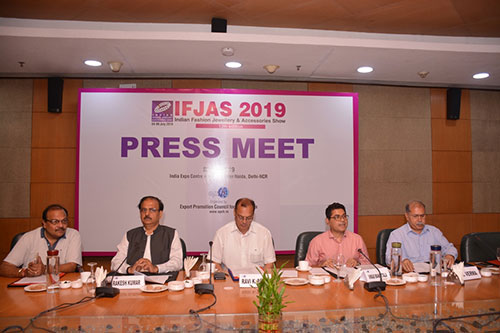 decades, India has developed its expertise in this field and has now emerged as one of the leading providers of wide range of accessories matching with the dresses in accordance with the prevalent fashion.
Shri Vikas Manaktala, President Fair said that Council has made all out efforts to publicise IFJAS through advertisement in International magazines, fairs and exhibitions abroad e-mailers, embassies/missions abroad and through social media to invite overseas buyers from all across the globe and also domestic volume retail buyers to source the finest in Indian craftsmanship and artistic finish in perfect harmony with modern designs, contemporary colours and new product development under one roof.
Describing it an important segment of India’s export basket, Shri Rakesh Kumar, Director General – EPCH stated that “the Council has been organizing IFJAS on an annual basis. USA is the largest importer while UK continues to be second largest buyer. This sector has tremendous potential to expand further.”
Buyers from Argentina, Barbados, Brazil, Belgium, Colombia, Finland, France, Greece, Italy, Israel, Japan, Kuwait, Lebanon, Mexico, Nigeria, Norway, Russia, Senegal, Singapore, South Africa, Spain, Sri Lanka, UAE, UK and USA have already confirmed their visit to source the requirement of exquisite range of products of fashion jewellery and accessories.
Apart from the countries mentioned above; buyers from CIS countries namely Kyrgyzstan, Azerbaijan, Turkmenistan, Ukraine and Tajikistan will be visiting the show.
Further buyers from African countries like Congo, Ghana, Gambia, Senegal, Nigeria and South Africa will also be represented at the show.
While addressing the press and media, Shri Kumar said a theme pavilion on Designs, trends and Forecast on fashion jewellery & accessories for 2020 will be set up at this show apart from participation by artisans and craftpersons from South, Western and Eastern region of the Country.
Fashion shows being an additional attraction will be held on each day of the fair so that visiting buyers can see the strength of Indian fashion jewellery & accessories and models will be displaying different categories of fashion products sourced from the exhibitors of the show.
Ajay Shankar Memorial awards for best designed and displayed stands in the category of fashion jewellery & accessories will also be distributed during IFJAS 2019 further elaborated Shri Kumar, DG – EPCH.
The Handicrafts exports during the year 2018 -19 is Rs 26590.25 crores registering a growth of 15.46% in rupee terms and 6.44% in dollar terms over the same period last year. Further, the exports of Fashion Jewellery and Accessories during the year 2018-19 has been 2332.97 Crores registering a growth of 11.34% over the same period last year.
The organizers of the show is Export Promotion Council for Handicrafts which also organizes World’s largest congregation of Handicrafts exhibitors under one roof during IHGF-Delhi Fair held twice in a year.
Transition to circular model may be bumpy
It is unclear how the transition to circular business models will affect apparel workers and their communities, especially the most vulnerable ones. There have been cases where new business models – the gig economy, for example – have perpetuated inequality and poor working conditions for the greater economic gain of a few. There is an opportunity to design and operate a new economic system that addresses this culture of uneven power dynamics. The need is to understand how to enable positive outcomes for workers, employees, customers and the broader society in the transition to an inclusive and fair circular apparel industry.
Adopting circular business models principles can potentially reduce the use of raw materials and could generate net economic benefits. In the fashion industry, different circular business models – including rental, reuse, re-commerce, repair, fashion as a service and closed-loop production systems – are already being implemented and tested by different apparel brands and retailers. The transition towards circularity can help to improve lives and livelihoods in the apparel industry; increase decision-makers’ capacities to address social issues of the apparel industry within a circular economy; and increase or improve the quality of open-source data and methodologies that address gender and social inclusion in the implementation of current circular business models in the apparel industry.
Sewing threads are a big business for Bangladesh
The sewing sector in Bangladesh is the backbone of the readymade garment industry. Demand for cotton thread is lower than that of polyester thread. Currently, there are more than 30 sewing thread factories in Bangladesh. Six factories supply 72 per cent of the current demand. Over the next 10 years Bangladesh’s sewing sector is expected to grow on t an average 15 per cent.
There is a huge untapped potential for Bangladesh’s sewing thread sector. The global textile and apparel market is in an unstable situation as the trade war between the US and China is escalating. US companies are coming to Bangladesh for business and China is moving out of the textile business, which is a golden opportunity for Bangladesh. Considering these factors, the sewing thread sector will expand. And in the new economic zones, most investors are interested in the textile and apparel sector, which very much includes the sewing thread sector.
However, the sewing business in Bangladesh is mainly operated by back-to-back letter of credit, where numerous banks are involved. This makes the delivery process lengthy. Although the sewing thread business is good, there is always uncertainty as demand is constantly fluctuating. To ride on the market wave the sector needs to bring production diversification.
Reebok attempts image makeover
Reebok is attempting to refresh its image and winning over critical young audiences like Gen Z and millennials. From its Stranger Things sneakers to its’90s themed collections and campaigns, Reebok is still trying to find a footing with young consumers. Its global campaign launched in March is a break from the athletic apparel maker’s typically sports- and performance-focused messaging. The campaign touched across digital, social and traditional media integrations. Reebok's prior digital strategy was seen as too focused on moodiness and hyper masculinity. Growth and sales have become a bigger priority versus traditional branding and creative ideas.
Reebok has in recent years had to grapple with a surge in athletic apparel and athleisure competition. The company has accordingly diversified its offerings to keep up with the category. It has for example introduced a maternity collection for new and expecting mothers.
Meanwhile Melanie Boulden is departing as Reebok’s chief global marketer and head of brand management after just over a year. Boulden’s sudden departure could sting Reebok. Chief marketing officers’ tenure at the top 100 US advertisers fallen by a month to 43 months compared to 2018. CMOs are also in some cases being replaced by chief growth officers or equivalent roles.
Polyester products export still weak in May
Polyester products net exports grew to a total of 69kt in May, With PET bottle chip and PET fiber chip contributing 55kt. PFY net exports increased 10kt plus, PET film export maintained steady, while PSF exports sustained negative growth.
For PET bottle chip, South Korea, India and Southeast Asia markets generally revised down export price in Apr, while China PET resin price was at high rates, hence the enlarging China-overseas spread led to poor order intakes. Afterward, as China materials retreated to low rates, export sales recovered somewhat. PFY and PSF exports didn't recover much in May, hence seems not entirely price to blame.
Nike fourth quarter revenue rises 10 per cent
For the fourth quarter Nike’s revenue rose from nine per cent to ten per cent. In North America, sales growth accelerated from a decline of two per cent in fiscal 2018 to an increase of seven per cent in fiscal 2019. The acceleration was balanced across footwear and apparel, with footwear seeing the biggest jump in growth.
Product innovation drove more than 20 per cent growth in sportswear in the fourth quarter. Nike’s women's category grew in double digits in fiscal ’19 accelerating in the back half of the year. The Air Max Dia, a women's sneaker, helped drive double-digit growth in the women's category last quarter. As of now the category makes up less than a quarter of total revenue. The Nike app provides complete shopping experience on mobile for the brand, and growth has been strong here, too. Revenue increased at a triple-digit rate, and Nike is just starting to roll it out globally. The Nike app will launch in China in fiscal 2020, the fastest-growing region for Nike, with revenue climbing 24 per cent last year.
For the year ahead revenue is expected to be up in the high-single-digit range. Balanced growth is expected across all geographies.
New Archroma dye mimics indigo
Archroma’s new Diresul Smartdenim Blue is a liquid sulfur blue dye designed to mimic indigo. It has been especially designed to address the limitations of the Indicolors technology. The approach finds its origin in Archroma’s deep belief that it is possible to make the textile industry sustainable, economically and ecologically. Diresul Smartdenim Blue has a greener shade, better fastness to minimize back staining, and allows to create overall wash-downs much closer to actual indigo than any other dyestuff, whilst avoiding the greyish cast especially in bleaching with hypochlorite. It can be applied in all standard dyeing methods recommended for sulfur dyes, including pad-ox, pad-steam, exhaust, denim in all its variations (color denim, bottoming and topping of indigo), as well as in the Advanced Denim procedures (Denim-Ox, Pad-Sizing-Ox).
The new product will be the core of Archroma’s Indigo Reflection, a coloration system that behaves like indigo, with an even more sustainable and efficient application process compared to indigo. With this new innovation, Archroma completes its spectrum of eco-advanced denim coloration solutions, from this new indigo-mimicking Diresul Smartdenim Blue which is aniline-free and can be used in Archroma’s water-saving Advanced Denim technology, to its recent launch of the purest indigo, the aniline-free pre-reduced liquid Denisol Pure Indigo liquid.
Nashville Fashion Alliance dissolved five years after inception
The Nashville Fashion Alliance (NFA), which had formed in an attempt to elevate the city’s diverse industry and culture into a denim hub, has quietly dissolved after five years. Robert Antoshak, the Managing Director of Olah Inc., who was also the last chairman of the NFA, confirmed that the organisation’s board voted to dissolve NFA in March, but didn’t make a formal announcement. He elaborated his company’s inability to set up a Fashion Accelerator Innovation Resource Center as a reason for this.
However, Antoshak expects fashion entrepreneurs and specialists to implement the project successfully. He also expects a local university to incorporate elements of the fashion innovation center into its programming. The NFA was founded through a kickstarter campaign that raised $100,000. A report NFA published in 2017 indicated Nashville had the largest per capita concentration of independent fashion companies outside of New York and Los Angeles. The fashion industry contributed $5.9 billion to the city directly and indirectly and employed more than 16,200 people. Those numbers could reach $9.5 billion and 25,000 people by 2025 with the right investment.











