


FW
Sportswear remained top trend with luxury, sports combining for new styles
Performance sportswear often overlapped with streetwear in the past 18 months. Luxury designers and brands collaborated with sportswear companies to introduce new trends and styles. A prominent example of this is Virgil Abloh the Creative Head of Louis Vuitton menswear section who collaborated with French football player Kylian Mbappe to design his football boots
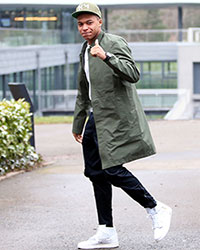 Performance sportswear often overlapped with streetwear in the past 18 months. Luxury designers and brands collaborated with sportswear companies to introduce new trends and styles. A prominent example of this is Virgil Abloh the Creative Head of Louis Vuitton menswear section who collaborated with French football player Kylian Mbappe to design his football boots.
With comfortable, form-fitting pants being increasingly worn by women every day, athleisure trends dominated the beginning of this decade. Joggers began to be adapted from sportswear staples such as sweatpants, and featured an elastic cuff, swapping out cotton for more casual fabrics. As a survey by NPD reveals, Athleisure sales reached $48 billion in 2018 and will continue to grow throughout 2021.
Brands/designers launched new styles
American designer Kanye West, who quit Nike and joined adidas in 2014, launched the YEEZY range of sneakers in 2015 with countless original silhouettes and colors following. The brand has been able to keep the style relevant through continuous innovation in its design and style. West’s collaboration with the brand Adidas further inspired Nike’s collaboration with designer Virgil Abloh, which has till now launched 40 sneakers and several apparel collections. The collaboration has changed the scale at which brands and external collaborators work together.
Changing the concept of football jersery, Paris Saint-Germain and Jordan Brand’s strategic partnership led to the Parisian football club swapping out Nike’s Swoosh for the Jumpman logo on special Champions League jerseys in 2017. The styles immediately became a status symbol as were seen on by Gigi Hadid, Kendall Jenner,etc. The collaboration legitimised PSG as a lifestyle brand and gave Jordan Brand a way into an entire market.
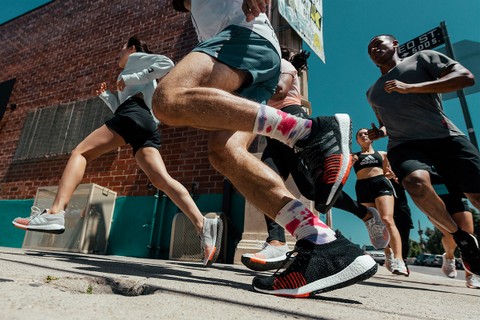
London-based skateboard brand Palace collaborated with Adidas to launch a Palace x adidas Wimbledon collection, which was worn by women’s singles winner Angelique Kerber. The brand also outfitted Juventus as well as Cristiano Ronaldo with a special-edition jersey and matching training gear.
The Nigerian home jersey for the 2018 FIFA World Cup in Russia almost overshadowed the nation’s performance at the tournament itself. The jersey’s announcement spread like wildfire online and the initial drop sold out almost everywhere, with some jerseys even being resold for absurd amounts.
Players at the recent NBA tournaments attempted to outshine each other with wilder outfits. These players soon became the walking billboards for brands and stylists and helped spawn social media accounts whose sole purpose is to chronicle NBA fits. The interest around what these players are wearing is currently at an all-time high which indicates their increasing prowess.
Luxury brands turn to streetwear
The transition of luxury fashion to casual sportswear and streetwear culminated in many new collaborations like Supreme’s collaboration with Louis Vuitton, Dior’s collaboration with the Jordan Brand and Prada’s collaboration with Adidas.
Chunking designs inspired by hiking and trail running became the biggest footwear trends in 2018. Outdoor brands such as Salomon or Hoka One stepped up their collaborations with celebrities with utility being at the center of this streetwear zeitgeist.
In an attempt to break the two-hour barrier for the marathon Nike also launched its Breaking2 project in 2016. The brand chose three elite runners – Eliud Kipchoge, Zersenay Tadese, and Lelisa Desisa – to run in a private race in Italy in 2017.
Testing times for Indian spinners
The Indian cotton spinning industry has been severely constrained in the current fiscal, being adversely impacted by the demand slowdown, unfavorable raw material prices and rising funding requirements.
Higher domestic raw material costs, with Indian cotton prices trading at a premium to international cotton, have also contributed to the loss of export competitiveness. While export volumes have seen some uptick in recent months, they remain lower than the levels seen in the preceding fiscal. Revenues are expected to fall by more than five per cent and operating profitability to contract by around three per cent for the fiscal. Cotton prices are likely to remain below the minimum support price level till March 2020 on expectations of a bumper crop production for cotton year 2020. Yarn prices and contribution levels are continuing to tread lower than the 2018-19 levels even though yarn prices have started moving up. There has been an increase in working capital debt levels by 15 per cent year on year, reflecting the inventory build-up amid a shortfall in earnings and limited capacity additions envisaged over the next 12 months.
Spinners are expected to register a revenue de-growth of around six per cent, with both volumes and realisations having come under pressure in the first half of fiscal 2020.
Fast Retailing aims to be the biggest fashion player worldwide
Fast Retailing aims at being the world’s largest fashion retailer by revenue in 2020. The owner of Uniqlo grew 7.5 per cent in 2018. Uniqlo’s international sales started in 2017. In 2018, the chain was once again the engine of the group, with a growth of 14.5 per cent. The Japanese company plans to add 300 stores in a year, reaching 3,745 stores in August 2020.
Fast Retailing has roped in Mujin and Exotec Solutions to improve efficiency in warehousing and distribution. Mujin is a Japanese robotics controller maker. Exotec is a French robotics startup. They will help introduce more automation at global warehouses, including in picking and shipping processes. Known for its affordable line of casual clothing, such as lightweight down jackets Uniqlo is currently enjoying strong growth in China. However, the unit has struggled with inefficiencies, occasionally blaming unseasonable weather for poor sales and excess inventory - an issue Fast Retailing hopes to address with shorter lead times and improved logistics. The hope is to avoid making, shipping or selling anything unnecessary. Fast Retailing in partnership with UN Women will champion women’s rights and empowerment in the apparel industry. Fast Retailing and UN Women will together promote safe and secure work environments, and advance empowerment for all women and girls.
Myanmar continues strong growth in textile/apparel sector
Myanmar’s export revenues from the textile manufacturing sector make up nearly 10 per cent of the country’s export revenues. Myanmar exports its garments and textiles mainly to Europe, Japan and South Korea. If manufacturers make a shift from the Cut, Make, Pack (CMP) production system to a free on board (FOB) system, annual earnings could swell 10-fold should demand remain at the current level. Under a CMP system, all raw materials, such as fabric and buttons, are imported by local factories, which then assemble the garments for export. Under an FOB system, the exporter quotes a price that includes all costs, including delivery of goods aboard an overseas vessel. The local factory is responsible for the whole production process.
Employment in the industry is also expected to hit a million workers by 2024. Around 600 factories in the country now offer job opportunities to approximately five lakh workers. The boom in Myanmar’s clothing and textile industry comes at a time when wages in other regional production hubs such as Vietnam and Cambodia have risen, driving manufacturers to cheaper nations. The minimum wage in Myanmar is among the lowest in Southeast Asia. The European Union is working with more than a hundred garment and textile factories in Myanmar in expanding training and capacity building programs for social and environmental performance.
Fabrics & Trims Show in Mumbai this March
To be held from March 19-21, 2019 at the Bombay Exhibition and Convention Centre in Mumbai, the upcoming Fabrics & Trims Show will showcase innovations in the industry besides forecasting upcoming trends. The fair will feature product categories including textiles for apparel, trimmings, embellishments, accessories, and related products and services.
Manufacturers will have the chance to exhibit their wares and expand their distribution networks by meeting buyers from across India and abroad.
The trade show will run alongside four other textiles related trade shows, Denim Show, India Laundry Show, Digitex Show, and Gartex and Texprocess India. Fabrics & Trims Show expects up to 20,000 visitors according to its events profile.
The trade show is organised by events management business Mex Exhibitions which runs a number of business-to-business events including the Gifts World Expo. Its business’ director, Gaurav Juneja, was recently appointed as the treasurer of the Indian Exhibition Industry Association.
Bangladesh garment exports down seven per cent in Nov ’19
Bangladesh’s readymade garment exports fell by 7.74 per cent from July through November 2019. The garment industry has shrunk since July with dozens of factories closing down and at least 29,700 workers losing their jobs. Workers’ salaries remain an issue because manufacturers aren’t receiving a high enough price for their products. Another issue is of training and redeploying workers as the industry adjusts to automation through new technologies. One machine can do the work of seven people. So sector diversification has become important.
The country has not been able to take advantage of the US-China trade war, because its product categories are very different from that of Vietnam, so Vietnam has been a gainer. So, Bangladesh hasn’t been able to expand the type of garments it produces to compete amid a Sino-American trade war that has sent manufacturers fleeing from China to countries like Vietnam.
The readymade garment sector is the most dynamic in Bangladesh’s economy. Exports of readymade garments have nearly tripled over a ten-year period. Bangladesh’s garment industry which produces shirts, trousers, jackets, T-shirts and sweaters is the engine of the nation’s exports and accounts for 84 per cent of Bangladesh’s total export volume.
Global cotton consumption falls in 2018-19, trend to continue
Economic slowdown, the trade war and the decrease in general consumption affected the consumption of cotton during the 2018-2019 season, which dropped by one per cent. This trend is expected to continue over the next few seasons due to uncertainty, coupled with the usual risks that agriculture faces. At the end of the season, the global cultivation area decreased by one per cent. Yield also fell, by two per cent. This means that world cotton production will reduce by three per cent.
China is the main consumer and the second largest producer of cotton and the United States is its main exporter. The sector started the year with an increase in prices, but throughout the season the prices of raw materials suffered ups and downs. Sustainability, meanwhile, continued to gain ground in cotton production. Organic cotton will account for a third of world production in 2020.
In addition, sustainable production has also been part of other raw materials, such as mohair wool, which in the last year laid the foundations for the certification of the production of this material in farms with high levels of animal welfare. As a whole, preferred fibers those that encompass more responsible and ecological methods in their production, have also gained ground in the last year, accounting for approximately 6.2 per cent of the total volume of fiber production, including materials such as viscose, acetate, lyocell, modal and cupro.
Global fashion trends that emerged this year
"A trend that made headlines during the year was that of tiny handbags. At the 2019 American Music Awards, American singer Lizzo sported a ridiculously tiny handbag. The 31-year-old Juice hitmaker stepped onto the red carpet decked in a peach, one-shouldered outfit by Valentino. Her statement Valentino bag completed her look at the show"
 The fashion industry once again took centrestage in 2019 as several new trends and disruptive startups moulding and shaping the market made up the year.
A trend that made headlines during the year was that of tiny handbags. At the 2019 American Music Awards, American singer Lizzo sported a ridiculously tiny handbag. The 31-year-old Juice hitmaker stepped onto the red carpet decked in a peach, one-shouldered outfit by Valentino. Her statement Valentino bag completed her look at the show.
Neon green was the ‘it’ color as was evident from the first look of the Spring fashion 2019 itself. Several major labels – from Gucci, with its feathered neon gowns and Balenciaga with its fluffed-up sweater – embraced the shade in the beginning of the year with the trend further seeping down to red carpets and magazine covers as well.
Brands explore their wild side with cow prints
This year fashionistas scored with monochrome and minimalistic cow prints. The black-and-white cow print not only made a bold fashion statement but also added a playful vibe to the ensemble. Some of the most prominent celebrities like the Ducbess of Sussex and Victoria Beckham were seen dressed in this rather understated look from the animal print family.
Sneakers make a fashion statement
In the last couple of years, sneakers have become a fashion staple. Designers and stylists across the world are paring these sneakers with all types of outfits and using them for all kinds of outings. Some of the biggest names in fashion lend their own touch of innovation and luxury to sneakers last years. These ranged from prominent brands like Adidas by Stella McCartney to the Rhyton Gucci sneakers.
Conscious shift to sustainable fashion
In 2019, the apparel industry made a conscious shift towards sustainability. Globally, this wave was spearheaded by designers like Stella McCartney, Vivienne Westwood, and Kenneth Cole. In India, a host of home-grown brands are ensuring that the country does not miss out on these positive changes. For instance, designer Sujata Chatterjee has launched a new startup Twirl Store which rewards customers to buy upcycled products on its website. The brand also donated some of its collected clothes. Similarly, Chennai-based brand Rossebelle produces sustainable women’s wear and other products with eco-friendly material, deadstock fabrics, and re-purposed vintage fabrics.
Industry leaders hope that in future more brands, designers and labels adopt sustainability just as they accept new trends like tiny bags and small sunglasses.
Bahamas Retailers’ Federation appreciates duty cut on shoes and clothing
The Bahamas Federation of Retailers has appreciated the government’s move to cut duty rates on imported clothing and shoes by 20 per cent. According to the federation, this duty cut has not only resulted in a ‘strong sales capped by “one of its best holiday seasons on record but also empowered the vendors to pass on their cost savings to customers.
The Federation now expects the government to codify the new policy into legislation and expand it to the rest of the wholesale and retail industry as it will significantly boost the local economy through increased domestic investment, increased local employment, increased domestic demand, increased selection & variety and therefore increased returns to the government via the resultant increases in NIB & VAT receipts generated.
This elimination of 20-25 percent Customs duty on footwear and apparel was unveiled in the 2018/2019 budget. Recognising that Bahamian retailers were struggling to compete with online shopping and south Florida merchants, the Government implemented the Customs duty waiver as part of its package of tax relief measures.
Bangladesh depends on imported cotton
Bangladesh is the only country in the world, which is mainly dependent on cotton fiber. Other major textile- and garment-producing countries have diversified their production to manmade fiber like viscose. Bangladesh imports more than eight million bales of cotton a year and the consumption of cotton by the mills has increasing more than by 10 per cent year-on-year. Consumption of cotton will continue to grow in Bangladesh in the near future because of the high export of garments. Africa has become a huge source of cotton for Bangladesh. Last year, Bangladesh met 37.06 per cent of its cotton requirement from Africa. CIS (Commonwealth of Independent States) countries supplied 11.35 per cent of the cotton, 11.14 per cent from the US, 4.65 per cent from Australia and 9.65 per cent from the rest of the world.
Cotton prices are declining worldwide. This is good news for Bangladesh. Now Bangladesh cotton importers can either book a lot of cotton in the futures markets or import cotton. If spinners can purchase cotton at lower prices, they can supply the yarn and fabrics at lower prices to garment makers. Garment exporters in turn can sell the goods to western buyers at competitive prices.











