FW
Reconsider LVMH-Tiffany deal, urges Louis Vuitton
As the LVMH’s deal with Tiffany & Co seems uncertain, board members of LVMH Moët Hennessy LouisVuitton have urged the two companies to reconsider the deal. Members are concerned about the impact of Coronavirus pandemic and the growing social unrest over the death of George Floyd at the hands of Minneapolis police.
The outpouring of anger over racial injustice in America has prompted widespread demonstrations in the country scuttling attempts to get the economy moving again. In addition, LVMH board members have voiced concerns about Tiffany’s ability to cover all its debt covenants at the end of the transaction, which was expected to be concluded mid-year.
As no firm decision could be made at the meeting, attendees urged the board to reconsider the deal. Combining the financial firepower of the world’s largest luxury group with the iconic American house, the deal was heralded as a master stroke by Tiffany, which could use the might of LVMH to both power its jewelry business and also gain a much larger presence in the US.
RMG Sustainability Council takes over Accord’s operations
Accord on Fire and Building Safety in Bangladesh has handed over all its operations to the RMG Sustainability Council (RSC). However, Accord signatories will continue to fulfill their obligations under the existing Transition Accord agreement through the work of the RSC.
RSC is a newly established not-for-profit company in Bangladesh created and governed by global apparel companies, trade unions, and manufacturers. The RSC was officially registered in Bangladesh on May 20, 2020 to be a permanent safety monitoring and compliance body in the RMG sector in Bangladesh.
The council will continue with factory inspections, remediation monitoring, safety training, and a safety & health complaints mechanism at the RMG factories supplying to Accord signatory companies. These programs will be implemented in accordance with the protocols and procedures developed by the Accord, which have also been inherited by the RSC.
The RSC will appoint a Chief Safety Officer (CSO) to lead the inspections work. The CSO’s performance of technical duties will be free of interference from the RSC governing body. The independence of the existing safety & health complaints mechanism that is available to workers in factories supplying to Accord signatory companies shall also be safeguarded under the RSC.
‘Retailers need to inform customers about the category of masks they are selling’
Bobby Arora, Director, Status Quo
 “We wait for customers to come into our stores. At this moment it is important for every offline retailer to reach out to their customers and tell them about the new products they have started selling. They need to tempt and bring their customers to buy their product and when they buy they will obviously come in and buy more products. Sometimes even though we do not want to buy online but the continuous rotation of ads tempt us to buy the product but this doesn’t happen offline. In today’s situation retailers will have to adopt this approach of showing customers the products they need as it could be they are delaying the purchase of these products.”
Masks have become more of a necessity than a fashion accessory in COVID-19 era. “It has become very important to wear masks before stepping out of homes, people are stocking around six to eight types of masks to match their outfits,” observed Bobby Arora, Director, Status Quo at #3 webinar organized by DFU Publications-DFU LIVE on May 30 on the topic: ‘New Categories Dikhao, Sales Badhao’ (Emerging New Categories for Apparel Retailers, Post-Covid). Arora said, “Today, no one can step out of their homes without wearing a mask though they are not very comfortable. However, as long as current restrictions prevail, everyone will have to wear them.”
Currently, there is a huge shortage of surgical masks in India. “It’s important to secure these masks for our health workers and people involved in treating COVID-19 patients. These masks are not reusable and need to be disposed off after each use. On the other hand, cloth masks are washable hence reusable,” Arora explained.
Better communication to facilitate sales
According to Arora, as masks have high demand, it is important for retailers to keep customers updated on their stocks and sales. “Retailers need to inform their customers about the category of masks they are selling,” he said. Noting there are very few customers for masks in the market, Arora said, “There is a tendency amongst consumers to delay mask purchase. E-commerce companies keep complete track of consumers’ choice of masks and their preferred price points. However, offline companies fail to achieve this. They wait for customers to come to their stores whereas they need to reach out and enlighten consumers about their new products and how they can be bought online.”
Arora pointed out though some consumers do not prefer to buy products online, they are tempted by the continuous advertisement of a product on social media channels. “However, this is not the case with offline retailers who need to emphasize the importance to their customers,” he added. Though masks may not bring in significant revenues for retailers, they are a value-driven and inexpensive product to stock. “Masks enable retailers to reach out to their customers in their times of need. In turn, this will increase customer loyalty towards them not just for masks but also other products,” Arora summed up.
Online petition to extend grants and holidays for retail companies launched
Daniel Morris, co-founder of The Morris Fyfe Agency in Brick Lane, east London, has launched an online petition calling for business rates grants and holidays for retail companies to be extended to include wholesale agents and distributors. London-based Double H Agency, Love Brands, Jonny Drama, Just A Group, FOF Fashion Marketing and Brand Machine Group, as well as Manchester-based agency Red Alert, are among the signatories so far but Daniel plans to extend the campaign to cover all affected sectors.
Currently sales agents and distributors, who are typically self-employed or directors drawing dividends, do not qualify for the sort of help from central government or local government that is available to the many retailers they supply.
The petition states: “The business rates relief for retail companies should be extended to include wholesale agents and distributors whose businesses have been equally affected by the shutdown. Our business, like many others, is 100% reliant on retail. Since the outbreak, our customers have been mostly furloughed and no one is visiting wholesale showrooms. Our office is obviously closed and all of our customers have closed their doors.”
Daniel adds: “In short, we fully support the government business rates 12 month holiday for retailers and only ask to be treated the same, as we are part of the same supply chain and therefore paying the price in terms of reduced income from retailer cancellations, discounts and delays. We believe that the government doesn’t really understand and recognise the role we play in getting goods to market and how we are recompensed – at least that is the only justification we can think of, for not being included in the COVID19 government support. My petition is saying that we are directly related to retail and should be considered in the same bracket. With buyers furloughed, offices shut and those people working doing so from home, those of us with retail showrooms are experiencing a similar impact to retailers. In fact, you could claim it’s worse, as we don’t sell through websites. We can’t just walk away from our showrooms, so they are staying full of samples with no visitors. We’re not eligible for the 12-month rates holiday, or the £25,000 grant for ratepayers in the retail, hospitality, tourism and leisure sectors, because we’re not classed as retail, and I can’t get the small business grant funding of £10,000 because my rateable value is above £15,000. The only logical next step has been to launch the government petition.”
EU to provide €334 million to Bangladesh
The European Union is mobilizing over €334 million for the fight against COVID-19 and its consequences in Bangladesh. This alongwith a €20 million German grant will help the Government of Bangladesh to provide cash assistance to workers in the export-oriented industries adversely affected by the economic fallout of the pandemic, and contribute to boost the resilience of the national social protection system.
This amount is part of the EU’s ongoing development cooperation programs in Bangladesh. The Union is already addressing many areas crucial in the COVID-response and the recovery of the economy. The €334 million allocated to help Bangladesh fight the pandemic is on top of the ongoing programmes, the European Union said in a rectn press release.
In addition, the French Development Agency – Agence Française de Développement – (AFD) will support the Bangladesh Government with €150 million to improve the country’s social protection measures.
The €113 million grant will suffice for three months of wages to about 1 million workers laid off by readymade garment (RMG) factories in Bangladesh. Under the grant, a worker will get Tk3,000 a month for June, July, and August.
French government postpones summer sales dates
The French government recently announced that it will postpone its summer sales by three weeks in order to give independent retailers time to shift spring inventory at full price and restore their cash flow.
The sales will now begin on July 15 and last four weeks. The discount period had originally been scheduled to run from June 24 to July 21.
The Fédération Nationale de l’habillement, which represents independent French retailers, welcomed the announcement.
The government was trying to find buyers for ready-to-wear chains that have filed for bankruptcy as a result of the coronavirus crisis, including Camaïeu, which employs close to 4,000 people, and La Halle, where 2,200 jobs are at risk. It now expects the French economy to contract by 11 percent in 2020, versus an earlier forecast of an 8 percent drop.
Daniel Grieder quits as CEO of Tommy Hilfiger Global and PVH Europe
Daniel Grieder recently quit as the CEO OF Tommy Hilfiger Global and PVH Europe.
Grieder joined Tommy Hilfiger’s European management team 23 years ago, and has been in charge of the label’s business in Europe since 2006. He notably masterminded the ANandevelopment and successful deployment of Tommy Hilfiger’s ‘see now, buy now’ strategy.
To succeed Grieder, PVH Corp has appointed Martijn Hagman, an executive with over 12-years of experience in various senior management posts within the group. Hagman, born in the Netherlands and formerly with auditing and consultancy firm Ernst&Young, is currently the COO of Tommy Hilfiger Global and PVH Europe, and the CFO of Tommy Hilfiger Global.
Jeanologia launches new sanitization technology
Jeanologia has conjured up a new sanitization technology for retailers. The brand has created Sanibox, a sanitization chamber with a viral deactivation level of 98 percent, can sanitize materials swiftly and safely through its combined ozone technology and humidity control that disinfects, eliminates bacteria and deactivates the COVID-19 virus.
Sanibox is available for purchase by retailers and can be used in both brick-and-mortar stores, as well as distribution centers for e-commerce businesses. But the story behind its technology began at the beginning of the coronavirus pandemic, when the Spanish government called upon Jeanologia to help sanitize protective facial masks for hospitals with its well-known proprietary ozone technology.
Sanibox’s wide-ranging applications include brick-and-mortar stores and distribution centers. The technology can also be used on apparel that was sent online to individuals, or [applied] to staff uniforms before use.
Sanibox has been certified by the CSIC and complies with AFNOR NFT 72-281, a French standard method that verifies the effectiveness of airborne surface disinfection systems and its utilized by the European Biocidal Product Regulation (BPR).
COVID 19: An opportunity for ‘Made in USA’ apparel manufacturers
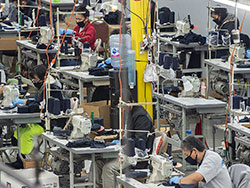 Support for domestic apparel manufacturing in the US was growing even before the outbreak of COVID-19. However, with COVID-19 disrupting most supply chains, manufacturers are quickly shifting to local PPE manufacturing. SEAMS, the representative of manufacturers of sewn products in the US notes a growing desire amongst members to make and access PPE for healthcare workers and government organizations. Within a week, these manufacturers shifted their production to making face masks, gowns, etc.
Early movers
One such manufacturer, Macquin supported clients in the US by helping them reorganize their production model to PPE making within a short span of time. Los Angeles technology company Tukatech, shifted its staff to guide businesses on how to make PPE equipment. The company started by creating patterns for HAZMAT suits, caps, masks, gloves, boot covers and gowns. Being a technology company, Tukatech was able to make a digital 3-D sample and create sewing instructions to hand over to anyone.
Similarly, performance activewear manufacturer, 99Degrees was able to find its place within the PPE industry by producing isolation gowns. Also shifting to isolation gowns, LACorp, a Virginia-based cut and sew plant, was able to secure contracts for making ace coverings for the Department of Health and Human Services, which eventually expanded to include isolation gowns.
Call for a new collaborative model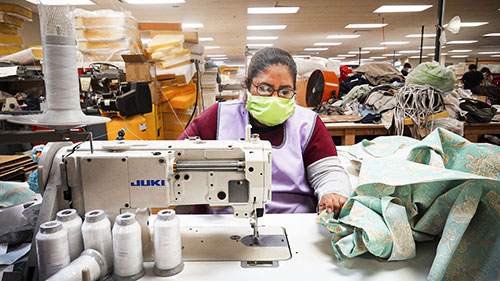
According to Michael McDonald, President of the Sewn Products Equipment & Suppliers of the Americas investing in modern equipment will help brands remain competitive with their Asian counterparts. A case in point is 99Degrees, which was able to secure contracts for more than two million level one and two gowns. They were able to protect employees by implementing social-distancing practices in factory.
However, there needs to be more collaboration between manufacturers, industry organizations and the government. The government needs to launch an initiative for PPE similar to the Department of Defense’s Berry Amendment, which calls for more funds to be spent on the purchase of many products—including clothing, fabrics and yarns.
As every adversity brings an opportunity, the pandemic has created a greater support for domestic products in the US. There is also greater sense of community across the country with brands, manufacturers and consumers supporting each other.
Wholesalers adopt a direct to customer model to tackle inventory, boost sales
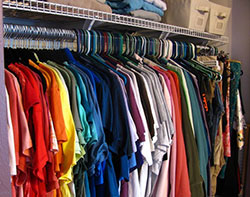 Faced with constant retail order cancellations due to COVID-19 is compelling many wholesalers to adopt alternative channels of delivering their products to consumers directly. Stuck with excess inventory, these wholesalers are now implementing tactics like platforming products, drop shipping, and adopting consignment and rental models.
Tapping digital channels with virtual appointments
One alternative emerging for these brands is holding virtual appointments with clients and customizing their products according to need. As Melissa Gonzalez, CEO and Founder of retail consulting firm The Lionesque Group points out, these virtual appointments enable brands to digitally answer their questions or demonstrate products. A digital channel, Virtual Styling app, created by apparel brand Paige enables customers to connect with retail experts via video conference besides giving them a sneak peek of latest collections. Shoppers can also communicate through video conference tools such as Facetime, Zoom, Google Hangouts or WhatsApp. Besides, these initiatives, the company also livestream tutorials on wellness and grooming, favorite books, music and TV shows on Instagram.
Embracing a rental model
Brands are also embracing the rental model to boost revenues. Rental trend has taken off across a wide range of industries from gyms renting out their dormant exercise machines to bridal companies leasing wedding costumes and sporting goods companies lending their equipment. Steve Cody and Bruce Linton, Former Co-CEOs of cannabis company Canopy Growth, Founded peer-to-peer rental marketplace Ruckify help brands and retailers monetize their inventory. Sales on this marketplace have tripled since the beginning of the pandemic even though the company has slashed expenditure on customer acquisition.
Providing a single sale point through consignment stores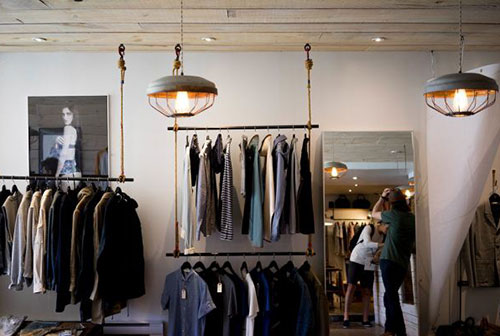
Another sales mode opening up for wholesalers is the consignment model. Virtual stores offer a single point of sale for retailers. Founded by Neighbourhood goods, these stores usually feature brands that shoppers would not typically find in a store. For instance, the consignment store of Neighborhood goods embraces some larger brands such as Dollar Shave Club, Modern Citizen, Aesop and Fossil.
They have also introduced a free platform called ‘The Commons by Neighborhood Goods’ for brands, restaurateurs, musicians and artists to engage with customers and reinvigorate their businesses.
Making customization a key to success
Realizing the need for a new sales model, Performance denim brand Duer launched ‘Next by Duer’, a new platform that allows shoppers to order products before they are made. These orders are then sent to the factory, customized according to demand and shipped to customers. This helps them save money as the orders are prepaid. This lightens the inventory besides reducing waste.
Left with excess inventory, athleisure apparel brand Vuori shifted focus to comfort clothing. It also began to engage with customers digitally by livestreaming on Instagram with a fitness trainer for a morning exercise class. Similarly, men’s apparel brand Cuts Clothing has collaborated with Happy Returns to provide its customers with a physical space to return products. This allows them to focus more on its products.
Despite the challenge they pose, brands still acknowledge the opportunities that wholesale provides. However, they need to remodel operations in a way that in future, wholesale makes up a smaller percentage of overall sales, advises Zahra Bahari, CEO of brand management firm The Powell Cos Real.